Calling David J. Haskins a bassist is technically correct, but doing so ignores his myriad other artistic pursuits. Singer, songwriter, playwright, film scorer, director, poet, author and spoken-word artist are all labels that apply to the Northampton, England-born artist known as David J.
He has a rich and creatively varied background, with notable work as early as 1978; nearly a half century later, his present activities are no less interesting. David J comes to The Ritz on Aug. 1, preceded by Silent Pictures and a set by DJ Basura.
And while some artists draw sharp lines between their varied pursuits, most everything that David J does is intertwined with his other creative activities.
“The Germans have a word for it: gesamkuntswerk,” he explains. “Literally, it describes everything under one umbrella, all the types of art that one does collectively being one big piece of work.” He says that that idea has always appealed to him, even while he might bring different mindsets to different creative activities. “There’s a resonance that you can find from paintings to poems to songs,” he observes. “It all resonates, and I do see it as one big dollop of work.”
Against that background, it makes sense that on his current tour, audiences experience both David J’s spoken-word pieces, his music, and a hybridization of the two forms. He’s touring in support of The Mother Tree, his new album released in June.
The Mother Tree features J reciting from his latest book of poetry, Rhapsody, Threnody & Prayer, with musical accompaniment on some tracks by RAQIA, an instrumental trio featuring violinist Gregory Allison, keyboardist Jon Bernstein and guitarist Tad Piecka. It’s an engaging, evocative and contemplative work that conjures its own atmosphere.
And atmosphere has always been a key component of David J’s work. He first came to public notice in the late 1970s with post-punk band Bauhaus. That group’s “Bela Lugosi’s Dead” was a highly influential track that helped launch the goth-rock movement. One of David J’s original tracks for Bauhaus—“Who Killed Mister Moonlight?”—would provide the title for his well-received 2014 memoir. The group released five studio albums, five live releases and placed ten of its 11 singles on the UK charts.
Bauhaus broke up in 1983, though they’d reunite several times, most recently in 2022-23. After the initial split, David J and two Bauhaus bandmates formed a new, more mainstream oriented group, Love and Rockets. That group also came and went multiple times over the years, releasing seven albums along the way and landing the same number of its singles on American charts.
Tenures in those two groups would be enough to keep most musicians both busy and creatively fulfilled. But David J has written for theater three times, and composed scores for four works. In 2024 he released Tracks From the Attic, a three-disc, 37-song collection of home demos. Those recordings were made, as he says, “with only the help of [my] Muse, a recorder and a lit candle.” Tour dates to promote that lavishly packaged release were notable for their recreation of his writer’s room at home: David J alone, with a lit candle.
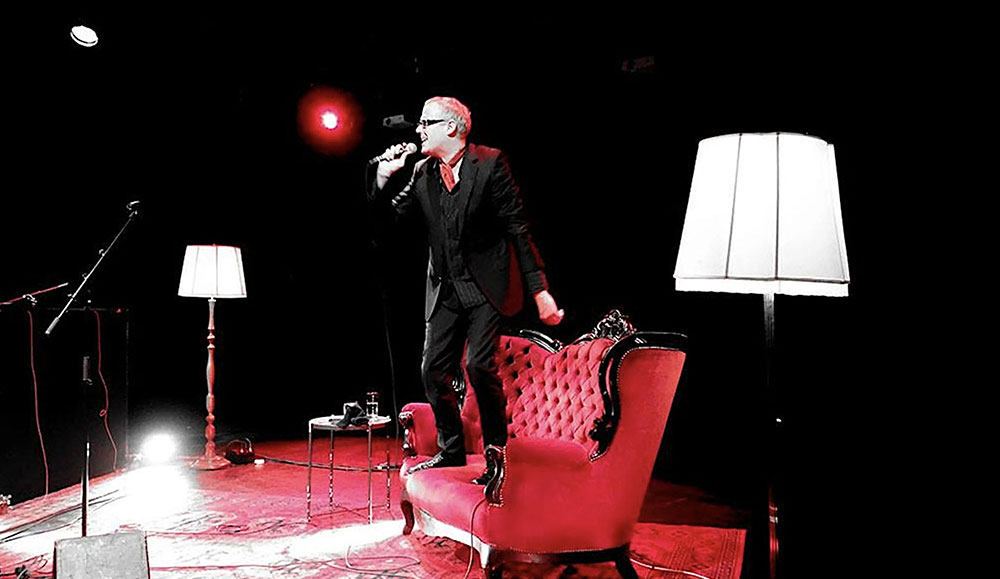
Concerts in support of The Mother Tree are nearly as spare, helping to shine the spotlight on David J’s lyrics and subtle—yet always evocative—music. He says that the album “is a launching pad for the type of presentation I’m doing: the first half hour is just me standing there reciting these spoken-word pieces over pre-recorded music. And then I pick up the acoustic guitar and play songs.” For the San Jose date, he’ll be joined by multi-instrumentalist John Courage.
The vivid imagery in David J’s poetry often ventures well beyond the traditional boundaries of rock and roll tunes. One recent single—and a regular fixture on the current set list—is “Exit El Hombre Invisible.” The work centers on William Burroughs in Mexico City, the period during which he fatally shot his wife. The musical backing is equally outré, featuring guitarist Steven Brown from Bay Area experimental group Tuxedomoon.
Onstage, David J’s music and poetry connects and engages with the audience. In the process, the metaphorical wall between performer and audience dissolves. But David J doesn’t make a conscious effort to make that happen. “That tends to happen naturally,” he says. “I’m naturally inclined to do that. And the longer that I’ve been in this game, the easier it is to do that, and to be comfortable in any given live situation.”
David J’s collaboration with RAQIA—on The Mother Tree’s title track and select others—came about through a happenstance encounter. “I was going to see my musician friend Nora Keyes play at a little place in downtown L.A.,” he recalls. J had planned to leave after Keyes’ set, but in the moment he changed his mind. “This band took the stage, and I thought, ‘I’ll stay and see what this lot are like.’ And I was completely arrested by it.” He describes RAQIA’s improvisational music as “interactive…they were listening and responding to each other in a jazz kind of way.”
That spontaneity would carry over when the group joined David J in the studio. Ahead of time, he had shared a recording of his spoken-word, but once they all gathered in the studio, there was no further discussion nor preparation. “I gave them carte blanche to come up with whatever they wanted,” he says. “And then we all went in [to the studio] together at the same time, and recorded it in one take.”
While some of his poems—like the Burroughs-referencing piece—are observational, much of David J’s work is drawn from personal first-hand experience. “Songs and poems are like diary entries, really,” he says, emphasizing that the recalled memories inform his performance. “I remember the circumstances—where I was, what I was doing, who I was with—and then I tap into that. And it’s all given the perspective of moving on, of evolution. All of that comes into play.”
David J performs at 8pm on Aug 1 at The Ritz, 400 S 1st St, San Jose. Ages 18+. $25 adv/$28 door. theritzsanjose.com