Fredrika Newton sat in her living room, talking to Roger Guenveur Smith, the young writer/actor who would portray her late husband, Huey P. Newton, in a 2001 film directed by Spike Lee. Smith asked to see some of the huge number of documents, photos, videos, personal correspondence, newspaper articles and other materials documenting the rise of the Black Panther Party for Self-Defense—and U.S. government attempts to destroy it—that were in her basement.
Fredrika Newton agreed. The film, A Huey P. Newton Story, based on his 1966 creation of the BPP’s “A 10-Point Plan for Social Reform,” went on to win multiple awards. And she realized that this invaluable cache of materials needed to be preserved and archived.
“When I discovered all that was left to me, I wanted to make sure [it was] preserved,” she said in a telephone interview, giving credit to Huey Newton’s first wife, Gwen Fontaine, “who did a phenomenal job of organizing [the materials].”
She began contacting institutions that could possibly archive the collection. A negotiation with Berkeley’s Bancroft Library could not be satisfactorily resolved. The Oakland Museum of California generously agreed to store the materials for a period, and then Stanford University Libraries said yes. The collection of materials has become one of the most researched of the Libraries’ holdings.
But in order to make the materials more available globally, Stanford and Oakland’s Dr. Huey P. Newton Foundation Inc. launched a pilot project in the fall of 2024, funded by a grant from the Andrew W. Mellon Foundation, to begin digitizing the archive. That project, now completed, digitized between 8% and 10% of the materials.
Stanford’s online Spotlight exhibit of the Dr. Huey P. Newton Foundation Inc. and the Libraries’ catalog, SearchWorks, now “makes a rich trove of selected digitized archival material available to give viewers a unique glimpse into the personal life, intellectual pursuits, revolutionary activism, and enduring legacy of Dr. Huey P. Newton, co-founder of the Black Panther Party, along with programs and initiatives enacted by the Party,” according to a joint announcement by Stanford and the Foundation.
The current goal, said Fredrika Newton, is securing additional grants to digitize the rest of the collection.
What the Archives Contain
Huey P. Newton espoused a philosophy he called “revolutionary humanism,” reflected in the Oct. 15, 1966 “10-Point Plan,” which includes items such as “1) We Want Freedom. We Want Power to Determine the Destiny of Our Black Community, 4) We Want Education for Our People…That Teaches Us Our True History And Our Role in the Present-Day Society, and 7) We Want An Immediate End to Police Brutality and the Murder of Black People.”
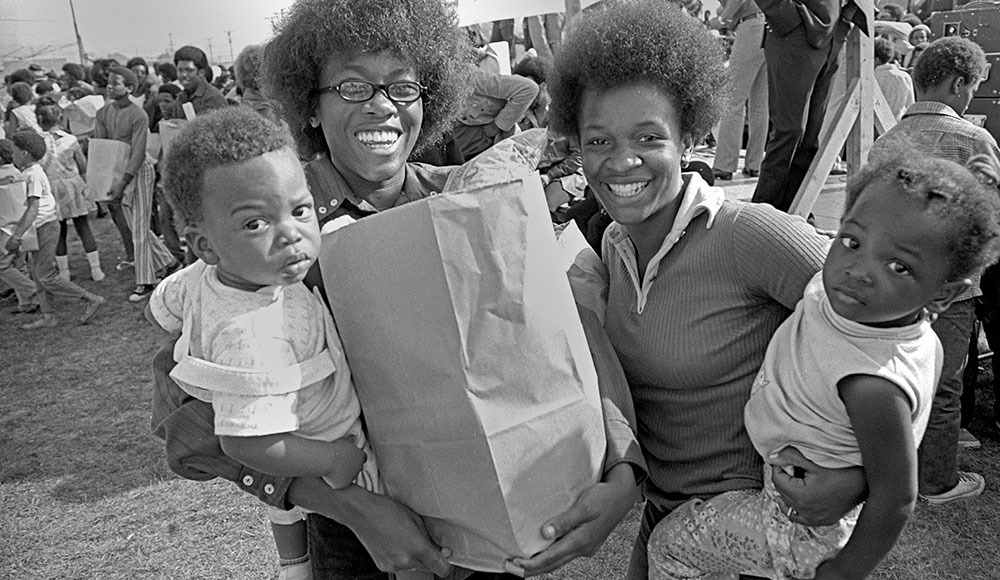
To that end, he and BPP co-founder Bobby Seale—and the many others who resonated with these aims—created the Community Survival Programs, including the famed Oakland Community School (OCS), the Free Breakfast for School Children Program, Free Grocery Giveaway program, the S.A.F.E. program for senior citizens, medical services for underserved communities, free transportation for families to visit loved ones in prison, and free sickle-cell anemia testing. A 1972 grocery giveaway provided 10,000 free bags of groceries to people in East Oakland.

All of this is documented in the archives, through photos, brochures, flyers and newspaper articles, such as one from a Sept. 16, 1976 edition of The Black Panther Intercommunal News, headlined “Oakland Community School Expanding Services to Youth.”
“The archives provide a road map for modern-day activists on how the Panthers organized the Survival programs,” Fredrika Newton said.
According to Benjamin Stone, the curator leading the project at Stanford University Libraries, “the deep dive into the archival collection provides rich detail on the processes that enabled the Black Panther Party to conceive and manage innovative social programs such as the Oakland Community School. Lessons learned will contribute to future efforts to digitize even more material.”
Hoover’s War Against the BPP
But the archives also contain memos, letters and other documents, obtained through the Freedom of Information Act (FOIA), that prove the U.S. government and J. Edgar Hoover’s FBI were actively attempting to disrupt BPP activities.
On June 15, 1969, J. Edgar Hoover declared, “the Black Panther Party, without question, represents the greatest threat to internal security of the country,” pledging that 1969 would be the last year of the Party’s existence.
Felicia Smith, Stanford’s Racial Justice and Social Equity Librarian, said, “One of my primary takeaways from working on the digitization of Dr. Huey P. Newton’s archival collection is the insight it offers into the U.S. government’s surveillance and disruption of the Black Panther Party. The collection includes extensive FBI memos detailing how the agency targeted Newton and other Panthers through COINTELPRO, the counterintelligence program designed to undermine Black liberation movements.”
Hoover and his FBI were determined, according to COINTELPRO memos obtained through the FOIA, to “Prevent the rise of a messiah who could unify and electrify the militant nationalist movement…Martin Luther King, Stokely Carmichael and Elijah Muhammad all aspire to this position.” Newton was also considered part of this “subversive” group.
A link to another of the COINTELPRO documents shows that “by July 1969, the Black Panthers had become the primary focus of [COINTELPRO] and was ultimately the target of 233 of the total 295 authorized ‘Black Nationalist’ COINTELPRO actions.”
The archives provide proof positive that the U.S. government, through its agency the FBI, exerted extraordinary efforts in surveilling, infiltrating, creating false narratives and attempting to disrupt relationships within the BPP.
It is worth pointing out that H.R.9973, the COINTELPRO Full Disclosure Act, first sponsored in the U.S. House of Representatives by Illinois Rep. Bobby L. Rush in 2021, then sponsored again in 2024 by Illinois Rep. Jonathan L. Jackson, has never advanced out of committee.
Wrote Smith in an email, “[preserving this information in the archives] counters attempts to erase or minimize Black history as something separate from American history, provides primary sources for researchers, students, and the general public to learn about the Black Panthers without filters or narratives, and helps people understand the complexities of the Black Panther movement that was infiltrated by the FBI.”
The role of libraries and research archives in preserving accurate history is also shown in this effort, she noted. “By digitizing and sharing these archives, we’re not only preserving history but also empowering people to learn from it and use that knowledge to work toward a more just and equitable society. This work is a testament to the power of information and the critical role that libraries play in protecting and disseminating knowledge for the benefit of all.”
BPP Legacy and Influence Preserved
Smith made other major points about archive materials. They show, she said, that many of the Panthers’ programs were designed and implemented by people who were barely out of their teens or were actual teenagers. They also show that “70% of BPP membership was women,” despite the emphasis and enduring images of males. There are multiple photos depicting “Black Joy,” such as the one showing OCS Director Erika Huggins throwing back her head in laughter.
The BPP influenced, and continues to influence, global movements, she said, such as the British Black Panthers, the [New Zealand] Polynesian Panthers, the [India] Dalit Panthers, “and even the Brown Berets.”
Smith is deeply aware of the importance of her role in this legacy preservation. “As an African American Librarian at Stanford University, I understand the profound importance of preserving and sharing the history of the Black Panther Party through our newly digitized archives. This work is absolutely vital, especially in a time when Black history is being challenged or erased in many places and curriculum across the country.”
She added, “Far beyond their revolutionary image, the Panthers built systems of care in response to urgent needs in their communities—a legacy that remains deeply inspiring.”
Oakland Research Room to Open
And far from being just an era in the distant past, “It is difficult to walk around Oakland without encountering people who have a familial relationship to the Party,” Fredrika Newton said.
Oakland’s Black Panther Party Museum, part of the Dr. Huey P. Newton Foundation Inc., will open the Dr. Huey P. Newton Research Room by the end of summer 2025, which will allow access to all of the currently digitized archival materials, said Xavier Buck, Ph.D., the museum’s founder and executive director of the Foundation.
Unlike most research rooms, which demand quiet, this will be a communal, community-oriented space, Buck said, true to Huey P. Newton’s vision, and one in which “you can bring your coffee in with you.” Noting that Newton had a Ph.D. from UC Santa Cruz, and deeply valued both advanced academics and children’s education, he suggested that classes, or other groups of younger people, could pair visiting the museum and research room with the bus tours to several historic sites connected to the BPP. Handbooks from the Oakland Community School, emphasizing the philosophy of the African proverb “Each One, Teach One,” are also part of the larger museum’s exhibits.
The museum is located at 1427 Broadway, Oakland, and is open Wed-Sat, 10am-3pm and by appointment.