
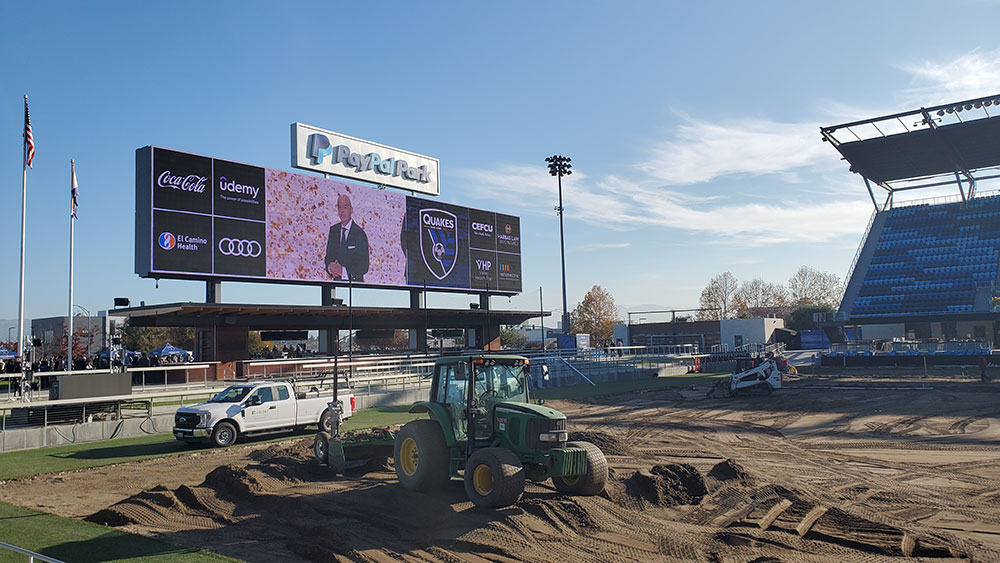
At PayPal Park, a few hundred people file in to the stadium on a chilly Friday morning in December. San Jose Earthquakes season ticket holders, politicos and other VIPs gather in a few luxury suites for coffee and burritos.
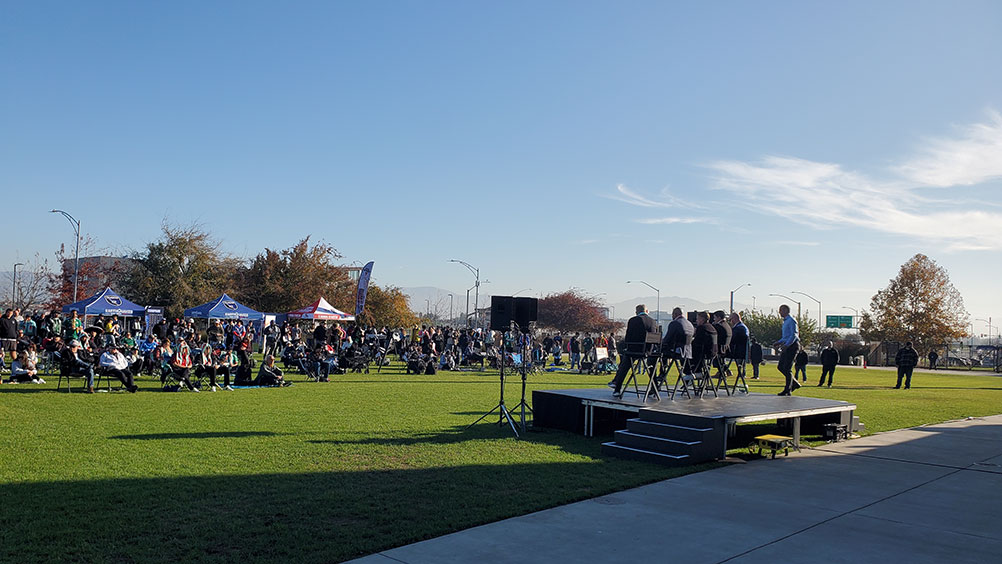
Those with general admission tickets gather in the fan zone behind the jumbotron, either on chairs or their feet. I see US National Team supporters, several Germany scarves, a few England jerseys and many Mexico shirts.
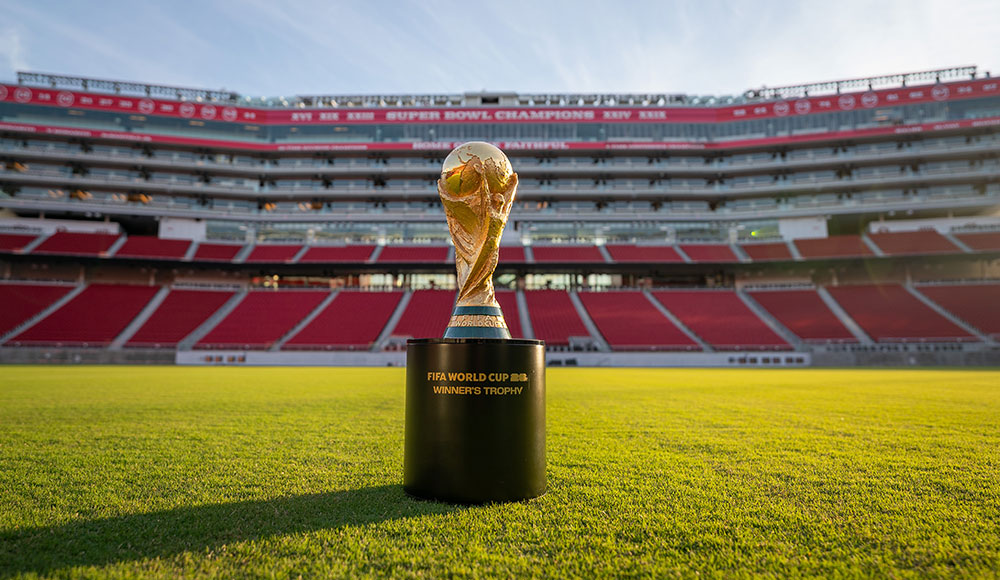
The watch party for the FIFA World Cup 2026 draw ceremony is about to begin.
Next year’s FIFA World Cup will officially be the largest sporting event in history, representing a 48-team tournament hosted across the United States, Mexico and Canada. Since PayPal Park is far too small for the World Cup games, Levi’s Stadium is set to host five Group Stage matches (June 13, 16, 19, 22 and 25) and one Round of 32 game on July 1.
Here at PayPal Park, historic vibes still linger from the 1994 World Cup—the last time the United States hosted. Not surprisingly, numerous former Quakes players and coaches are in attendance, including John Doyle, who played in the 1990 World Cup, and the Honduran Victor Bernárdez, who appeared in the 2010 and 2014 tournaments. Also there to soak in the moment are San Jose’s mayor and councilmembers, as well as TV and radio announcers, journalists, entrepreneurs, city hall employees and civic leaders. Compared to 30 years ago, more dimensions of local pride have emerged in the intervening decades. Institutions are collaborating like never before.
Getting Centered
The World Cup is not the only spectacle coming to the greater San Jose area, of course. Levi’s will also once again host the Super Bowl in just over a month. In March, the Shark Tank will host the West Regional of the NCAA® Division I Men’s Basketball Championship.
Plenty of marketing potential exists: It’s easy to fly into SJC. An increasingly urban university sits downtown with thousands of students. Why hasn’t someone built a full-blown visitors’ center? Many other cities half the size of San Jose have similar facilities in their urban cores.
I recently slithered into the former abandoned northwest corner of Third and San Carlos to find exactly just such a place. Previously a FedEx joint, which was before that a Kinko’s for years, the entire space was transforming into a full-blown local sports merchandising, gift shop and centralized meeting space, a one-stop hospitality suite for all things pro-San Jose—a concept decades overdue.
Instead of copy machines rattling nonstop, hideous floor-to-ceiling columns in the middle of the space, retail racks of staplers, Post-its, mailing envelopes and unsold Business for Dummies books, the whole space was completely rejiggered. Banners hung on the wall, referencing the sporting events coming to town and those that have since past. I saw groovy couches and seats. Soon we will see a merch area, plus a podcasting station, a boardroom table, free meeting space for local nonprofits, a press work area and other configurable ideas. The potential was rocking.
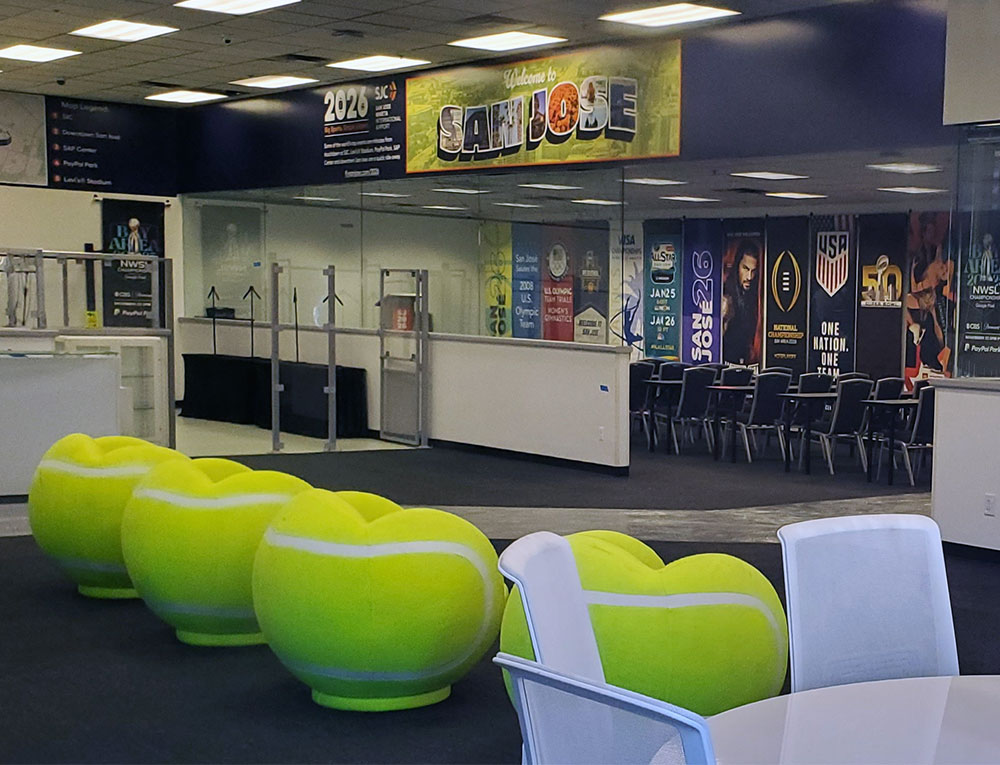
As soon as I walked in, John Poch, executive director of the San Jose Sports Authority, gave me the lowdown while seemingly in the middle of 20 other things.
“The whole intent of the visitor center, from the Sports Authority, what we call the ‘Locker Room,’ is to be a one-stop concierge,” Poch said, while showing me around and pointing to every nook and cranny. “You want to know where to dine in San Jose or downtown? We can share it with you. You want to know where to stay? You want to know where the retail is? We can help you. VTA, airport, we can send you in that direction.”
Every major city, anywhere, has a place like this, a visitors’ shop where people get a grip on where to go, where to eat, airport logistics, public art info, or what games and events are coming to town. The Locker Room is not finished yet, but it looked massively promising.
As Poch continued to show me around, he kept calling the place a “one-stop concierge.” He was right. Any seasoned newspaperman with neighborhood experience would immediately utter an all-too-common San Jose question: Why didn’t we do this 30 years ago?
“I walk by this space all the time; I just thought it was a perfect combination,” Poch said. “You’re in close proximity to San Jose State, which is huge, not just from the foot traffic of the students, but everything San Jose State brings to downtown. We’re close to our core downtown hotels and we’re near VTA and we’re at our plaza in the middle of downtown. So I thought this was the perfect location.”
In less than five minutes, Poch told me about 20,000-capacity block-party concerts, drone shows, new partnerships, promotional strategies, the prioritization of San Jose collaborators and all sorts of things set to unfold surrounding the games next year and beyond. The energy was infectious.
Any event planner will tell you about “the energy,” the vibe that circulates as the events draw near, how everyone comes together, the planning, the permits, the F&B, the rentals, the gear, the schlepping, the organizing, the teamwork, the whole nine yards. Stagehands will tell you this too. There’s a high that emerges during the process of building out the gig all day long and watching it come together.
This is how I felt listening to Poch. There was energy.
And it’s not just next year. The Locker Room is here for years to come. When it becomes fully operational in January, it will look much better than anything Kinko’s or FedEx ever did.
The best thing? Everyone seemed psyched to collaborate with everyone else. Downtown managers from City Hall might be setting up office space in the Locker Room. You’ll see Cinequest materials and Jazz Fest information. Maybe even book-signings from former Quakes and Sharks.
Poch said any person he partners with, for whatever event, will be required to have Fil Maresca on speed dial. Through his company Filco Events, Maresca has spent the last 35 years in San Jose building community through music, event promotion, collaborations and helping newbies navigate the broken permit process at City Hall.
“The best thing about Fil Maresca, he has a San Jose spirit,” Poch said. “He is one of us. He works like one of us, and he treats you like one of us. I can’t speak more highly of Fil. He’s just terrific.”
The Greatest Show on Earth
In the luxury box at PayPal, I’m sitting right next to Lee Wilcox, San Jose’s assistant city manager and also a fellow Leigh High School graduate. I’m on my third cup of coffee in 45 minutes.
The draw ceremony, especially the embarrassing exchanges between FIFA honcho Gianni Infantino and the autocratic United States president, is painfully unwatchable. But a good thing, though, is we learn that the USA might play at Levi’s in the round of 32. Nostalgia creeps in. There is no way for some of us to avoid talking about the 1994 World Cup, especially since several attendees here at PayPal are wearing original jackets or shirts from that World Cup.
“1994 was a very pivotal moment for the country, especially this area, for soccer,” Wilcox said, emphasizing that San Jose landed an original MLS franchise two years later. “I was at the MLS opening game with a bunch of friends,” Wilcox said.
We both nod and exchange more memories of those years. At my request, Wilcox delved deeper into his memory bank. He attended San Francisco Bay Blackhawks games at Spartan Stadium in the early ’90s, when he was a kid. After the Blackhawks won the 1991 championship, the future assistant city manager and his youth teammates stormed the field.
“My first involvement with a city official was with a police officer escorting me and my soccer team off the field because we weren’t supposed to go on the field,” he recalled. “So we walked up the main ramp. My dad and the other parents were waiting for us and I was very afraid that I was going to be in very big trouble.”
Yet nothing happened. He lucked out.
“As a city guy, it’s kind of funny,” Wilcox admitted. “But yeah, I remember all of us just jumping down on the field and rushing to celebrate with the players. It was so, so intense.”
As the draw ceremony winds down, many fans at PayPal start to realize the June 2026 Group Stage games at Levi’s might not be world-beating experiences. The first game, Switzerland versus Qatar, won’t lead to throngs of near-naked Brazilian women walking around Los Gatos like 1994. Two Jordan games in less than a week might trigger the Royal Family and their entourage to buy out Hotel Valencia, and we’ll get sheiks, oligarchs and certainly a few spooks in the vicinity, but the fan base won’t compare to the South Americans.
But you never know. This is the World Cup. The Greatest Show on Earth. Anything can happen. Nobody hanging out at PayPal to watch the draw ceremony seemed hugely deterred. At least not yet.
PayPal’s Next Act
Poch is not the only one transforming his environment in prep for the years to come. PayPal Park itself is entering its next phase of evolution. In tune with more than 40 years of San Jose history, the Earthquakes recently landed a permit to host outdoor concerts at their stadium.
When the announcement came over the wire, old-timers immediately fixated on the memories. On June 12, 1982, the Tubes played a concert at Spartan Stadium following an Earthquakes game against the Tulsa Roughnecks. The merch included long-sleeve rock jerseys that said Earthquakes on the front and The Tubes on the back.
Two months later, the Greg Kihn Band gigged immediately following another Earthquakes match. This was before Kihn’s smash hit “Jeopardy” had even come out.
I attended both of those concerts. They were the first two concerts I ever saw. Both were landmark collaborations rivaling the KOME versus Journey softball game at Municipal Stadium a few years earlier.
As if that wasn’t enough, everything came full circle last week, when the City of San Jose put its own logo on a plaque with the Grateful Dead’s Steal Your Face logo, all to celebrate the band’s first performance. The San Jose Earthquakes were among the collaborating institutions that night, when hundreds of people showed up to celebrate the plaque unveiling.
Thirty years ago, nothing similar would have possibly happened here. Not with the Dead, not with the soccer team, not with the city government, not at all. The local pride these days has skyrocketed.
New Energy, New Era
After the watch party for the World Cup Draw concluded, fans filtered out of PayPal Park. Catering staff began to empty the equipment from the luxury suites, carrying away the remaining few burritos with them. They wouldn’t let me pocket one for the road, unfortunately.
As people departed, Wilcox and I sat down in a few couches and reminisced more about the 1994 World Cup, and all the things it did for this area.
After 1994, Wilcox said he didn’t feel like a soccer dork anymore. Once ’94 came around, and the World Cup energy was here, all of his friends who previously never talked about soccer now all of a sudden wanted to play. They asked questions, threw parties and watched the games together.
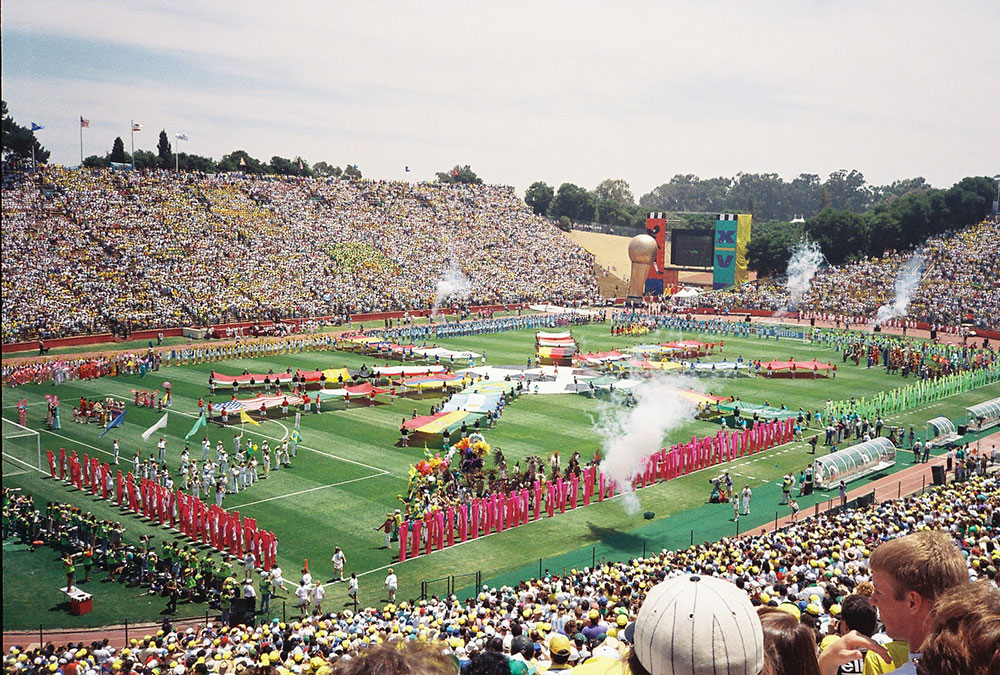
“I had a group of, I dunno, there were like 12 of us, and we would ride our bikes into downtown Los Gatos, where the Brazilian national team was stationed, and we would find pickup games at different parks with people that were staying here,” Wilcox recalled.
The kids couldn’t communicate with the Brazilian fans, but Wilcox and his friends played pickup games with them every night for a month during the World Cup.
“And going into high school, all of a sudden, soccer was a much more popular, accessible and talked-about thing,” Wilcox said. “I didn’t feel like the minority anymore.”
San Jose has come a long way since the last time the US hosted the World Cup. Despite the seemingly lackluster array of games at Levi’s this time, San Jose institutions are already anticipating next year’s celebrations. And for the Super Bowl, the block party with Kehlani on Santa Clara Street is already sold out, a far cry from the failed San Jose promotions when Levi’s hosted the Big Game last time.
We’re looking at a brand-new era for San Jose. It’s not 1994 anymore.








A city-sponsored visitor’s center focused on one-time sporting events. What about ALL the year-round cultural institutions in our community?
Love this! My soccer dork (and friendly thief, if there’s a burrito) self in South Carolina can’t wait to get there! New Energy, New Era indeed. Thanks, Gary!