
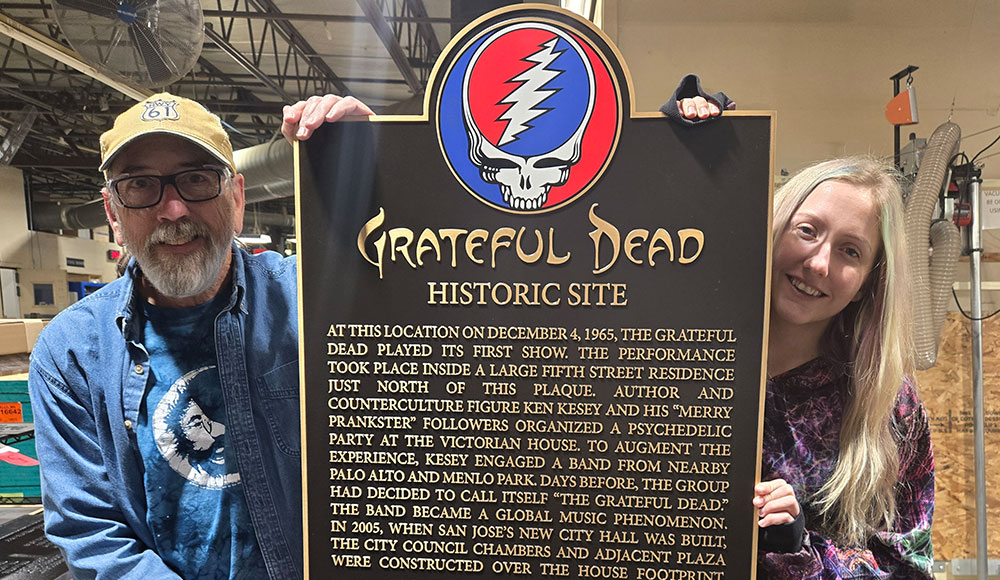
On Dec. 4, 1965, Jerry Garcia, Bob Weir, Bill Kreutzmann, Ron “Pigpen” McKernan and Phil Lesh played their first official gig as the Grateful Dead at one of Ken Kesey’s Acid Tests in downtown San Jose.
If one defines “official” as loading equipment, plugging in and playing music at a public event for a few hundred people, then it was official, even though it was at a house on South Fifth Street, right where San Jose City Hall plaza now sits.
Next week, on Thursday, Dec. 4—the 60th anniversary of the event—a plaque will be unveiled at the back of City Hall, stumbling distance from where the house originally stood. A free public gathering will begin at 4pm, with the official ceremony starting at 4:45pm.
Dan Orloff of San Jose Rocks and former San Jose Mercury-News sports columnist Mark Purdy will illuminate the long strange trip of tracking down the house, where it was relocated, and how they took the plaque concept from idea to execution. An array of characters will speak at the podium, including Jerry Garcia’s daughter Trixie and at least one person who attended the gig 60 years ago.
The event in 1965 was not the first Acid Test but it was the first public one. After the inaugural edition at Ken Babbs’ spread in Soquel—mostly a private party with friends and band members when they were still called the Warlocks—Kesey felt the next one should be a public spectacle, so the band decided to play. Kesey then chose a night that the Rolling Stones were performing at the San Jose Civic. After a house was secured, the Merry Pranksters handwrote flyers with a street address and the words, “Can you pass the acid test?” They pinned the flyers to telephone poles around downtown San Jose and issued them to people who spilled out of the Stones gig. LSD was still legal at the time.
Many accounts of that night exist. Tom Wolfe documented the chaotic party for several pages in his book The Electric Kool-Aid Acid Test. Over the decades, various attendees have emerged with their own fuzzy reports.
In my view, the best place to start is with the band members themselves. In Bill Kreutzmann’s book, Deal: My Three Decades of Drumming, Dreams, and Drugs with the Grateful Dead, he confirmed the first Dead show and that the event was indeed the first public Acid Test. Efforts were made to get Jagger and Richards to the party, but they never showed.
“But inside the Acid Test, something more important happened,” Kreutzmann wrote. “We had already played all those shows as the Warlocks, but this was the start of something new, something different. It was bigger than itself for the first time.”
The Acid Tests were the physical manifestation of what goes on in your mind during an acid trip, wrote Kreutzmann. Sounds. Noises. Color and light. Snippets of conversations recorded earlier.
“It was a psychedelic circus and everyone was the sideshow and everyone was the main event,” he wrote.
Lesh detailed even more in his book, Searching for the Sound: My Life with the Grateful Dead. The band set up on the opposite side of the room from the Pranksters because Kesey’s goal was to “diffuse the pyramid of attention” so people would receive multiple stimuli from every direction. The band played with speaker columns that were so large, one could crawl into the subwoofers and lie there. Across the room, the Pranksters supplied the supplemental sounds and the strobe lights.
“Unfortunately, the room was very small, so all the attendees were crammed into the same space as the band, and the crush of bodies together with the wind-tunnel sound and flashing projections turned the Test into a mind-numbing blur of noise, light, and heat,” Lesh wrote.
“The tapeloop master control was in Prankster hands; this ran a series of very long delays through a Mobius-strip speaker setup, with speakers in all corners of the room, receiving input from microphones and other mixers scattered everywhere.”
In 1965, no one believed the Grateful Dead would turn into a global phenomenon, or that San Jose would ever become anything. Thankfully, a lot can happen in 60 years.







Incredibly well written, Gary! You are a big part of how San Jose Rocks was able to pull content together from various sources and take our first step in putting San Jose on the music map forever.
You can still visit the house, too! Instead of tearing it down, it was moved to 635 E St James St.
That’s actually the wrong house. If you come to the event on Thursday, the protagonists will explain the long strange trip that led to the correct house.