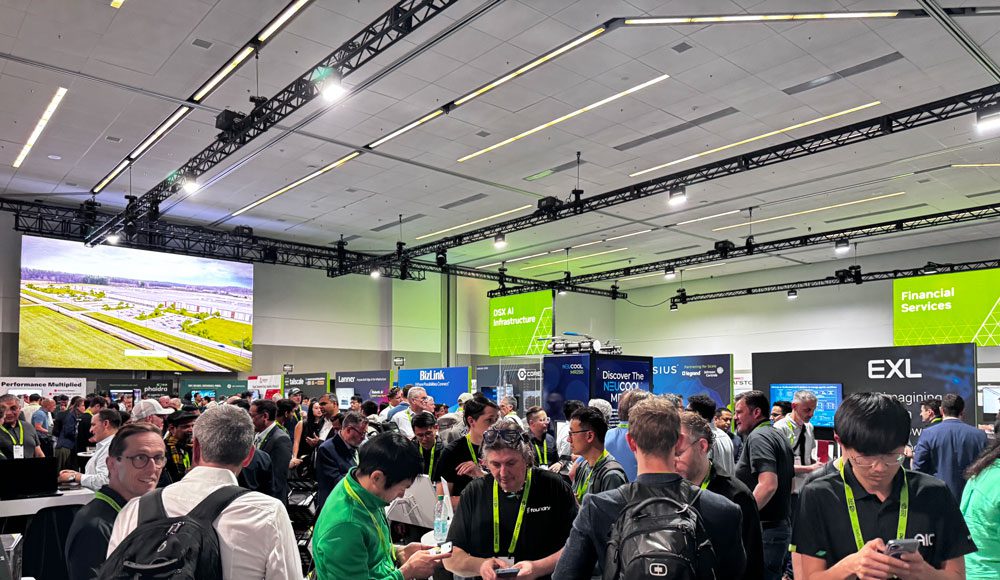
The valley’s biggest tech event took over downtown San Jose this week. An army in neon green lanyards turned the city’s core into a wonkfest of futurism and opportunity—demonstrating new robots, buying out bars and restaurants, rolling logo-wrapped Cybertrucks down clogged streets and dispensing all manner of branded merchandise.
Parking lots have been fenced off and taken over by pop-ups with artificial lawns, lounge chairs and temporary buildings adorned with large logos. The remaining parking spots go for $40.
SoFA District’s normally sleepy restaurants bustle with many languages and activity. Nvidia’s GPT conference has been a windfall for a downtown that lost most of its conventions around the pandemic, and much of its daytime workforce.
The Silicon Valley paradox is that as trillions are minted, the trickle down to non-technology sectors keeps residents and businesses scrambling to keep up. Nonetheless, it is a very welcome boost.
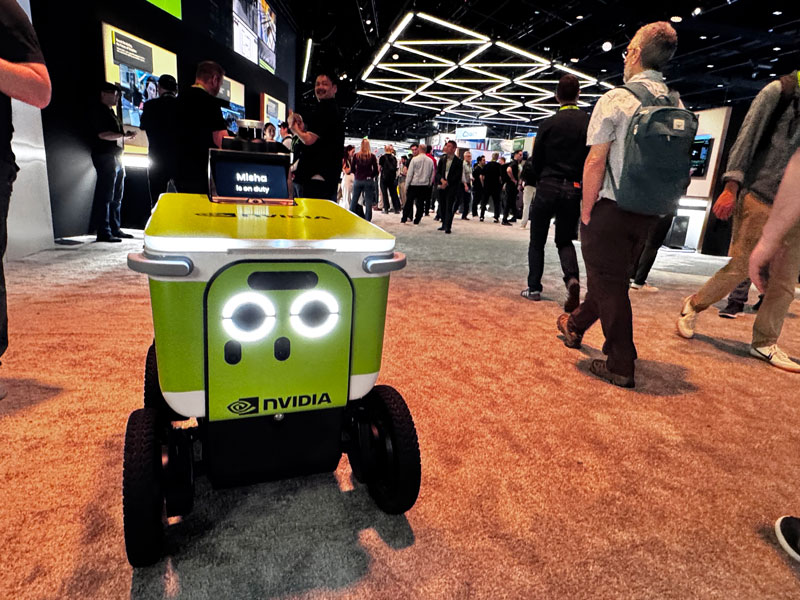
I stroll onto the exhibition floor at the San Jose Convention Center, and am introduced to Misha, a robot that resembles a bright green beer cooler on wheels with large illuminated circles as eyes. It’s a DoorDash and Uber Eats delivery unit. Customers unlock it with their phone, a door flips up, and they can retrieve their order.
I meet another robot, this one named Miroki developed by the French firm Enchanted Tools. He is yellow and has moving rabbit-like ears and large, friendly eyes. It rolls around on a sphere, about the size of a bowling ball, and is engineered to provide companionship to seniors in care facilities.
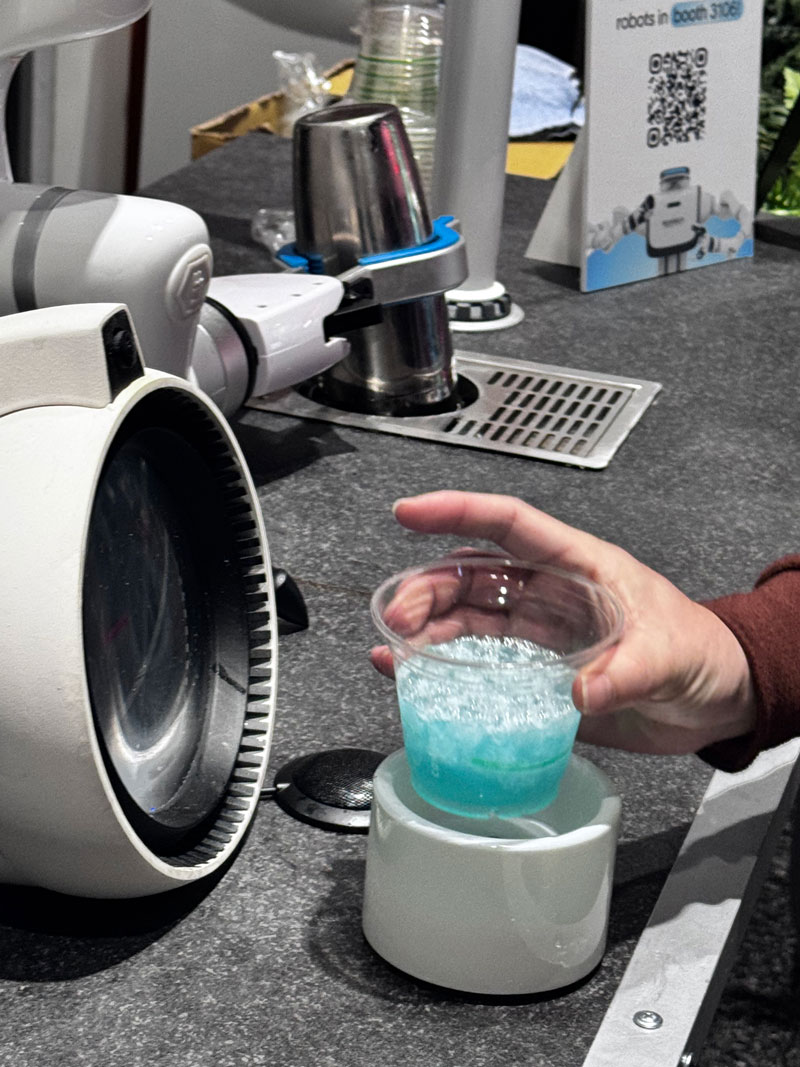
A third robot is mixing a blue cocktail. It has a human assistant nearby to collect payments.
At a nearby booth, a manifold of pipes and clamps provides an impressive visual. HPE’s Jim Lujan tells me it’s a “CDU,” but after seeing my puzzled expression, he de-acronyms it to Cooling Distribution Unit. He explains that the heat exchanger cools hot AI chip arrays in data centers with water and propylene glycol.
“Oh, antifreeze,” I offer.
“A version of it,” he replies.
Nearby, Nvidia exhibits line the exhibition hall wall. Miniaturized computers—designed to process trillions of calculations a second—sit behind clear panels. On a screen, an app turns animated game characters into photorealistic humans, akin to the filmed experience of a movie.
A brand ambassador hands me a mouse. She says the system only changes the lighting, not skin pores or facial geometry. I ask if the technology could one day replace actors.
“Potentially,” she says. “We’re not trying to gatekeep it.”
That type of agnosticism about technology’s social impacts is precisely what is unsettling about this disruptive revolution. As a San Jose downtowner, I welcome the economic and psychic benefits that a major event staged by what is now the world’s most valuable company—seven months ago it overtook Apple and Google—as well as the productivity benefits artificial intelligence brings to the creative process. I use it to massage article drafts, provide research and generate recipes for family dinners out of whatever happens to be in the refrigerator.
The Nvidia GTC convention highlights AI’s benefits, its rapid evolution and the surrounding ecosystem of vendors. What’s largely absent is the kind of academic or critical discussion about broader societal impacts that you might find at an independently produced gathering like South by Southwest.
There are many reasons to be optimistic about the taming of the intelligence beast, from unlimited clean energy solutions and improved vehicular safety to extending lifespans, replacing factory farming with lab grown meat or having robots wash our dishes.
Futurist Arthur Kurzweil’s prediction “that the 21st century will achieve 1,000 times the progress of the 20th century” is coming to fruition.
Entire sectors—healthcare, robotics, manufacturing, science—will become AI-driven, Nvidia CEO Jensen Huang said in his keynote, that the revolution will transform the physical world in a new industrial revolution. The new buzz word is “factories” that enable smartness to be manufactured at scale, accelerating the transformation.
The Promethean Dilemma
Cheap, insanely powerful and friendly computing tools will be at our fingertips. Nvidia even sells a 2.6 pound data-center grade supercomputer that can run huge AI models in a Mac mini-sized box you can carry around in your backpack. The DGX Spark costs just $3,999.
In other words, you can own your data and build your own model, instead of sharing your information with ChatGPT or Google Gemini. It can run on your desk, from a mountaintop in New Zealand or in a cave in Afghanistan. No internet connection is needed. Therein lies the Promethean dilemma.
Just two weeks before Nvidia CEO Jensen Huang took to the stage to discuss the transformational nature of AI, a watershed event occurred. Three Amazon Web Services (AWS) data centers—in Dubai, Abu Dhabi and Bahrain—were damaged by Iranian drone strikes, an event that conflict watchers had predicted would be inevitable.
Six intelligence officers who served in the Israeli army during the Gaza War and had first-hand involvement in the use of AI to generate assassination lists, told +972 magazine that a program called “Lavender” selected bombing targets and contributed to the high number of civilian casualties.
Just last week, China warned against excessive use of AI for military purposes. Just as the Islamic Revolutionary Guard Corps views data centers as military targets, future adversaries will seek to incapacitate data processing centers that support armed conflicts. The Anthropic-Pentagon rift over AI use in lethal weapons and mass surveillance further highlighted the growing relationship between large scale data processing and the battlefield theater.
San Jose and Santa Clara are home to 111 of California’s 289 data centers, and more are being built. Mayor Matt Mahan has sought to attract AI firms and make San Jose “the most AI-enabled city hall in the country.”
Santa Clara has benefited from its decision, many years ago, to operate its own electrical utility and provide cheap power to semiconductor manufacturers and data centers. San Jose is betting big on the future and recently announced $3.5 billion in planned upgrades to high voltage transmission lines by PGE, CAISO and LS Power.
Vancouver-based developer Westbank, which owns several large parcels in downtown San Jose, has mapped out two projects to co-develop housing and data centers and use the generated heat to warm residences.
One will bring a 10-story data center, coupled with three 10-story residential towers, to the SoFA entertainment and arts district’s Valley Title parking lot. The other will be on Terraine Street at the north edge of downtown—an 18-story apartment complex with 345 homes paired with an 11-story data center.
Microsoft is building a data center on Alviso-Milpitas Road with up to 100 megawatts of gas-fired electrical generation power, enough to power a city of 100,000 people.
The AI embrace amidst rising global tensions begs the need to secure data centers. The heightened security awareness was clearly evident at this week’s conference, as orange vehicle barriers surrounded meeting facilities and attendees ran their backpacks and purses through scanners to enter parks and convention facilities.
There are other issues to think about as well. Scientists are discussing what happens when large scale models trained on a diet of human produced information start consuming increasing amounts of synthetic data. Accuracy and reliability degrade, and a model can even collapse.
Employers and teachers are getting increasingly astute at spotting AI-generated memos and homework assignments. The success of the personal computing revolution occurred when the concept of “High Tech/High Touch” introduced human interaction and personalization to the technology community, incorporating emotional intelligence, critical thinking and human connection into the mix.
A similar companion movement, along the lines of “High Tech/High Touch,” will be needed to ensure the success of this latest suite of promising, powerful and transformative technologies.
This week, Sen. Elissa Slotkin (D-Mich.) introduced a bill to limit the Pentagon’s use of AI and establish guardrails on autonomous weapons. Reactive government regulation by legislators who struggle to even understand fast changing high tech is probably not the solution either.
As the drama unfolds, at least Silicon Valley will, once again, have a front row seat.