The ghosts of San Jose symphonic musicians go way back, and they refuse to become invisible.
In the same way that the organization San Jose Rocks preserves local rock history, someone should also preserve the Royal San Jose Bloodline of classical music history. This is not a conspiracy, and I am obsessed with this idea, thanks to a random conversation with the legendary Lee Kopp, while both of us loitered in the SoFA District.
First of all, in my view, Symphony San Jose is rocking these days, no joke. Families are going. Kids are showing up. Gen-Z humans are present at every gig. And it will surely get better.
The best thing? San Jose has a long legacy of symphonic music. This is not new information, but the history deserves to be revisited.
For those that believe in absolute beginnings, one source cites 1877 as the first year that a symphony orchestra concert was ever played in San Jose. Then within two years, the first San Jose Symphony Orchestra organization was established. At the time, San Jose was a fledgling agricultural region with no high culture of any sort. Small groups of amateur musicians began to assemble and play small gigs. That’s basically how it started.
Eight years later, according to an April 23, 1885 issue of the San Jose Daily News, the “San Jose Orchestral Society” gave their very first concert to a “very large audience” at the Baptist Tabernacle. The reviewer gushed over the individual performances, the soloists, the orchestration and each movement of the Overture to Oberon by Carl Maria von Weber.
“The orchestra, considering every member is an amateur, certainly handled this difficult composition in a way seldom heard outside the great cities,” wrote the unbylined reviewer, before commending the instrumentalists and even the orchestral director. “The society deserves the encouragement of all cultivated persons as its aims are of a most beneficial nature, not only to the members but to the people of this city.”
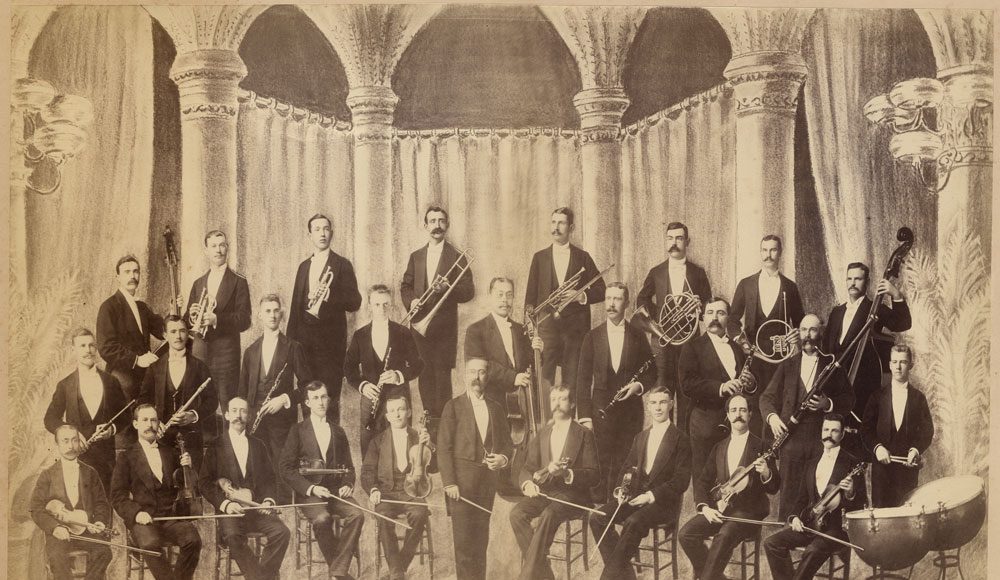
Then in 1892—one century before anyone cared about Photoshop—an amazing act of photo montage took place. Twenty-seven musicians of the San Jose Orchestral Society each posed separately for an individual photo while wearing a tuxedo. The results were then pasted together in one “group shot” to make it look like they had all posed together. Why did they do this? Legend has it that in 1892, there were only two tuxedos in the whole town of San Jose. Again, this is an old story, but it deserves revisiting.
Yet this group was not the absolute beginning. The Orchestral Society had its roots in the Germania Verein Amateur Orchestra, and the musical bloodline is mixed up with the entire history of the earliest German immigrants in San Jose, and also the history of the Germania clubhouse that still stands on Second Street, just north of St. James Park. About 40 years ago, an old framed version of the 27 tuxedo-clad musicians was found in the basement of the clubhouse, and the heroes at History San Jose then went to work and safeguarded it for the future.
To crudely simplify a much longer story, for the duration of the 20th century, many incarnations of the San Jose symphonic bloodline emerged and receded, all maintained by the efforts of many people who persevered to keep the tradition alive throughout the ups and downs. The history is all connected. Everything led to everything else. All phenomena arose due to the coming together of previous phenomena.
The current incarnation, Symphony San Jose, right now, is in the middle of a great season. All sorts of creative ticketing ideas are offered these days. The SoundCheck Pass, for instance, offers a $25 pass for anyone aged five to 25, which allows them to attend all eight of the Saturday night concerts for the whole season. SoundCheck Pass holders can even buy one companion ticket for $25 per concert. I’m told that twenty-somethings are actually doing this. It’s a great date-night package.
I cannot say for sure exactly what the ghosts of San Jose’s past would think of these developments. But I know they’d be more than proud. Those two tuxedos in 1892 helped cement a royal symphonic bloodline that still endures. No conspiracies are necessary.