

The intersection of Race Street, The Alameda and Martin Avenue is a hall of mirrors, reflecting every direction, through both time and space.
Every time I navigate these legendary crossroads, I hear Zorba the Greek and Perez Prado. It must be the espresso.
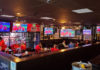
In 1956, nearly 60 years ago, the celebrated photographer Arnold Del Carlo snapped this intersection from inside Tiny’s Drive-in. Del Carlo could not predict the future. He wasn’t clairvoyant, but his photography came close. Little did he know that his body of work would later sit in the Sourisseau Academy for State and Local History at SJSU, where vivid imagery of mini-jukeboxes on every single table at Tiny’s Drive-in would shatter spacetime in 2025.
Located right where Five Guys now sits at 1205 The Alameda, with some of the same exterior elements, Tiny’s featured waitresses on roller skates who would serve people at their cars outside. Inside, customers could flip through mini-jukeboxes and select tunes from their tables. Even at the counter, they could pick a song.
If the photo in question is indeed from May of 1956, then anyone can imagine what songs were probably on those jukeboxes. For sure “Heartbreak Hotel,” “Sixteen Tons” and “Rock Around the Clock.” Maybe Perez Prado’s instrumental version of “Cherry Pink and Apple Blossom White.”
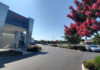
The best aspect of Del Carlo’s photo—aside from the tabletop jukeboxes—is that we can see through the glass and across the street to the corner of Race and Martin, when a few buildings actually occupied what’s now the parking lot next to the Flamingo Motel. You can almost hear the roller rink in the building where Recycle Bookstore is now.
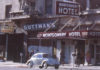
Through those very same glass windows, our gaze then shifts ever so slightly to the right, where we can see the restaurant on the other corner, the one that’s now Mexico Lindo, but in 1956 was something else entirely. Later in the ’60s, before I was even born, that building became one of the most illustrious restaurants in San Jose history, named after its Greek owner, the man himself, Angelo Lygizos. The restaurant was still around in the ’90s.
Just reading about Angelo’s life would make anyone want to go out and eat a steak in his honor. Born in 1921 in Greece, he came to the US as a teenager and joined the US Army, which led him to WWII. After the Nazis invaded Greece, his ancestral country, he helped sabotage the Germans by destroying railroads. In that war, he earned the Bronze Star and a Purple Heart. After arriving in California, he began his next career as a restaurateur.
I did not know Angelo personally, but everyone knew who he was. For years, he had a local TV show, going back to the days before cable even existed. Countless photos of celebrities hung from the wall inside the restaurant.
My goal here is not to relive the past. I’m just revisiting the past. There’s a big difference. Angelo—the man, the myth and the restaurant—still appears on many people’s mental maps of this intersection. Although Angelo was no myth. He was the real deal.
Did I mention the espresso? It was actually a double. At Crema Coffee, directly across from Five Guys, I sat at the counter by the window facing the intersection and stared in the opposite direction from Del Carlo’s 1956 photo. This is when everything became a hall of mirrors. The journey was not just a spatial experience, but also a temporal adventure.
Any such journey is multisensory. I could smell the coffee roasting in the back corner of Crema. I could almost taste the buffet offerings at both Mexico Lindo and Las Cazuelas a block down. I heard Mexican music, the theme from Zorba the Greek and whatever Crema was playing. I saw sidewalk tables at Café Rosalena. Greenlee’s Bakery still persisted right down the street, leftover from before Tiny’s. Across The Alameda at Recycle Bookstore, I could even catch a whiff of the freshly baked bread.
See? The present offers so much. Yet when the traveler discovers that sweet spot where history overlaps with everyday life, that’s when he knows the double espresso is working its magic and the cosmic mystery is unfolding.






Gary Singh
I remember Tiny Naylors restaurant in the Metro picture
My father and he were friends and did business together
Actually I think that his Royal Showcase Co in San Francisco built some of that furniture
Tiny was a huge man
What a great picture