
Autopsies are not just for humans. They’re also for houses.
Thanks to a remarkable exhibit, “Beneath I-280: Excavating a Neighborhood Lost to San José Freeways,” we can now look at several former houses that used to sit where the freeway now exists. Even if you don’t want to sift through boxes of appraisals, documents, Caltrans Right of Way Assessments and aerial maps of neighborhoods destroyed by the 280-87 interchange, even if you don’t want to pore through all of that stuff, you can now visit the Jennifer and Phil DiNapoli Gallery on the second floor of the Martin Luther King, Jr., Main Library. Huge photos of long-gone houses, enlarged and framed, grace the walls, replete with respective street addresses that don’t exist anymore. Five entire nonexistent blocks of Delmas Ave have been reconstructed along one wall.
Throughout the show we see more than just houses. We see service stations. A corner market or two. Successful working-class families and churches. Bucolic suburban happiness. Children playing on the sidewalk.
The city of San Jose City slaughtered all of it.
Many who lived in the project area didn’t even realize the city was gunning to buy them out and obliterate their house until a Phil-Silvers-looking buffoon with a short-sleeve dress shirt and dumb slacks arrived in their front yards to take pictures. Nobody knew.
The origins of the photo exhibit began when researchers at SJSU’s Institute for Metropolitan Studies pored through the aforementioned boxes and documents, resulting in a spectacular online presentation with before and after maps, flyovers, data sets and human stories, all related to every single house San Jose’s planning czars destroyed along the 280 corridor. Leila Ullmann, Maxwell Friedman, Bennett Williamson and Matthew Schroeder assembled the online presentation. Williamson then curated the exhibit in the library.

As with most California freeways, 280 was intentionally built through lower income communities of color, where land was cheaper and residents had less political power than their neighbors in more vanilla parts of town. And then everyone voted to expand the city by freeways and expressways. San Jose didn’t want to design a city for people. They wanted to design a city for cars. So that’s what happened.
The Beneath I-280 exhibit is almost ghoulish, especially how the curators included the parcel documents for several houses, which almost resemble death certificates, except they’re just documenting homes instead of people. We see exactly how the assessors evaluated each individual house with absolutely no regard for the humanity inside. We read stories of displaced people forced to sell their homes or businesses.
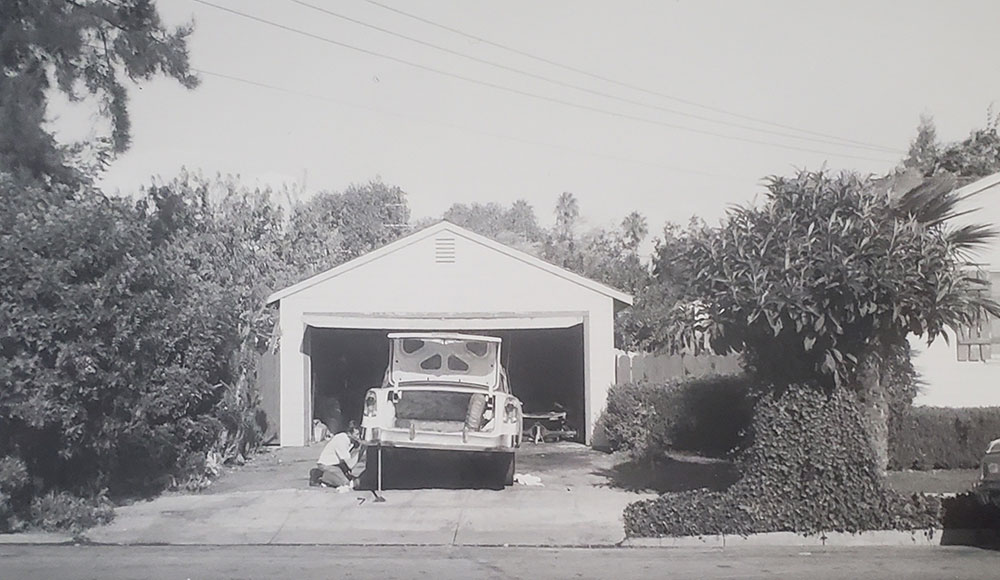
A photo of 494 Willis Ave., for example, shows a man changing a tire in the driveway. The garage door is open. Bountiful foliage characterizes the yard. If one researches further, parcel document #35447, dated 11-12-1965, shows that Guillermo Marquez was the owner. The total property area was 6785 square feet. There were six rooms. The rental rate was listed as $105/mo. The assessor’s office determined the market value of the property was $18,500. At the bottom of the document, we see the line: “Deduct $50.00 if owner wishes to retain carpets & drapes.”
Another photo shows three children walking in front of 482 W. William St. That’s right—there was a West William Street. This is where maps come in handy. Before the freeway was built, both William and Reed extended from downtown much further west than they do now. In this case, 482 W. William was an oddly shaped parcel with a detached garage. When looking at the parcel document, we discover that Eliseo Robledo was the owner of the 6691 square-foot property. In 1965, assessors determined it was worth $13,250.00.
Another text panel in the second-floor exhibit is titled “The Curator’s Compass” and offers a guide with 12 commandments: Be astonished. Look for the people. Put yourself in their shoes. Enjoy the details. Reflect on your car dependency. Consider the cost of freeways. Confront the injustice. Imagine more complete streets. Imagine a city without freeways. Make space for voices. Appreciate the archives and archivists. Leave changed.
When it comes to looking beneath the surface of San Jose, one can’t think of a more useful set of commandments. Death certificates were never more enlightening.






Incredibly biased article with words like destroyed and lost. Even assumptions like planning a freeway thru poor neighbors is completely subjective and carry no evidence. Instead freeways are productive and built san jose as a technology hub of innovation and manufacturing in the 1980s. All because of this freeway
The same thing happened in Placer County in the 1950s when they built I-80 through Auburn. The state knew that the 1960 Winter Olympics in Squaw Valley were coming up and they needed a freeway for the Bay Area and SoCal athletes to get up there so they used eminent domain to destroy houses and businesses for that road to be built. I cannot imagine how awful it was for people to be forced out of their homes for that.
We had a home/ ranch on 280/King road area.
We had chickens, a pony.
Dirt roads, tall grass across the street in a lot where we crawl and would play army . I remember a boxing rink & an old church.
And a candy store on the corner of
king road where 50cents got us a bag of candy.
Dad would send us to buy milk,
bread $3 dollars a gallon of gas was 10cents.
I remember our parents wrapping us in warm clothes, socks on our hands to see the snow fall!!!!
Back in the 60s a rare occasion!
It was a rag tag neighborhood.
And To me & my twin brother it was a fantastic place to be a kid.
Progress Always Comes At A Price Progressivism Never Bothers To Calculate Nor Care About.
My family’s house was on Cindy Lane with a short walk to Moorpark elementary school. My parents were bought out in 1966 and moved about 3 miles away. Looking forward to seeing the exhibit.
How long is the actual exhibit up, to know how long I have to get there from South Carolina? Thanks for sharing this!