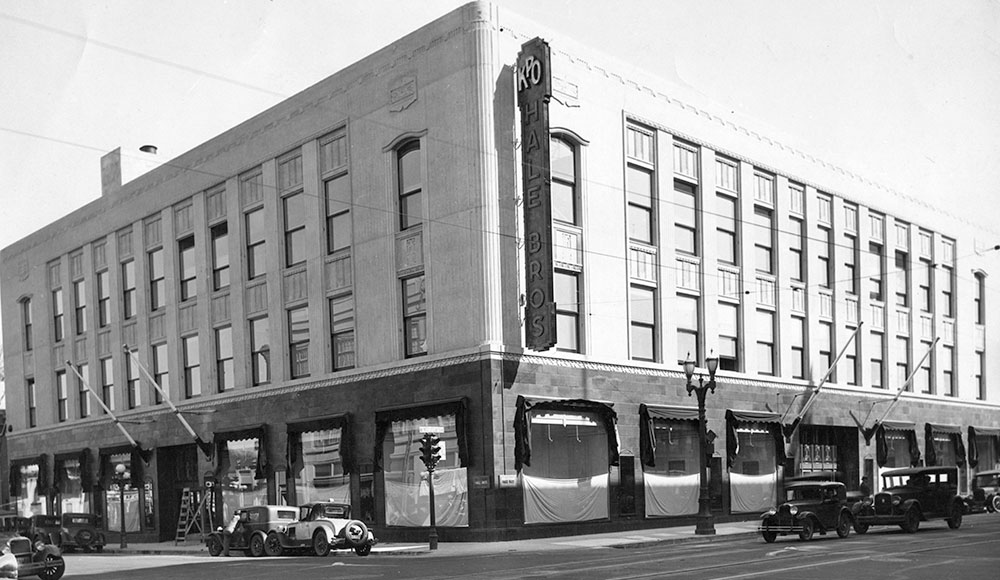
The San Jose Jazz Break Room looked quite a bit different in 1930. Today, the escalators are long gone.
This weekend, the San Jose Jazz Summer Fest explodes all over the urban landscape, celebrating 35 years of this particular festival and all its incarnations. As every year goes by, various clubs and spaces either move or simply go out of business. Then when Covid-19 hit, decimating live audiences, the folks at San Jose Jazz decided to convert a portion of their office into a venue for live streaming shows. Thus, the SJZ Break Room was born.
The Break Room, as it’s often called, now showcases amazing gigs. During Summer Fest, the Break Room serves as one of the urban hangouts, a gathering place where late-nighters—you know, like most jazz people—can lurk in the shadows. It’s not a huge place, which gives it a close-up and intimate feel. Especially thanks to Ben Henderson’s sign-painting talents, people can now easily spot the place from outside, where it sits at First and San Carlos, across from Original Joe’s.
Inside, the lighting dims. What exists by day as an office then morphs into a club space accompanied by video projections from the live gig onto the bank of windows, unlike any other space in town. With a capacity of approximately 100, almost every seat is within 30 feet of the action. With the performers on the same level as the audience, each show feels like a living room gig.
Over the last few years, I’ve experienced mind-blowing performances at the Break Room. I’ve seen kids and I’ve seen veterans. I’ve seen musicians from all over the world in that space. This weekend, even more will unfold, including midnight shows Friday and Saturday nights.
In addition to the Local Color folks and Kaleid Gallery, both of which also occupy a space in the same building, the Break Room has successfully converted one of San Jose’s most hideous buildings into a destination. Many people, young and old, now pay attention to that corner.
Before the artists and musicians moved in, everyone did their best to ignore the building. Drunks and nightclubbers urinated all over it, or even slept beneath the overhang.
I can remember, exactly 20 years ago, walking to the Metro offices every single day, right past the Valley Title Building when the Chamber of Commerce was located inside, on the street level. I would usually see someone passed out underneath the overhang. Right on the other side of the glass, inside, was the chamber CEO, sitting at her desk. Every day, that’s what I looked at, as I walked down South First: A downtrodden dude passed out on the pavement and the CEO of the San Jose Silicon Valley Chamber of Commerce on the other side of the glass. Talk about symbolism.
But it wasn’t always that bad.
In the glory days, when downtown San Jose still had retail, and when people dressed up in suits and drove Model Ts to go shopping, the same building was the legendary Hale Brothers Department Store. It opened in 1931.
Hale’s had it all. Clothing, toys, fashion, holiday stuff, a lunch room in the basement, and much more, straight up until 1968, when it died a natural death as the comfortable classes bailed for the suburbs. Thousands of old-timers still remember it. Many claim that Hale’s was the first place they ever saw an escalator.
Then, in a textbook San Jose maneuver, Valley Title took over the building, ripped out the escalators, ruined the exterior and converted the upper floors to ugly ’70s office hallways, which still remain to this day.
As usual, it took contemporary artists and avant-garde musicians to transform a hideous building, and a neighborhood, into something useful. One can only shudder at what would have happened otherwise.
After all, in 1931, City Hall was still located in what’s now Plaza de Cesar Chavez. There were no music festivals of any sort. The country bumpkins who populated San Jose certainly didn’t go to midnight jazz gigs. Recorded music barely even existed.
I like to think we’ve progressed since then. I know we have. This weekend, thanks to the SJZ Break Room, minds will again be blown.