Nearly 40,000 students are enrolled at SJSU this year. All of them should attend Heather David’s campus tour of modernist architecture on Sept. 20.
With so many mid-century buildings still populating the campus, David spent hours of her own time researching the history of each building, its architect and the various movements and schools represented. Many campus employees who see these structures every day probably don’t even think about these things. The tour is sponsored by the Preservation Action Council San Jose (PAC*SJ), and tickets are available on the PAC*SJ website.
For instance, according to David’s research, the Music Building was built in 1953 from earlier designs by architect Stanton Willard. Hugh Gillis Hall came along in 1954, thanks to Ralph Wyckoff, and the Administration Building in 1957, thanks to Anson Boyd. Local architect Allan Walter designed Joe West Hall in 1968. The Faculty Offices, aka where the English professors hang out, was concocted by Harold C. Guilkey and Associates in 1958. The Art Building arrived thanks to Stone, Mulloy, Marraccini and Patterson architects, in 1959.
“I have come away from this investigation with a much deeper appreciation for San Jose State,” David told me. “The campus feels way more intimate and relatable to me than, let’s say, a Berkeley or Stanford. And because so many buildings went up in the ’50s and ’60s, it really is a fantastic place to explore modernism—from Bauhaus to Brutalism.”
David’s obsession, I mean specialty, however, is mid-century modernism. She already wrote books about roadside motels and Bay Area kitsch. Thousands have viewed her Flickr page. Which is why Duncan Hall, MacQuarrie Hall and others like it on campus attracted her attention.
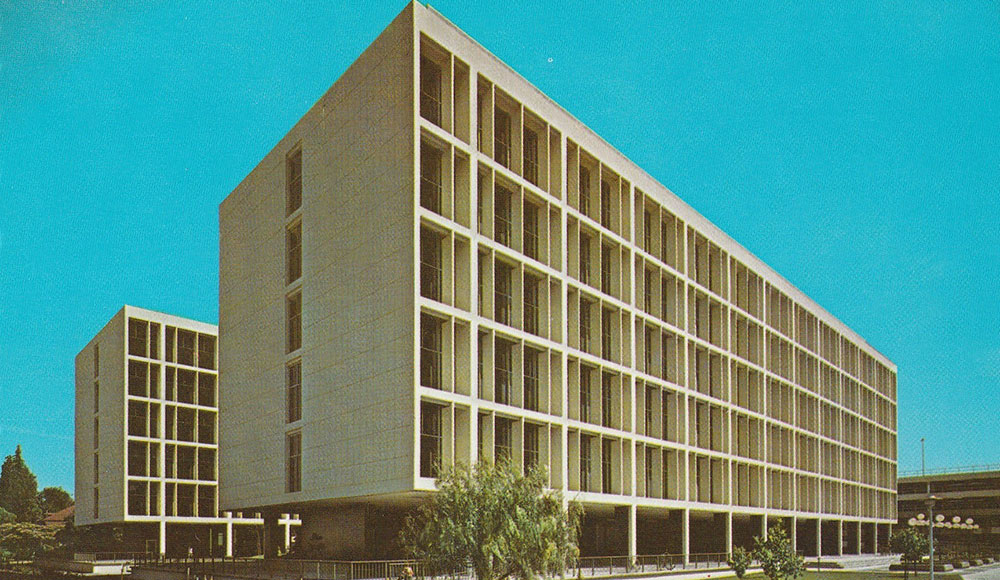
Duncan Hall in particular brings back memories for many people. Back in the ’60s, though, the Spartan Daily bashed the building in print, calling it a $3 million catastrophe. Water dripped from the ceiling. The elevators skipped floors. The power went out. Students weren’t muscular enough to handle the thick glass doors.
At the time, San Jose was still a backwater fruit-packing suburb, so many students, staff and faculty didn’t understand the big-city ambitions of a real urban university. In fact, San Jose State wasn’t even called a university at the time. It was named San Jose State College. The monolithic Duncan Hall was considered futuristic.
“Most of the articles I found criticizing the modern buildings focus on the functionality of the buildings, many of which were erected with limited budgets and at warp speed,” said David. “I took all of my Natural Science classes in Duncan Hall and I never had a problem with elevators or condensation. Duncan Hall is still standing, thank you, and at this time, the postcard image that I posted on Flickr is one of my most ‘favorited’ images.”
David has over 16,000 photos on Flickr. Enthusiasts far and wide have voiced their approval of Duncan Hall.
“People all over the world think it’s a cool building, except the people who actually live here, which seems to be an ongoing challenge for San Jose,” David said. “We just don’t know what we’ve got ’til it’s gone.”
David’s tour is timely because right now the campus is proposing a mammoth destruction project, in which a good portion of the older buildings will be demolished with little understanding of what each academic department will subsequently need in order to operate thereafter, while tearing up the whole campus for years in the process. This is typical, of course.
Nevertheless, if David’s tour sells out, another one will surely emerge. More information can be found on the PAC*SJ website. No matter what happens, David will continue gathering materials.
“I spent close to $100 on old postcards of San Jose State,” David said. “Interesting to me that there were so many produced. Maybe because so many students went there.”
One of the postcards even arrived with someone’s original handwriting on the back, along with a canceled Franklin D. Roosevelt stamp. The sender of the postcard wrote: “Dear All — This is the school we visited this year. A little nicer than Berkeley…Leaving now for the ocean. See ya later in the week!”
A little nicer than Berkeley. It has a ring to it, you think?