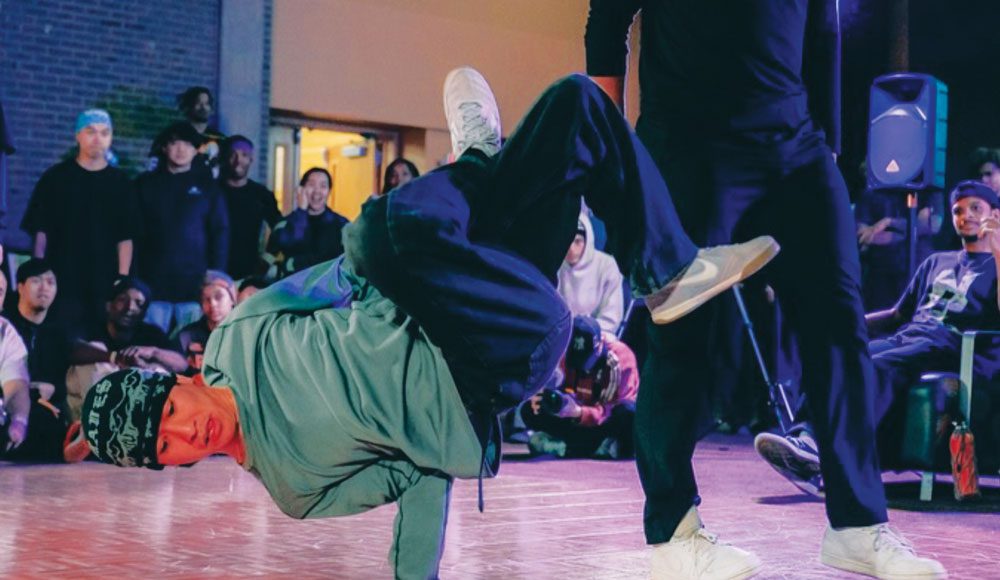
If you’ve driven by San Jose State on a Sunday or Tuesday, you might’ve seen people doing headspins by the MLK Library’s front steps. Breakdancing, an energetic, acrobatic dance of precision, is experiencing a resurgence of interest in the area after decades of ebbs and flows in popularity. With breakdancing competitions still being held globally, as well as many underground events in the Bay, what initially developed in New York in the ‘70s has piqued the interest of a younger generation.
Colin Nguyen, a third-year marketing major and founding officer at SJSU’s breaking club, observed, “I have definitely seen a growth in interest in the Bay Area dance scene,” adding: “More and more people are looking for pathways to learn and explore. The meetings at the library are great. We have such a vibrant community here in San Jose.”
Breakdancing or “breaking,” emerged from communities of the Bronx in the 1970s, intertwined with the genesis of hip-hop culture. Poor, marginalized youth pioneered the dance form, blending unseen rhythmic footwork and athleticism to early DJ sets from trailblazers like Kool Herc or Grandmaster Flash.
By the early 1980s, breaking made its way to California through the popularity of early hip-hop themed films like Breakin’ or Wild Style. In the Bay Area specifically, influences from Oakland’s locking and robotic dances—popularized through TV programs like Soul Train as well—emphasized individuality and high-energy takes on preexisting, more rudimentary styles first seen on the East Coast.
In San Jose and the South Bay, breaking took root amid the region’s diverse communities. The 1980s saw informal cyphers appear in parks, malls and community centers. South Bay’s proximity to Silicon Valley didn’t deter its street culture; instead, it fostered an inclusive scene.
Long before the internet age, potential breakers drew inspiration from smuggled VHS tapes of European competitions in the ’90s. By the mid-’90s, a renaissance of sorts swept the area, with aspiring b-boys and b-girls gathering at spots like the halls of Fremont’s Ardenwood Plaza or San Jose’s Roosevelt Community Center.
These spaces became crucibles for creativity, where dancers honed both nuanced, surgical ticks with gravity-defying, gymnastic-like bursts.
These wildly explosive battles drew crowds and, of course, occasional police attention. But like the original b-boys and b-girls of ’70s New York, breaking competitions are highly organized, peaceful events with a wholesome, intramural sports feel.
A pivotal and longtime presence in San Jose’s breaking history has been the Style Elements Crew, formed in 1994 by a group of young dancers from Stockton, Modesto and San Jose. At a time when U.S. breaking felt dormant, they injected fresh energy and excitement by prioritizing new styles—each member crafted a unique delivery to avoid derivative moves– and in doing so, created many of their own forms. They pioneered group routines in competitions and advanced techniques first seen a decade or so prior.
A huge breakthrough came in 1997 when Style Elements became the first American crew to win Germany’s Battle of the Year, an elite and global benchmark for b-boy excellence.
Relocating briefly to Los Angeles in the early 2000s, Style Elements returned to the South Bay for milestones like their 19th-anniversary celebration in 2013 at MACLA and Roosevelt Center.
In the Bay, breaking has never really waned, even as mainstream popularity vacillated. Community events, like the Renegade Rockers’ 40th-Anniversary Jam in San Francisco in 2023, kept momentum afloat, blending old-school cyphers with modern battles, while honoring breaking’s original connection to funk and soul. The art form’s Olympic debut was a huge expansion of its global reach, with b-girl Logan “Logistx” Edra representing the U.S. in Paris 2024.
Khoi Quan, known widely as DJ Quantum, a local artist who soundtracks many breaking competitions in the area and overseas, had this to say when asked about breaking’s global appeal. “I think social media plays a big role in inspiring the kids these days. Algorithms reward visually impressive skills and breaking looks crazy impressive even in five to 10 seconds!”
Today, SJSU embodies this persistence through its vibrant breakdancing community. The club provides campus space for students to battle, collaborate and celebrate breaking’s roots (as well as its future). The diverse, eager participants they attract ensure that breaking remains a positive outlet for expression amid the stress and malaise of academic life.
Gary Moi, the club’s other officer, who has now been breaking for 10 years himself, concluded: “Breaking in the library has never been better. We consistently have interested new students. I get to do what I love with a community that loves it just as much.”
*SJSU Breaking Club meets every Tuesday and Sunday on the steps of MLK Library with workshops from 3:30-4:30pm and open sessions from 4:30-5:30pm