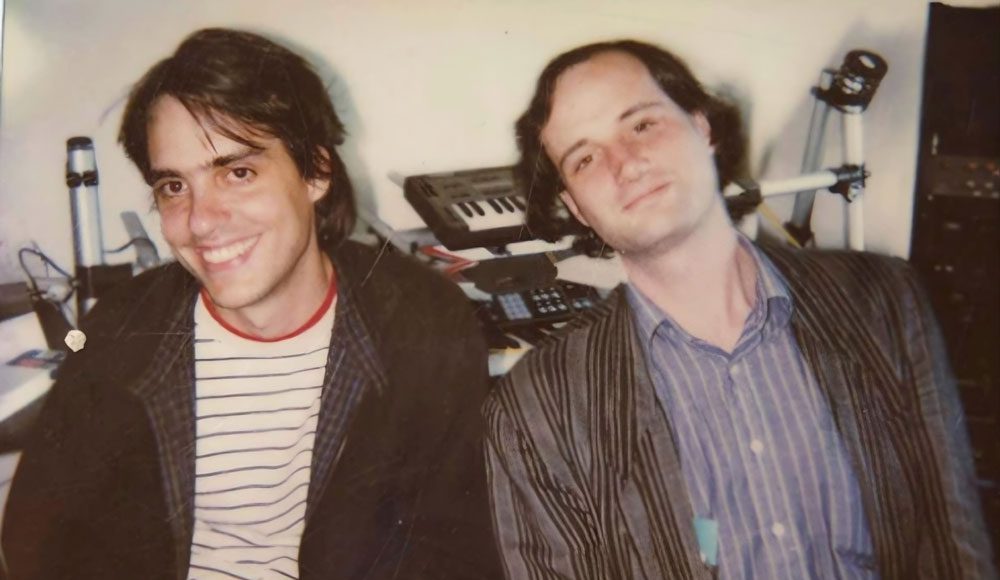
In the School of Music at San Jose State University (SJSU), there is a room upstairs where the gear is different nowadays, but software manuals from 35 years ago remain.
Several of those manuals accompanied the original versions of MAX, an object-oriented programming environment that David Zicarelli and Miller Puckette created in the late ’80s. SJSU music students were among the first undergraduates to use MAX for any creative purposes.
To make a long story short, as the ’90s began, personal computers were not yet powerful enough to digitally process audio in real time, so Miller was working on a DSP version of MAX that ran on a NeXT Machine, while Opcode sold a MIDI version of MAX that composers and performers used for patching various operations together. Eventually, those two versions combined into one package, MAX/MSP, as personal machines became faster.
Now Zicarelli will return to SJSU for two events, a guest lecture on Friday, March 6, at 10am and a workshop the following week, Thursday, March 12, at 3pm, both in the Art Building, but co-presented by the School of Music.
Everything that Zicarelli and Puckette worked on 35 years ago provided technological inspiration for the Electro-acoustic music concentration started by professor Allen Strange in the SJSU School of Music. At the time, Allen’s program was revolutionary, inseparable from Silicon Valley history.
Allen had already written the very first electronic music textbook in the early ’70s and by the time Zicarelli and Miller Puckette began their work, Allen was already established all over the planet. MAX became the go-to environment for many of Allen’s students.
At that time, most undergraduate music programs required a concentration in performance, composition, history, jazz or music education. Allen created a whole separate concentration called Electro-acoustics, which wasn’t that different than studying composition, as you still took all the same classes, but you supplemented your studies by learning any number of things including synthesizer architecture, hardware and software, interactive computer performance systems, analog and digital sound engineering, musique concrète history, the compositional lessons of Indian cooking, Middle Eastern tunings and all sorts of stuff that none of the other faculty understood, which made it even more fun.
MAX/MSP always seemed a part of whatever anybody did. If you wanted to attach contact microphones to a kettledrum and destroy the whole thing with a circular saw while running the resultant audio through a hundred filters and envelopes in MAX/MSP, you could do that. If you wanted to put sensors on a dancer’s body and use her movements to trigger the way MAX then controlled various synthesizers, you could do that. It was very ’90s, but you could do all of that, and, sometimes, even get academic credit.
In other cases, if one was a computer science major, one wrote specific MAX patches to help researchers study how neural networks could aid in the creation and performance of improvised music. And you could present your research at international conferences.
At that time, there was no other cheap public university where an undergraduate program gave students such possibilities. Normally one had to attend a ritzier college for access to this kind of software or hardware, and then wait until grad school. But Allen knew everyone in the history of the synthesizer industry, and for a while he used MAX/MSP more than any other environment. He understood its potential in the early stages and passed on the knowledge to his students.
Thanks to David Zicarelli and Miller Puckette, along with their various colleagues, MAX/MSP went on to achieve universal status as a computer music and live video environment. It’s now used all over the world.
These days, the influence of those two guys—David Zicarelli and Miller Puckette—can still be felt in the music building at San Jose State, as long as one has access to the right room. The same manuals from 35 years ago are still sitting on the shelf. If one rifles through it all, you can see exactly what the students worked on in 1991, before the World Wide Web or Pro Tools even existed.
Today, we are lucky to be alive when David Zicarelli and Miller Puckette are alive.