
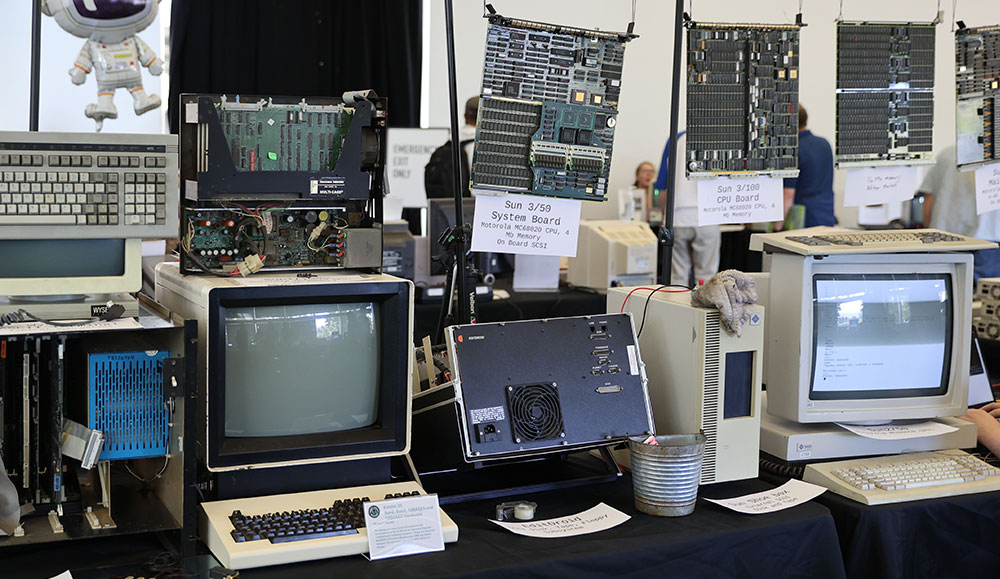
When a few thousand vintage computer freaks and their grandchildren congregate for a few days, enlightenment ensues. The past merges with the present and the future.
This weekend, the annual Vintage Computer Festival returns to the Computer History Museum. Over two days, historians will give tours and talks. People will sell a vast array of stuff on consignment. There will be panel sessions, parties and plenty of insider stories, with both nerds and newbies arriving en masse. Specific events will celebrate landmark anniversaries—from the Homebrew Computer Club in 1975 to the original Commodore Amiga launch in 1985.
These guys are not messing around. One previous festival featured more than ten different original Apple 1 machines, or pieces of machines, all on display.
“We had to hire a security guy,” said Dag Spicer, a Computer History Museum senior curator and member of the Vintage Computer Federation board. “That’s just under $10 million worth of computers in a little space.”
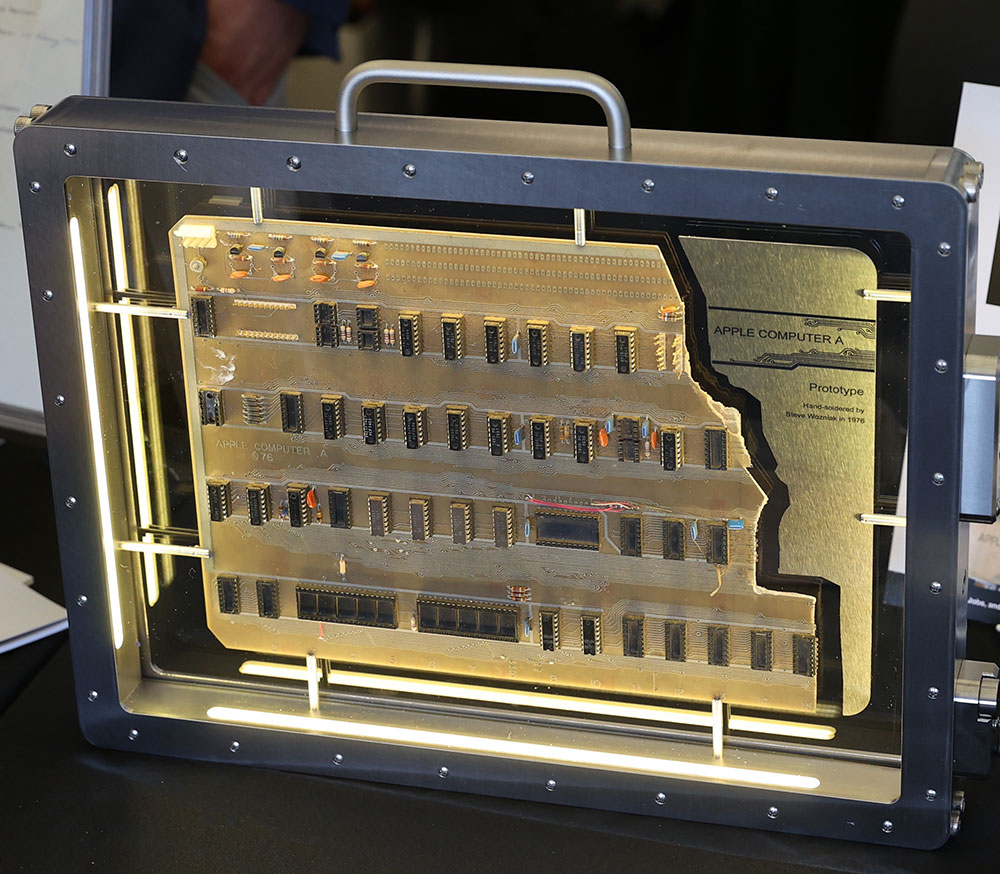
RR Auctions even showed up with a broken Apple 1 prototype hand-soldered by Steve Wozniak. It later ended up selling for nearly $700,000.
Another magical aspect of the Vintage Computer Festival is the sheer joy from watching all the kids. People don’t bring just sons and daughters. Plenty of third-generation folks are now showing up.
“One of my favorite things is the interaction between the parents and their kids,” said Erik Klein, president of the Vintage Computer Federation. To kids, Klein continued, computers are ubiquitous. They’ve got their phones, they’ve got their video games. “Their watches are probably more powerful than most IBM systems from the ’70s,” he said.
“It’s quite endearing in many ways,” Spicer added. “It’s wonderful to see these people, some of whom came from across the country, even around the world. So yeah, hands-on demos of historical systems from probably the ’60s to the ’90s, and you can learn preservation tips from other people who are preserving their own systems. They come to learn from the masters, so to speak.”
Yet perhaps the most mind-blowing machine currently on display at the Computer History Museum just might be the RAMAC 305, part of IBM’s groundbreaking 1956 computer system developed at 99 Notre Dame Ave. in downtown San Jose, IBM’s original West Coast R&D lab. The RAMAC was the prototype for all hard drives that we still use today. Without exaggeration, almost everything we do in terms of hard drive storage originated in that lab, in that building, which has sat empty and ignored for years because nobody in San Jose seems to care.
“In history, we talk about the importance of place. Or the magic of place,” Spicer said. It isn’t exactly the Grand Canyon or the Louvre, but 99 Notre Dame is important, even if for only a few. “You can take scientific tours of Paris that will take you through the buildings where Lavoisier and Pascal and Descartes and all these characters worked,” Spicer added. “And it’s a wonderful way to see Paris, but it’s really of interest only to science nerds. And that’s, in a way, I guess, what’s going on here.”
Everyone who ever saved anything to a hard drive has that building to thank, at least partly. It’s just overwhelming to contemplate.
“The amount of data that we generate on a daily basis, on this planet, and it’s all getting stuffed on hard drives from that core, from that seed, still today,” Klein said.
Over the years, informal talks have ensued, with San Jose City Hall and retired IBM employees that worked on the RAMAC, as well as the landlord, but no serious civic interest in the history has ever come to fruition.
Regardless, the Vintage Computer Fest will only get bigger and more expansive, with or without San Jose. Next year, in addition to the existing West Coast and East Coast festivals, there will be one in Canada and a few others.
“We’re talking to folks in Europe and South America and elsewhere,” Klein said. “We’re looking to get these shows going wherever people want to do it. We want the federation to be an umbrella organization for the hobbyist community, much like the museum is an umbrella organization for the history of these machines.”
The Vintage Computer Festival West takes place Aug 1, 10am-6pm, and Aug 2, 10am-5pm, at the Computer History Museum, 1401 N Shoreline Blvd, Mountain View. Tickets: connect.computerhistory.org.






Have vintage computer + to sell
Who do you suggest I contact?