When empires collapse, they eventually grace the walls of the Los Altos History Museum.
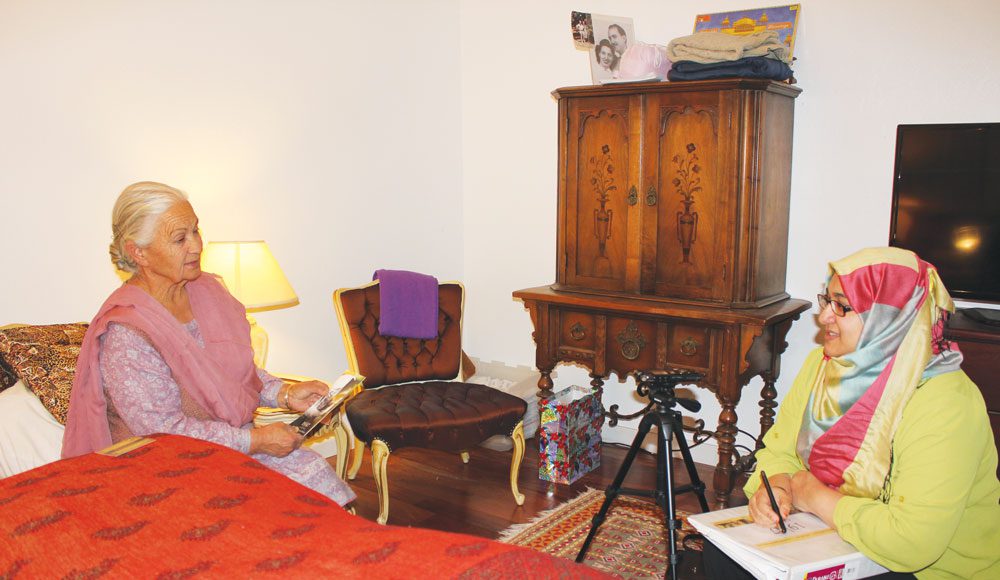
For more than 10 years, the 1947 Partition Archive, a Berkeley-based non-profit, has interviewed, documented and preserved eyewitness accounts from all ethnic, religious and economic communities affected by the violent Partition of British India in 1947. A grassroots organization, they have now archived more than 10,000 memories—the title of a recent glossy hardbound volume.
Inspired by the book, a new exhibition, “10,000 Memories: Partition, Independence, and WWII in South Asia,” debuts this week at the Los Altos History Museum and runs through May 24, before traveling statewide and beyond. The exhibition features first-hand accounts, photographs and multimedia storytelling from those who experienced Partition, or whose family lived through it. Several Los Altos residents are either board members of the 1947 Partition Archive or contributors to the book.
However, the exhibit is not just about Partition. An exploration of South Asian history on a larger level emerges.
“We wanted to take this opportunity to warm people up to the true story of colonization,” said Guneeta Singh Bhalla, director of the 1947 Partition Archive. “It’s really not taught in a comprehensive manner in the United States.”
As a result, we learn about different colonizer countries—France, Britain and the Dutch, especially—all of whom competed with each other. The British East India Company rose to the forefront, becoming essentially the first massive multinational corporation, calling the shots and subordinating individual states, much in the ways Amazon, Meta or Exxon are trying to do nowadays.
A few centuries later, after World War II, when parts of England were crumbling, bankrupt and bombed out, the Empire could no longer manage the colonies, so it eventually collapsed and abandoned what was left, namely the Indian Subcontinent.
From there, the exhibit then takes the narrative into the violence that erupted during Partition.
“There’s a lot of parallels there between America now and what happened with the British Empire collapsing,” Bhalla said, suggesting we are currently witnessing the end times of the American Empire.
Yet as much as the violence and forced displacement of Partition grabs the history books, many humane stories have come through the transom thanks to the efforts of Bhalla and her team of oral historians. Amid the mass murders that took place, many other people, even those of different religions, looked out for each other. The work of the 1947 Partition Archive has completely changed the narrative.
“A very small portion of people were responsible for the violence,” Bhalla said, adding that older history books have often depicted mass communal slaughter when that wasn’t the case. In many instances, organized gangs attacked people a few towns or a few villages away. It wasn’t usually a case of “neighbors turning on each other” as the history books often suggest.
“It’s a small group of mostly young men who had been recruited into these groups who were committing these acts of violence, which were very well planned and targeted,” Bhalla said. “They were not random. It was really to gain property. So when lawlessness became the thing, when there was no repercussions…they started looting and they started killing people. And religion became the excuse.”
Even so, the polarization that ensued before, during and after Partition provides a dire warning to how bad things can get when mass amounts of people are manipulated toward violent tendencies. Especially now in the currently decaying version of America, Partition history provides a stark lesson.
“As we now see, it’s so easy to get caught up in the polarization,” Bhalla said. “It’s actually a default, right? It’s the normal thing to do.”
Despite the various forces profiting off the polarization, even those manipulated into violence are still human beings with feelings. Anyone that studies Partition can see just how badly it can all go wrong.
“It’s really, really hard to play that neutral ground,” Bhalla said. “But I think where it can be useful is to catch yourself, and know that as a human, you’re prone to polarization and to maybe not act on it,” Bhalla said.
Over the years, people have suggested the 1947 Partition Archive be nominated for the Nobel Peace Prize. Surely, worse people have tried.