Jake was sick of all of this rehab business and he had this abominable emotional torment going. Everyone around the place—staff, that is—seemed artificially slow and almost deliberately annoying, like they were trying to eke out some last scraps of discipline and self-control and good decisions from him. He was getting out this morning regardless. Sure, he’d smoke another three or four cigarettes and bump fists and hug and force a few unctuous smiles, but he was getting out. Today. This morning. Oh, it should be said: Jake was in rehab.
The Girl had screwed up his hopes at a fresh start, a different go at things, as she had rather callously announced via short text to his BlackBerry that she wouldn’t be picking him up from rehab, this followed by some salt-in-the-wound commentary about her belief that he could “take care of himself.”
What amazed him was the utter imperviousness of The Girl to basic relationship concepts. Everyone could take care of themselves, but if her logic enjoyed much of an audience the whole point of dating would be lost. Androgynous robots walking around, taking care of themselves. Truth was—and he knew it—she was scared he’d drink again, or maybe she was scared he wouldn’t.
Anyway, Jake was still at The Camp. Details don’t really matter, but since he was still standing there, smoking perilously close to the line that marked the smoking zone, the title of the place is worth a moment’s thought: “The Camp.” Alarmingly ambiguous. Shades of vacation fun coupled with something edgier, boot camp and so on. It conjured camping, too, which was generally positive, so the poor bastards checking themselves in for thirty days of their lives were rewarded immediately with confusion about whether they were being disciplined or handed marshmallows. The truth was somewhere in between, as they say.
At The Camp they mixed a healthy dose of daily structure with endless talking. Counselors, yoga, meditation, films about addiction, AA meetings. For dessert you stood around the smoke pit—the smoker’s area, which was effectively the entire inpatient population—with surfer-looking guys and pill-popping divorcees and tatted-out beautiful girls, trading stories and laughing and joking until a staff member broke it up and pushed everyone into another meeting or back up to the cabins for bed.
Teenagers and burnouts together, shuffled around the rustic buildings, cigarette smoke rising in slow plumes into the clean air of the Santa Cruz Mountains. Swearing and laughter echoing off the rock escarpments above. This was The Camp.
Jake smiled. He was out today, discharged as they say, and it felt like a kind of graduation after the forced intimacy of the last month. Odd that he’d only now, on the day of his departure, noticed how rustic the place was, set back off a country road and a short hop from the little conglomeration of stores and shops called downtown.
And here he was, smoking on the edge of a painted line, thirty days removed from everything, waiting to be released back into it.
Anyway. This was all in his rearview, so to speak. He had finished about two hundred meetings, some yoga, a few dozen acupuncture treatments, two visits from The Girl and one torturous string of text characters on his BlackBerry the previous evening. She was an amalgamation of something like hope and purity and a kind of Slavic hardness that emerged exactly when Jake’s brand of American neediness flared up. Ukrainian-born, Czech Republic–living, immigrating-to-the-Promised-Land Girl. Anyway, what bounced around in The Girl’s head was of little interest to him at the moment; he was getting out of there and he was going on a bender. The rest would take care of itself. Just like she said.
Ty was a staff member at The Camp who had picked Jake up from his entombment in a Palo Alto hotel thirty days earlier: barefoot, chain-smoking, and day-drinking vodka in poisonous quantities. Now, finally, with Jake’s belongings stacked neatly outside the nursing station in the Northern California sunlight, his head pulsing with impatience, Ty appeared in his “The Camp”–emblazoned polo, driving the minivan, ready to evacuate him.
“You ready?” Ty said, all toothy, the remnants of tattoos from his own drinking days still visible on his arms. He stood there smiling as if this were a big moment, and honestly Jake agreed. It was.
“Yup. Sure am.”
This was all pregnant with meaning and faintly ridiculous, as he was effectively t-minus something to bender, which might have been funny if he weren’t in such a pinched state over The Girl. She sat squarely on his frontal lobes and limbic system, pressing into the folds, dragging her bare foot across the contours of his brain. In that state Jake stepped into the minivan with Ty—The Recoverer, as he imagined it announced, like a main event—and they drove out and away from The Camp, finally, toward Scotts Valley. Free, sort of. Not really. Gone, at any rate.
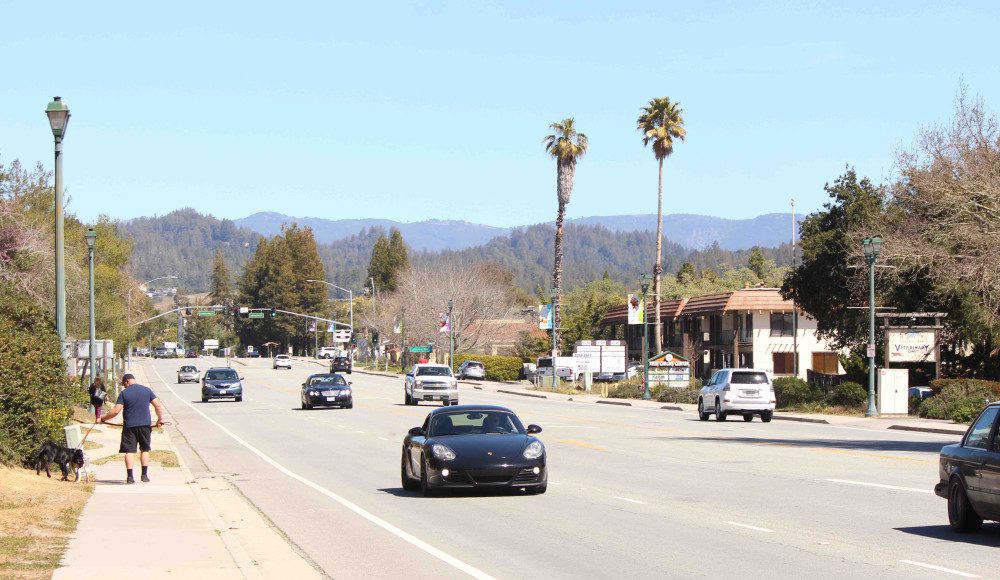
Scotts Valley, the town in the Santa Cruz Mountains sporting a collection of boring restaurants, fast food, hardware stores didn’t feel like Silicon Valley. It sat just over “the Hill,”—as the locals called the up-and-down drive on California State Route 17—but a world away from San Jose, Cupertino, Mountain View, Palo Alto, Sand Hill Road and the rest of the Valley. Far away from the endless announcements of funding rounds and product launches. If Silicon Valley was the valley of opportunity, Scotts Valley was the valley of blue skies, chirping birds in lush forestry, and an almost aggressive peace and quiet.
No wonder they put The Camp here. The boozers and pill poppers and meth heads and dope fiends could finally relax, stand in the smoke pit watching the curls from their hundredth cigarette of the day, shuffle between buffet-style meals with half-caffeinated coffee—someone clearly mindful of the speed freaks—and talk themselves into something like stability. The Santa Cruz Mountains rose clean and indifferent above it all.
Scotts Valley. What else? There was a Peet’s Coffee, turns out, and just then in the parking area in front of it was a minivan from The Camp driven by Ty, containing a recently discharged inpatient, who, if viewed through the window in the late morning California sun, seemed perhaps on the precipice of a new type of life. The guy—Jake—was stepping out now and Barnum and Bailey–like smiling and volleying back responses to Ty’s enthusiastic, slightly condescending patter about aftercare and recovery.
Along with Jake’s exit came his huge duffel bag and a little “The Camp” backpack, like the ones you give a nine-year-old on the first day of school, full of the desiderata of rehab: notes and books and handouts and a half dozen Bic pens he had collected here and there.
Ty drove off and in a comic moment Jake imagined him still prattling about aftercare, his encouragements gradually weakening until they were drowned out entirely by engines and road noise, a distant staccato hammering on a roof somewhere, neighbors watering yards and hollering across the street; the panoply of small-town sounds. As he turned onto the road he waved. He was a good guy.
So here was Jake, in this type of pickle, which was only thinly metaphorical as he was feeling an almost medical need to get a drink on the heels, so to speak, of all this torment. Was there a bar in Scotts Valley? IS THERE A BAR IN SCOTTS VALLEY?
Currently outside the Peet’s Coffee, center of town, eleven in the morning, duffel bag sitting with the little backpack perched on top. Sweat beaded on his scalp. Inside, a couple of queries to the baristas about “getting a beer” yielded mention of a liquor store open in the constellation of stores behind him. It was California and they could probably tell him where to get some meth to enjoy with his coffee. Christ, no one was really from there, right? They had probably moved out from Santa Cruz or from over the hill in the Valley—got a boyfriend making an extra dollar an hour down the road and traffic so much better and, you know, mom and dad ten minutes away. Life was good. Can’t wait to move to L.A. someday, but you know?
Where was he? Oh right! Jake’s homing in on the liquor store like a salmon laboring up a river, singular in purpose. He carried the duffel bag for a fraction of the few hundred yards, but that became ridiculous in the rising sun, so he hauled it all back to the front of the Peet’s and left it there. No one would steal it, he figured. If they did, they would have procured a pile of smoky T-shirts, shorts, dirty socks, reams of rehab literature, and a Big Book, complete with names and numbers penned in from his fellow inmates—a thousand ways to buy good drugs. They all fell off, especially the junkies.
And the boozers. A large, strong bottle of ale. A bottle opener.
Was Ty back to The Camp yet? Ty was gone. The beer was there. The Girl shifted nervously atop his troubled brain. She was quiet now and had stopped poking at him with her bare foot. Her little deer eyes darkened and she squinted as a slight flush of something passed across her face. The German-accented man behind the counter in the liquor store smiled wryly as he handed over the receipt. So this promised with near mathematical certitude to be the beginning of something. It was called a bender—maybe a royal bender—and he would unpack the meaning of this in due time. Mostly, he would just drink.
Little details could bedevil a bender right out of the gates. Like: the ale bottle poking conspicuously out of the brown bag as he exited the liquor mart, and he had no place to drink it either. His truck was over the Hill in Palo Alto. He didn’t know anyone in Scotts Valley. The sun was high in the sky now as noon approached and the little town was a menace of quietude and peace and locals shuffling about, attuned to notice people like him with a big brown bag and a sweaty, nervous glance.
Where was he? In the relative epicenter of a horseshoe cluster of shops to his right and left. A front sidewalk snaked along the lines of shops, and lots of asphalt and nothing much in the interior, which was where the liquor store was, so he made his way toward the semicircle of shops with his big beer, onto the shade of the front sidewalk, and down along the storefronts until finally there was a bench set back on a side alley, safe from the immediate visuals of passersby. This damn, sunny, somnambulant yawn of a town.
Ethyl alcohol. This was Jake’s subject. Ethyl alcohol, or ethanol, and hereafter alcohol, was often and notoriously misunderstood. So he was there to clear matters up: alcohol was shit, literally. It was the excrement of a fungus known as yeast. Yeast was a ravenous little bastard that ate anything sweet, shitting out carbon dioxide and alcohol. This process was known as fermentation.
Now, during fermentation the bastard yeast would keep feeding on the sugar until it ended up dying of acute alcohol intoxication. True. Yeasts were boozers. Like frat kids who die of alcohol poisoning. There were no moderate strains of yeast. When they died out, what remained was roughly 13 or 14 percent pure alcohol. These were beers and wines.
Distillation picked up where fermentation left off. Distillation was developed by the Arabs around AD 800, and it enabled pushing the alcohol content far beyond yeast fermentation. These were distilled spirits. Booze. People already knew that booze was “proofed,” about half the actual percentage: 80 proof was about 40 percent alcohol. Proofing was a practice used in Europe hundreds of years ago to “prove” the alcohol content of distillations. It was still used today.
What else? Alcohol was a kind of shape-shifter, hard to classify. It was the only drug that could also be classified as a food. An ounce of pure alcohol contained 170 calories, about what was in an average baked potato or a glass of milk. Alcohol was energy to the body. It was also a sedative and a stimulant and a poison. Drinkers understood all of this.
Jake’s first drink out of rehab was a little foreign, almost unwanted. Cough-syrup-like, it drained down into his stomach, warm and ale and bitter. The alcohol in the fermentation entered his bloodstream through the lining of his stomach; once in the blood it was sent, like everything in the blood, to the liver, where the liver recognized it as a toxin and immediately began breaking it down. In the meantime, it found its way to his brain, where it would make itself known in a sequence of neurochemical changes. He paused, almost reflexively, to walk through the brain changes.
The mesolimbic system was where the action was, with booze and with psychoactive drugs generally. There was a sequence of neural connections in this system known informally as the “pleasure loop,” because they reinforced desirable activities like eating and sex by releasing the feel-good neurotransmitter dopamine. Alcohol caused this release of dopamine, for free. Just drink and it was as if you had done something pleasurable. The same mechanism held for other drugs—this was the key to understanding physical addiction. Booze also spiked other neurotransmitters, serotonin and norepinephrine among them. It was a shotgun-type drug.
Now, with all these neurotransmitters shooting across his synapses, his conscious experience was fixing to take a major upswing. This was colloquially known as feeling a buzz. For present purposes, the buzz could be defined as the sort of feeling that eased the discomfort of drinking after thirty days of expensive rehab, on a bench tucked away in the quaint town of Scotts Valley, middle of nowhere. The alcohol buzz made all of this seem okay.
In Scotts Valley, now feeling at home, he was rapidly metastasizing into a kind of weapon, a creature marvelously effective at securing short-term objectives at the expense of long-term goals. You found yourself in the moment and completely clear about the next step—in a tactical sense. Up the road to a diner he went. The hostess told him there was no beer. She mentioned some other place, a BBQ joint, and pointed. The place wasn’t open yet, so he stood outside masquerading as someone in dire need of a BBQ burger, which, in fairness, he was. Inside they had domestic beers and burgers, and so now he was finally relaxed.
Texting was a kind of bugbear when drinking. Ostensibly a social good—how better to coordinate with friends when out—but it often became a nightmarish tangle of insensible, insensitive messages fired off once a few drinks transformed the usual measured outlook. He was drawn to it with a kind of mathematical certainty once his BAC crept up.
Someone might ask what The Girl had done, why he was texting her. Nothing was an answer. She hadn’t picked him up. That scratched the surface of his grievances. Good enough for now. He would explain in due time. So he was texting her in this natural way, ignoring the counterfactual—that had he not been drinking that morning, he almost certainly would not be communicating with her.
“Sorry I overreacted. I’m out and doing well. Going to Palo Alto to get truck. Take care.”
She texted back immediately. She was somewhere looking at her phone. Lying in bed, texting him, instead of driving out to Scotts Valley to pick him up. She was responding. That made it worse.
He knew she was protecting herself, her own vulnerability, but that remained an intellectual cogitation and set against his own torments it produced no real understanding. None. Why was he texting her back? Christ. He was too blunt-force traumatized by her sudden withdrawal to maintain any self-respect, but he was damn sure not going to get into a back-and-forth exchange. The burger arrived, mercifully. Another Coors Light, too.
Jake sat back in his seat and began, finally, to relax. He looked out at the parking lot and beyond that to the road, and to the green forests sprawling up beyond. Spending a month ensconced here was a departure, to be sure.
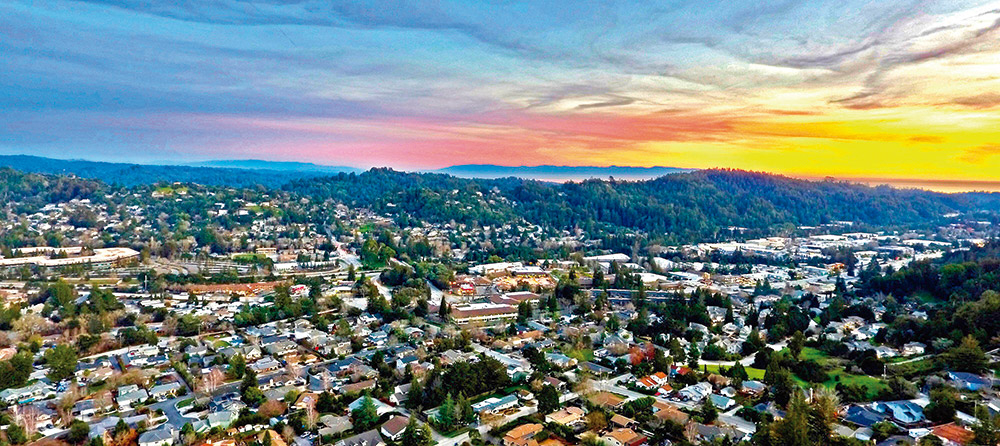
Scotts Valley, CA. Circa 2011.
There’s nothing here, he thought. Wait. No, that’s not true.
Netflix had started here.
Netflix chose Scotts Valley as its first headquarters in 1997. The company started as a DVD rental-by-mail service. Co-founders Reed Hastings and Marc Randolph set up their modest operation in an office park, perfect for a startup looking to disrupt the home entertainment market without burning through cash on a more expensive location. Scotts Valley provided the essential proximity to tech talent and investor networks in nearby San Jose and Palo Alto, but maintained the quiet, slightly removed ambiance that made it easier for smaller tech firms to grow.
At the time, Scotts Valley was already a place where smaller tech firms thrived, with tech operations dotting the town alongside recreational areas and residential neighborhoods. Surrounded by lush forests and winding mountain roads, the town felt removed from the high-stakes world of Silicon Valley, with a mix of small-town charm and rustic beauty that stood in contrast to the sleek offices and mirrored windows of Palo Alto or Cupertino. This tranquility made Scotts Valley appealing to founders who were after a laid-back but still strategically located environment.
Netflix operated out of Scotts Valley for more than a decade, gradually shifting from a rental business to a streaming giant. By 2007, the company had outgrown Scotts Valley and moved its headquarters to Los Gatos, closer to the main Silicon Valley circuit. The move left behind a sense of nostalgia in Scotts Valley—this small town that had unknowingly hosted the early days of a future global entertainment disruptor.
The town retained a handful of small tech companies, but it was mostly known for its residential pockets and its proximity to the mountains. Surrounded by redwoods and hiking trails, it had become a place people drifted to when they wanted to get out of the denser parts of Silicon Valley.
Jake’s impromptu reconnoiter of Scotts Valley in the moments after his glorious discharge from rehab had revealed several drinking options, all of which had seemed hopelessly obscured from view when Jake stepped out of the minivan.
Jake would add to his buzz on the heels of damnable rehab, before he caught a taxi over the Hill to Palo Alto to get his cool-ass vintage Porsche. Sure, sticking around and drinking in Scotts Valley might have seemed odd given Jake’s lack of enthusiasm for the place, but any drinker would recognize the logic of not wanting a just-started drinking experience to be put on pause for forty-five minutes in a taxi ride: buzz waning, restless, fidgety, are-we-there-yet type of feelings in the back of a cab. Wrong-o. This was all filed in the avoid-if-possible drawer, and so he was in Scotts Valley and this was why. After the next glass of Chardonnay—he loved the dry whites—he would hoof it over to the Peet’s and get a number to call a taxi.
Jake eventually left the Thai restaurant and now the baristas back at Peet’s Coffee seemed wonderfully pneumatic and transformed into smiling, cute little balls of customer service; soon enough a taxi pulled up outside and with waves and smiles and strange goodbyes—the sum total of their connection a medium dark roast and a huge duffel with a Fisher-Price backpack left on the sidewalk—he was finally, finally leaving rehab.
To the taxi driver: “Palo Alto.” “Sure.”
“What brings you to Scotts Valley?” the driver asked. He was a bigger guy, rotund, maybe fifty, with a leather vest and a graying goatee.
“Rehab.”
The driver laughed. “Right on.”
The taxi driver gave Jake a once-over, his gaze lingering on the duffel Jake slung into the backseat. “You traipsing across the country or something?” the driver joked, eyeing the bag. “Looks like you’ve got baggage for the long haul.” Funny, Jake thought. Baggage. More than he could carry, both in his hands and in his head.
Jake gave a quick laugh for an answer, then lapsed into silence, staring out the window as they drove, running his fingers through his hair occasionally and exhaling deeply. The driver seemed to take his silence as an invitation to drop the back-and-forth. “Okey doke,” he said, switching the station and leaving the volume low, falling silent too.
The town crept by, a little tech graveyard, Jake thought. The fresh summer air slipped through the cracked window of the taxi. The interior smelled of worn vinyl and faint cigarette smoke. Jake stared out at the quiet streets again. Take a good look, he thought, you’re about to return to the belly of the beast.
It was summer, 2011. The world felt on the brink of something—revolution or collapse—no one could tell. You could feel it even out here on the road, coming over the hill, back toward the action, the endless churn. In Egypt, crowds had risen to tear down a government, and in Silicon Valley, companies were rising just as fast. It was a new gilded age. Venture capitalists were sinking millions into any idea with a whiff of disruption, hungry for the next big thing. Social media was a way of life, connecting everyone and amplifying the change.
Twitter was a megaphone for movements; Facebook was the new water cooler; and Google+, newly launched, was supposed to overthrow them all. Every day, some app, some algorithm, or some widget was proclaimed the new holy grail.
Rehab collects people cast out from their lives, expelled temporarily from the glitter, the hopes and dreams and plans. Jake exhaled and sat back, grateful the driver wasn’t chatty. After thirty days of talk therapy, he could live with some silence. Scotts Valley, Palo Alto, Mountain View, San Francisco. He was here, in the eye of the story. Living in the dream.
———-
Erik J. Larson is the author of The Myth of Artificial Intelligence and the forthcoming Augmented Human Intelligence from MIT Press. His fiction includes Benderland, a Silicon Valley novel set in 2011, now being rewritten as Silicon Dreams. His essays and criticism have appeared in The Atlantic, Wired, the Los Angeles Review of Books and elsewhere. He writes Colligo on Substack.