Tony, Matt Johnson’s biopic about the late Anthony Bourdain, is a ghost story. Moviegoers watch the movie armed with the knowledge that the hero will ultimately take his own life. Unlike the writings of Sylvia Plath or Anne Sexton, the script isn’t doom-laden with portentous scenes that point towards Bourdain’s suicide in 2018. Tonally, Tony has much more in common with Eric Rohmer’s A Summer’s Tale (1996) than it does with Donnie Darko (2001). His death will take place decades after this coming-of-age film ends.
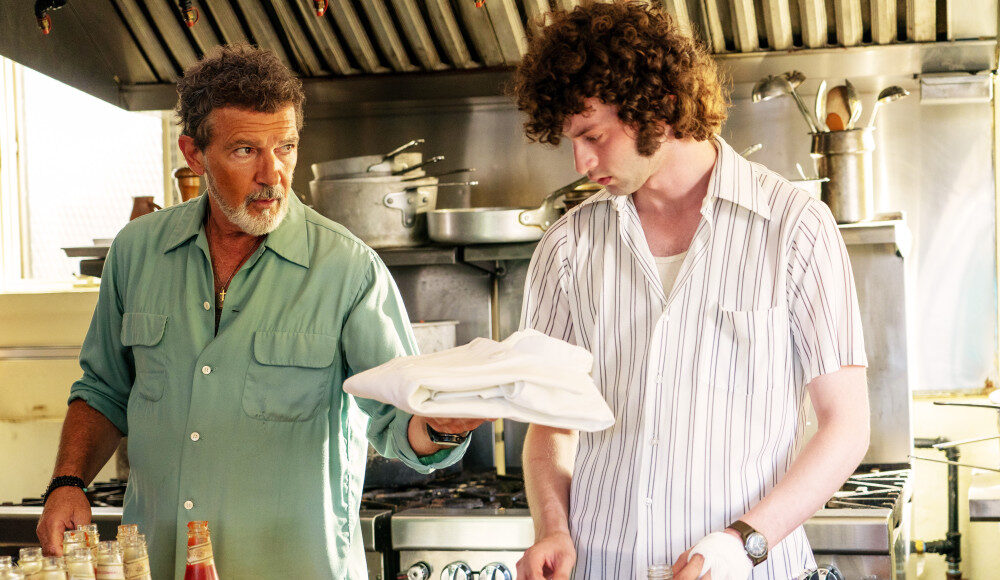
There is one reference to suicide but it’s made conversationally, almost in passing. Tony’s boss, who’s only referred to as “Chef” (Antonio Banderas), points to a painting that’s hanging in his restaurant. A sword is gutting a man dressed in his chef’s whites and a toque blanche. Framed as a two-shot scene, Chef tells Tony, wryly, that the man killed himself because the fish course was served late. Johnson then doesn’t zoom in for a close-up reaction from Tony. Nor does he linger after the chef’s brief anecdote ends.
In another movie, the pathos of the scene could have played out as an insufferable life lesson. Here the fictional construct gently alludes to Bourdain’s fate without delving into it. The director doesn’t need to dwell on the fact because the tragic arc of Bourdain’s life is built into the narrative from the get-go. The scenarios that take place in Tony sketch an outline of a troubled youth who’s still in formation. Roadrunner, a documentary from 2021, creates a fuller portrait of the man with interviews recorded by Bourdain’s acquaintances, friends and loved ones.
Viewers unaware of the backstory can simply watch the film as a snapshot of one rebellious adolescent’s summer by the seaside. A season spent pursuing the pleasures of wine, women and seafood, all accompanied by a 1970s playlist. One of those last hazy summers before a tall gangly boy has to contend with the complications of adulthood.
Because of Bourdain’s many appearances on TV, in series such as No Reservations and Parts Unknown, there’s a vast archive available of the chef’s onscreen persona. We’re familiar with the sound of his voice, the way he thinks, and even what moves him. Dominic Cessa (The Holdovers) hasn’t been cast or tasked to be a mimic. The rhythms of Cessa’s monologues are nothing like the ones uttered by Bourdain. The timbre of “Tony”’s voice is set at a higher pitch in Cessa’s natural register. He wears a hangdog expression throughout; it communicates the character’s confusion and lack of direction. I don’t recall him flashing a single smile. But he’s taller than everyone else in the film so his stature matches up with Bourdain’s 6’4” height.
The plot of Tony is set in motion when he follows Nancy (Emilia Jones), a former classmate he’s infatuated with, to Provincetown. The ups and downs of that romantic relationship gradually recede into the background after Chef hires Tony to wash dishes. Chef even lets Tony sleep at his place, albeit in the front porch hammock. At Chef’s restaurant, the cooks mercilessly haze and tease Tony until he learns the ropes. But that initiation is countered by Chef’s mentorship. He decides to teach him how to function in a working kitchen.
Banderas tempers the chef’s saintly innocence with the right amount of salt. He wakes Tony up every morning by pouring a full pot of cold seawater on his head. Bourdain wrote in his memoir Kitchen Confidential (2000), “I was—to be frank—a spoiled, miserable, narcissistic, self-destructive and thoughtless young lout, and badly in need of a good ass-kicking.” The kitchen culture depicted in Tony’s Provincetown represents this particular turning point.
While his employees indulge in each of the seven deadly sins, Chef offers Tony a pure form of charity, something the boy desperately needs. He’s a churchgoer who doesn’t proselytize to anyone. He’s aware of his wounds and imperfections. Disappointment shows up in the lines across his face. The man’s unrealized dreams appear in the corners of Banderas’ watery eyes and angry outbursts. In Tony, as in Pedro Almodóvar’s Pain and Glory (2019), the actor discards any traces of superficial gloss and artifice.
‘Tony’ is now playing in Bay Area theaters.