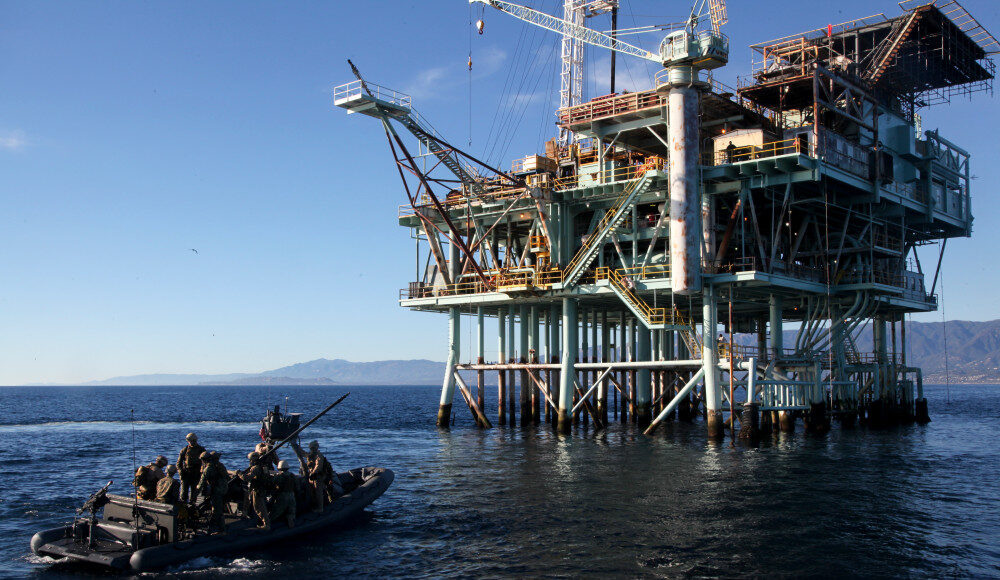
From rocket ships to oil rigs—how twisted does a tale have to be to connect the two? In this exploration, it will all come together, like a hospital gown.
SpaceX, proposed oil rigs and the Commerce Department’s review of California’s coastal-management program are all pieces in the fight over who controls the California coast. Washington and California fundamentally disagree about what the coast is for. One would think it would be for California.
The story picks up where Elon Musk decides to go to Mars. Musk poured money into SpaceX, and by 2024 Vandenberg Space Force Base in Santa Barbara County had launched 46 SpaceX Falcon 9 rockets. Musk aimed to push launches to 100 per year to speed deployment of the Starlink satellite internet constellation.
The California Coastal Commission (CCC) was alarmed by this and began reviewing the proposed increases. California voters created the California Coastal Commission in 1972 to give the state a strong voice in protecting its coast.
Alarmed, the commission began reviewing the proposed increase in space launches. SpaceX said it didn’t need the commission’s permission. A clash over who gets to greenlight a rocket turned into a struggle over who approves new oil rigs.
The commission’s objections cited increased sonic booms, wildlife disruptions and public coastal closures. After reviewing the proposed increase and repeatedly seeking information that SpaceX and the Air Force did not provide, the commission objected to the additional launches, E&E News reported.
Enter President Trump, no fan of California
“I hate the way California is being run,” Trump said in January 2026. “Maybe we’re just going to have to make them pay … because they don’t listen to us,” he said in October 2020.
Connected to Musk in the good-old-billionaire-boy network, Trump signed an executive order in August 2025 directing federal agencies to accelerate commercial space development. Two months later, the Air Force authorized the increase. But the order did something else. On May 20, 2026, the Commerce Department ordered a full formal review of California’s Coastal Management Program, the legal machinery that gives the state a voice when federal activities affect its coast.
Emma Haydocy, senior manager of coasts and climate initiative at the Surfrider Foundation, says attempts followed in Congress to restrict the commission and weaken provisions of the federal Coastal Zone Management Act, but those legislative efforts went nowhere.
The surfers’ paddle-out
On Aug. 4, the Surfrider Foundation gathered coastal activists online to explain why they believe the coast faces one of the most dangerous attacks yet on the California Coastal Commission. Surfrider acts as a bare-feet-on-the-beach watchdog for coastal protection. The group also warned that the federal government is moving toward possible new oil and gas leasing off California.
Surfrider believes the two developments belong in the same story. The federal government says it is conducting a program review; Surfrider says the administration is preparing to take a wrecking ball to California’s coastal protections. Somewhere between those portrayals lies a question for anybody gazing at Monterey Bay: Who gets to decide what happens to the California coast?
Can Washington take California’s voice away?
Surfrider believes that’s what the review is really about. Jennifer Savage, Surfrider’s California policy associate director, told the Aug. 4 webinar that the federal government could eventually attempt to defund or withdraw approval from California’s coastal-management program.
“This is an unprecedented action,” Savage said. It would not happen overnight, she said. There are procedures, hearings and opportunities for California to respond, and she expects any serious attempt to strip the program’s federal status to wind up in court. But Savage has no doubt about what she thinks is happening. “This is a rigged review,” she said, “and our coast is being singled out.”
Haydocy calls the review a weaponization of a federal law passed to allow cooperation between Washington and coastal states. Today California is the target, she says, but tomorrow it could be any state whose coastal rules run afoul of a presidential agenda. “It could be Florida,” Haydocy said. “It wasn’t this time, but it really could be any coastal state.”
The environmental battle has in that sense become a battle for states’ rights.
The never-ending story
Few people have spent more of their lives fighting for the California coast than Dan Haifley. He spent decades with Save Our Shores, served as its executive director from 1986 to 1993, helped lead the campaign for the Monterey Bay National Marine Sanctuary and led the landmark anti-offshore drilling campaign of the ’80s and ’90s. He continues to write about ocean policy and serves on the Monterey Bay National Marine Sanctuary Foundation board.
Does it ever end?
“No, it never ends and new things keep coming at us,” Haifley said. “They’re throwing in seabed mining, fracking, offshore oil, ocean space launches, floating nuclear stations, attacking our ability to review federal projects affecting the coast. All at the same time. All at once.”
Is this fight worse than the one in the ’80s, or just different?
“We are in a more perilous and risky time than we were four decades ago,” he said. “They’re using every legal mechanism to come after our coast and ocean in California.” He sees a pattern. “One is the Defense Authorization Act. The other is weakening the California Coastal Commission. Another is proposing looking at floating nuclear power stations. Another is looking at fracking, looking at seabed mining, weakening the rules around seabed mining.
“It’s just a whole suite of tools that they are using to get at the resources on our seafloor or to use the ocean for uses that may be damaging to it.”
Haifley says the administration is gambling with an economic resource as well as an environmental one. The Coastal Commission estimates California supports a $51 billion coast and ocean economy. But it’s hard to put a price tag on the coast itself. The numbers don’t count beaches free to the public, clean water, wildlife habitat, erosion protection, carbon sequestration, cultural value, property values tied to ocean views or the value of simply knowing Big Sur, Monterey Bay and Año Nuevo remain intact.
The tortoise and the hare
Haifley believes a half century of fortifying California coastal protections will save the coast.
“It’s kind of like the tortoise and the hare. The hare is the administration, throwing so many things at us, all at the same time. We’re the tortoise, so we methodically use what we have right in front of us, which is five national marine sanctuaries off California, 27 local onshore facilities laws, the courts and the law. And of course, public opinion. I think that we will prevail. It’s just exhausting.” The problem with being the tortoise is that the hare uses executive orders.
Haifley and Surfrider’s bigger worry is what happens if Washington systematically weakens California’s machinery to protect its coast. In the ’80s, Haifley traveled the coast helping communities adopt local laws restricting the onshore facilities offshore petroleum development would need. He calls those local ordinances a “blue wall.” Coastal activists are updating and reinforcing that tactic, he says, citing Measure D on the Nov. 3 Santa Cruz County ballot. Haifley argues that removing existing prohibitions against offshore oil development within California’s national marine sanctuaries would require congressional action.
Has Trump hacked the system to the point that the review’s outcome is already determined?
“No, he has not,” Haifley said. “The Monterey Bay National Marine Sanctuary staff are NOAA employees.” Employees of the National Oceanic and Atmospheric Administration tend to be scientists, educators and subject matter experts. “And they’re there, not for the money, but because they want to serve their country and they want to protect the environment and its resources. And in terms of this review, I’m confident that the career officials at NOAA will be very fair, as they have in past evaluations.” His concern begins when the evaluation rises above NOAA to a Trump appointee. “Once you get to secretary of Commerce, you get more of the political aspect,” Haifley said.
Why does bureaucratic process matter? A surfer carrying a protest sign makes a cool visual. A comment paragraph buried in the administrative record might someday help win a lawsuit.
Is this about political revenge? Haifley points instead to history. “California is really the only space on the West Coast where there are offshore oil platforms,” he said. “We have existing infrastructure. So, it’s inviting.”
California offshore oil production was born in 1896 at Summerland near Santa Barbara. However much Californians would like to escape that industrial legacy, the infrastructure remains, at least in the Santa Barbara area, and could make future development more plausible. And one more thing—the oil.
I love it when you talk crude to me
The Bureau of Ocean Energy Management has begun a process that could eventually lead to oil and gas lease sales off California. Surfrider’s Pete Stauffer said, “We’re pretty certain that most of the California coast, or at least significant chunks of California’s coast, will be included in this offshore drilling plan.”
Three geologists with knowledge of California petroleum geology got the same question: If you were running a major oil company and spending your own company’s money, would you explore for oil off the Central Coast?
Dwight Harbaugh said, “Definitely no.”
Vic Madrid, who spent a decade at Chevron before moving into environmental restoration, agreed. “No,” he said. “If I had an oil company, that’s not where I would invest my money.”
Rick Stanley, a retired research geologist and expert on Santa Cruz geology, concurred. “I don’t think I would,” Stanley said. “I think it’s too risky geologically.”
Three geologists, three ways of saying no. Not exactly a bidding war.
That doesn’t mean there isn’t petroleum under the ocean off Santa Cruz. “It is possible that there is oil … we can’t deny that,” Stanley says. During an offshore exploration program in the 1960s, Shell drilled wells off Santa Cruz and San Mateo counties into a sedimentary basin that Stanley says stretches roughly 80 miles northwest from near Santa Cruz toward the Farallon Islands. The sedimentary rocks are at least 10,000 feet thick in places, he said, and include the Monterey Formation, the oil-rich formation associated with much of California’s petroleum production. How would anyone find out?
“More wells.” Offshore exploratory wells are expensive ways of purchasing information. Madrid knows firsthand; during his Chevron years he worked on offshore rigs exploring the Monterey Formation near Point Arguello. He remembers exploratory wells in the 1980s costing $6 million to $10 million apiece. Those wells weren’t drilled to pump oil; they were drilled to find out whether oil worth pumping was there. Today an exploratory well would take Rockefeller money—though the oil industry has never lacked for that.
Oil wells wouldn’t come first anyway. The opening move would be seismic exploration—generating acoustic energy and measuring its return to map underground rock formations and identify structures capable of trapping petroleum.
“If you were gonna drill off Santa Cruz,” Harbaugh said, “you’d want to know if there’s favorable structures under the seabed.” That means the environmental battle can begin long before anybody drills a producing well. Harbaugh thinks offshore drilling is a bad trade for the California coast. “Extraction is temporary,” he argues. “A coastline supporting tourism, recreation and communities can keep producing value generation after generation.”
An oil rig behind Steamer Lane?
So can Donald Trump and his allies place an oil platform behind the world famous surfing spot Steamer Lane? Not tomorrow, not next year—and judging from the geologists, Haifley and Surfrider, probably not soon.
A federal lease sale is not an oil rig. A federal review of California’s coastal program is not decertification. And a Commerce review does not erase half a century of California coastal law. But the administration only has to weaken California’s ability to fight the next federal project. If California loses federal-consistency authority, Haifley doesn’t think Santa Cruzans will wake to an oil platform blocking the sunset.
It’s about leverage. “It would be a lot easier to site federal projects in the California coastal zone and in California federal and state waters than it would have been before,” he said.
The question is whether California will hold the same power tomorrow that it holds today when Washington proposes the next oil lease, the next seismic survey, a floating nuclear plant, a space launch, a seabed mining operation or something not yet proposed.
What can we do?
Peter Douglas, the legendary executive director of the California Coastal Commission, liked to say the coast is never saved. People who want to get involved can start at surfrider.org/action, which tracks current campaigns to protect California’s coast.
Santa Cruz County voters will consider the coastal protection initiative Measure D on Nov. 3. “It would require that any onshore facility, any zoning changes for onshore facilities, for seabed mining, or offshore oil and gas, be subject to a vote of the people,” Haifley said.
“We’re girding the blue wall.”
For half a century, Californians have fought to protect Earth’s most valuable shoreline. It drives a major share of the state’s income. Californians marry there, restore themselves there and hold it precious in spirit.
In 2026, Washington is not just asking what should happen on California’s coast. Washington is telling us to shut up about it.