
When the artist’s odyssey merges with the neighborhood’s odyssey, she is in the right place.
Originally from Jalandhar, India, artist Namita Paul examines the emotional imprint of architecture—the way built environments hold our stories and shape who we are. Rooted in the thresholds between home and displacement, between containment and unraveling, Paul’s artworks engage themes of longing and loss. Her new solo exhibit, Thresholds of Memory, occupies the Miro Gallery across from San Jose City Hall. The exhibition is organized by the Lucas Artists Program at Montalvo in conjunction with its 2026 Marcus Exhibition, The Art & Architecture of Maybe.
“Basically, memory to me now has two coordinates,” Paul says, as we walk around the gallery. “It has a geographical and a temporal location.”
One large-scale textile work hangs on the northern wall. W.M. 265 (2022) features indigo dyes and sequins on canvas and burlap. The work draws from personal and political histories, engaging with themes of home, rupture, repair, architectural space, memory and time, all triggered by artifacts and memories of Paul’s childhood home in Jalandhar, a building where her grandparents lived after being forcibly displaced by the Partition of India.
“So, here, memory is a muse,” Paul says, pointing to W.M. 265. “It’s a childhood memory. It’s something that’s been taken on. And something else was created with that childhood memory.”
As such, her older works acknowledge a past that has been lived and experienced, while the newer works articulate real-time encounters just before they become memories. With the newer pieces, Paul’s practice is not concerned with archiving the memories; rather, she allows memories to trigger the creative process.
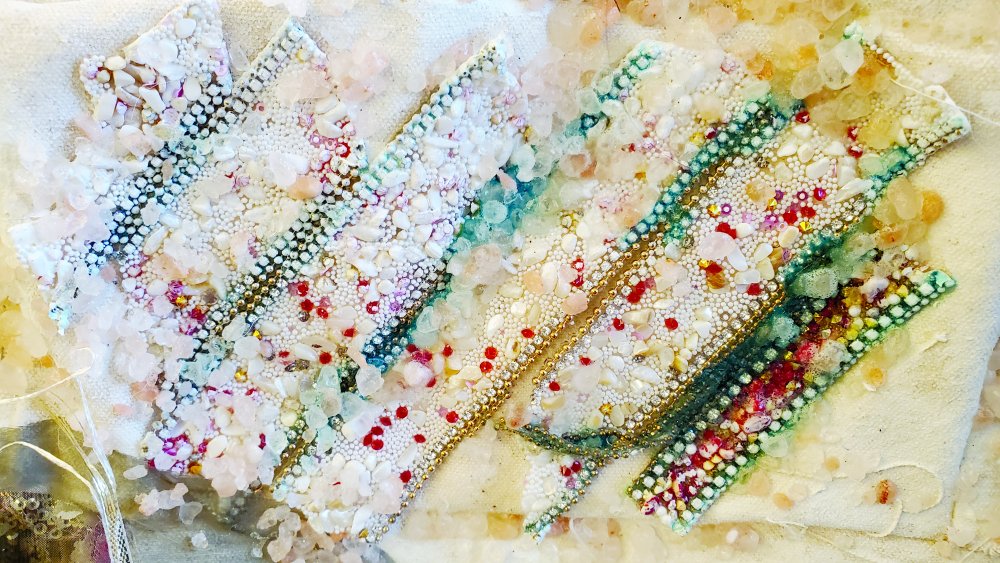
Devil’s Slide (2026) hangs on the Eastern wall of the gallery, likewise a canvas backdrop, but with gold leaf, aluminum leaf, various trims, Gota threads and Himalayan salt attached to it.
Inspired by the coastline of the same name near Pacifica, Devil’s Slide evokes rupture, shifting terrain and how relentless erosion can become both companion and witness. Here the displacement is more ecological than architectural.
“It’s about repetitive returns to this particular location and finding stability in this profoundly beautiful but constantly changing and inherently unstable location,” Paul says, as we move closer to the artwork. “So there’s that interesting dichotomy of, ‘Where do we find refuge?’ And the coast did that for me. So that was the idea.”
Gota threads often provide shine, shimmer and luminosity when decorating the edges of garments. Paul says she brought them into the work to help translate the concepts of edge and center. All while the salt crystals oxidize the gold trim in real time, if one looks closer.
“I wanted to catch the idea of changing landscape and unstable landscape,” she says, pointing to a section of the work that resembles a tide pool.
Tide pools are “in-between” places, Paul explains. First you see land, then they become submerged.
“There’s exposure and submersion,” she says. “And then there are little homes that are constantly changing and they’re constantly subject to tides. So that idea of transitional temporary places of being really caught my attention.”
As we continue to move around the gallery, every word Paul says eerily applies on a larger level to the building itself and the Miro Apartments in general, located right at Fifth and Santa Clara, where rupture, displacement, instability and loss have characterized the landscape for decades. I think of Pulitzer-winner Viet Thanh Nguyen’s parents, and their grocery store, that the city destroyed just to construct a parking lot, right where the Miro building now stands. I think of a dive bar, a car wash, a $3 breakfast joint and a Vietnamese tailor that were also erased from the picture.
But I already wrote several columns about all of that. That’s my threshold of memory, I guess.
Other works in the show include Red Threshold (2024), a deep vermilion work exploring the space between rupture and grief, and Daydream (2025), which considers the architecture of longing: the spaces we construct inwardly from fragments of places known or remembered. Again, perfect for Fifth and Santa Clara.
Thresholds of Memory is open to the public as part of First Fridays on Sept. 4 and Oct. 2, or by appointment: LA**********@**********ts.org.