
The simple act of voting affirms a tradition that has served Americans well for 250 years.True, the United States is not a pure democracy. If it were, Californians would not have 2 percent of the representation of each North Dakotan in the US Senate. Also, Puerto Rico and the District of Columbia would have voting congressional representation. And we would elect presidents based on popular vote rather than through an electoral college that’s biased towards whiter flyover states while disenfranchising the more diverse and educated coastal ones.
A clear example of that kind of undemocracy transpired in 2000, when popular vote-losing George W. Bush managed to stop Florida recounts that would have likely elected Al Gore, thanks to a 5-4 Supreme Court decision. Talk about making one vote count.
The attacks on voting rights have continued with ID law initiatives and restrictions on mail voting. We now see a massive increase in democratic-erosion events, from press restrictions and pardons of election disruptors and presidential family members to Department of Justice investigations of political opponents—which began under Biden and accelerated under Trump.
Fighting back against naked power grabs is an act of patriotism that begins with a cast ballot. Now more than before, it’s time to study the issues, the candidates and the ballot measures, then exercise our right to participate in guiding our future. Without that participation, we just give a green light to the rising tide of global authoritarianism.
This guide was prepared by Stephanie Uchida, Eric Parker and Dan Pulcrano
Statewide Offices
Governor
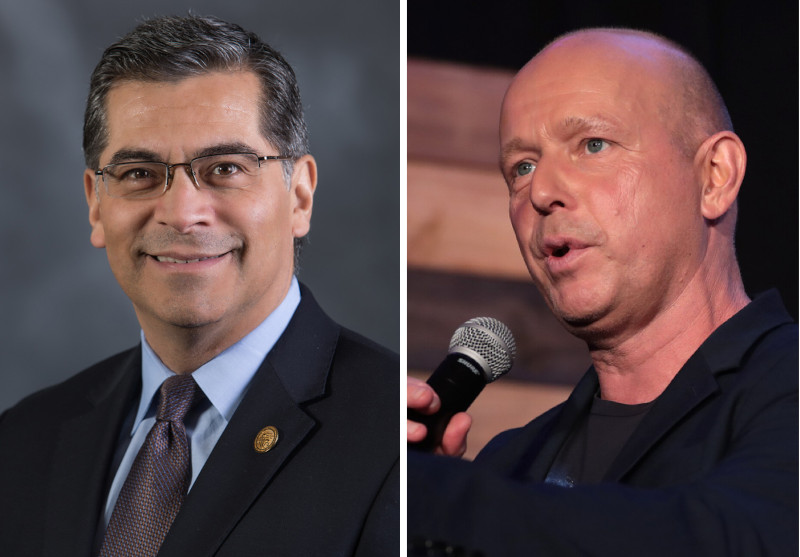
The national political divide is playing out in California, with Democrat Xavier Becerra trying his best to cast Republican Steve Hilton as a proxy for unpopular midterm president Donald Trump. UK-immigrant Hilton has created AI-generated ads cleverly portraying Becerra, the son of a Mexican immigrant and a U.S. born father, as a machine-selected candidate of Gavin Newsom and Kamala Harris. The attorney general took the Trump administration to court at least 120 times with some success. Hilton promises Californians $3 gas and to remove the $800 annual state tax on business entities, which disproportionately impacts small businesses and startups. The victor in this race will take office in early 2027 and lead the state’s executive branch.
Lieutenant Governor
In the race for lieutenant governor, Democrat Fiona Ma, the current state treasurer and a certified public accountant, faces Republican Gloria Romero, a former longtime Democratic state senator turned Republican, educator and charter school founder. Ma emphasizes affordability, opportunity and bipartisanship drawn from her small business and legislative record, while Romero is running on education reform, college accountability, fire recovery and an active role for the office.
Secretary of State
In the race for secretary of state, Democrat Shirley Weber, the incumbent and California’s first Black secretary of state, faces Republican Don Wagner, an Orange County supervisor, former Irvine mayor and ex-assemblymember. Weber emphasizes voting access, transparency in election filings and cybersecurity, drawn from her record overseeing the state’s elections and her years as a professor and four-term assemblymember, while Wagner is running on election integrity, voter ID, faster ballot counting and a more business-friendly, modernized office.
Controller
In the competition for state controller, Democrat Malia Cohen, the incumbent and California’s first African American controller, squares off against Republican Herb Morgan, a chief investment officer and investment firm founder. Cohen emphasizes transparency, efficiency and fairness in managing state finances, drawn from her record as a Board of Equalization chair, San Francisco supervisors president and seat on the CalPERS board, while Morgan is campaigning on exposing government fraud, a real-time blockchain ledger of state spending and proactive audits.
Treasurer
In the race for state treasurer, Democrat Eleni Kounalakis, the current lieutenant governor and California’s first woman elected to that office, faces Republican Jennifer Hawks, a retired Silicon Valley businessperson and first-time candidate. Kounalakis emphasizes affordable housing through public finance, investing in children and families and protecting pensions, drawn from her record as a housing developer, U.S. ambassador to Hungary and member of the UC Regents and CSU Trustees, while Hawks is running as an outsider on transparency, independent oversight and exposing waste, fraud and mismanagement.
Attorney General
In the race for attorney general, Democrat Rob Bonta, the incumbent and California’s first attorney general of Filipino descent, faces Republican Michael Gates, the Huntington Beach city attorney and a former Justice Department official. Bonta emphasizes housing access, civil rights and enforcing state laws, including more than 50 lawsuits against the Trump administration, drawn from his years as a San Francisco deputy city attorney and assembly member. Gates is running on implementing Prop 36, backing police, prosecuting fraud, enforcing Title IX and election laws, and protecting local control over land use.
Insurance Commissioner
Voters choose one. Two Democrats appear on the ballot: Jane Kim, an attorney and consumer advocate, and state Senator Ben Allen. The insurance commissioner regulates the state’s insurance industry and reviews insurance rate requests.
Superintendent of Public Instruction
Voters choose one. Sonja Shaw, a school district president, faces Richard Barrera, a state superintendent advisor. The superintendent leads the California Department of Education and oversees the state’s public K-12 schools.
State offices
Member, State Board of Equalization, District 2
Voters choose one. Democrat Sally J. Lieber, the incumbent, faces fellow Democrat John Pimentel, a member of the San Mateo County Community College District board of trustees. The board hears tax appeals and oversees certain tax programs.
Member, State Assembly, District 23
Voters choose one. Democrat Marc Berman, the current Assembly member, faces Republican David G. Johnson, a small business owner. The Assembly writes and votes on state laws and the state budget.
Judicial
Each judicial race asks voters a yes or no question on whether to keep or elect the named justice or judge.
Associate Justice, California Supreme Court: Joshua Groban
Voters decide whether to keep Associate Justice Joshua Groban on the California Supreme Court for the term provided by law. A yes vote keeps Groban on the court. A no vote removes Groban from office.
Associate Justice, California Supreme Court: Kelli M. Evans
Voters decide whether to keep Associate Justice Kelli M. Evans on the California Supreme Court for the term provided by law. A yes vote keeps Evans on the court. A no vote removes Evans from office.
Associate Justice, Court of Appeal, Sixth District: Charles E. Wilson II
Voters decide whether to keep Associate Justice Charles E. Wilson II on the Sixth District Court of Appeal, which covers Santa Clara County and surrounding counties. A yes vote keeps Wilson II on the court. A no vote removes Wilson II from office.
Associate Justice, Court of Appeal, Sixth District: Frederick S. Chung
The ballot describes Frederick S. Chung as a Superior Court judge and asks whether voters should elect him to a Sixth District Court of Appeal seat. Voters answer yes or no.
Associate Justice, Court of Appeal, Sixth District: Charles F. Adams
Voters decide whether to keep Associate Justice Charles F. Adams on the Sixth District Court of Appeal. A yes vote keeps Adams on the court. A no vote removes Adams from office.
Associate Justice, Court of Appeal, Sixth District: Allison Marston Danner
Voters decide whether to keep Associate Justice Allison Marston Danner on the Sixth District Court of Appeal. A yes vote keeps Danner on the court. A no vote removes Danner from office.
Associate Justice, Court of Appeal, Sixth District: Daniel H. Bromberg
Voters decide whether to keep Associate Justice Daniel H. Bromberg on the Sixth District Court of Appeal. A yes vote keeps Bromberg on the court. A no vote removes Bromberg from office.
California Ballot Measures
California Statewide Propositions
Prop 1: Bonds for Housing Affordability
This proposition authorizes $11.25 billion in general obligation bonds to fund affordable housing programs. It’s supported by Governor Newsom, the Democratic Party and labor. It has some token opposition from Republican legislators.
Prop 2: Increases State’s Rainy Day Fund
This would increase state budget reserves to protect education, healthcare and public safety during economic downturns.
Prop 3: Permanent Funding for Schools and Health Care by Extending Existing Tax on High Incomes
This proposition extends an existing tax on individuals earning more than an inflation-adjusted $371,000 to fund public education.
Prop 4: Repeals Prohibition Against Public Funding of Election Campaigns
Proposition 4 repeals California’s ban on public funding of candidate campaigns and would allow state and local governments to establish campaign funds. Proponents argue that it will reduce the influence of private money on elections. Opponents argue that it will cost taxpayers money to support candidates they don’t want.
Prop 5: Changes Recall Election Process for Statewide Officers
This measure would fill recall vacancies by special election at a later date or by appointment, instead during the election to recall the elected official. It would allow the recalled officeholder to run in the election to fill the seat they were removed from.
Prop 37: Creates Loan Program for Middle-Income Buyers of Qualified New Homes
Proposition 37 allows the state to borrow up to $25 billion to help prospective homebuyers buy new houses and condos. Bonds are repaid by mortgage payments, so as conceived, it wouldn’t cost the state anything.
Prop 38: Authorizes Bonds for Immunology Medical Research
By authorizing $8.4 billion in bonds for immunology research, Proposition 38 seeks to protect medical science from federal cuts to research programs. Critics argue it will increase state debt and that it disproportionately favors certain types of research and one nonprofit institute.
Prop 39: Prohibits Citizens From Voting Unless They Present Government-Issued ID
This Republican-backed bill would amend the state constitution to require government IDs to vote in person. It also Invalidates mail ballots without the last four digits of a government ID on the envelope.
Prop 40: Imposes One-Time Tax on Certain Taxpayers
The so-called billionaire’s tax imposes a one time 5% hit on taxpayers with assets over $1 billion. The money bypasses school funding requirements and the state spending limit. It would put tens of billions of dollars into health services over several years. Supported by Sen. Bernie Sanders and healthcare workers, opponents argue it will accelerate the flight of wealthy residents to more tax-friendly jurisdictions.
Proposition 41: Special-tax audits and spending-limit rules
Prop 41 requires the state auditor to review special tax proposals before they go to voters, making it harder to pass special taxes. Critics say it’s a billionaire-funded effort to undo the Billionaire Tax (Prop 40). New special taxes would count toward the state’s spending limit, potentially triggering automatic refunds and reducing funding for other state programs.
Proposition 42: Personal property and retroactive tax ban
Prop 42 makes it harder to create a wealth tax, prohibiting new taxes on the mere ownership of assets such as investment accounts, business interests and personal property. Prop 41 is considered an attempt to block Prop 40.
Proposition 43 — Local tax limitation
Prop 43 increases the passage requirement for local citizen-driven special tax ballot initiatives from a majority to two-thirds. Supporters say it keeps special interest groups from leveraging the simple majority system; opponents say it makes it harder to fund local services.
Proposition 44 — Community clinic spending requirement
Prop 44 requires community clinics that serve low income patients to spend 90% of annual revenue on patient care. Supporters believe it will prevent clinics overspending on executive pay. Opponents think it’s unnecessary because clinics are already regulated, and that compliance costs could force some clinics to close.
Proposition 45 — Environmental review changes
Sponsored by the California Chamber of Commerce, Prop 45 puts a 365-day limit on environmental reviews for projects designated as “essential,” such as roads and bridges. It also requires courts to rule within 270 days on environmental review lawsuits. It’s opposed by Sierra Club California.
Local Ballot Measures
City Governance and Operation Changes
Measure A, Morgan Hill
Changes the City Treasurer position to an appointed one rather than an elected one.
Measure C, Santa Clara
Amends public works contracting on the city charter to by setting the threshold for council approval and formal bidding at $250,000 and allowing for competitive best value contracting.
Measure E, Mountain View
Increases city’s hotel tax from 10% to 15% to fund city services.
Measure G, Sunnyvale
Authorizes city council to make changes in how public works projects are awarded, by changing city charter.
Measure H, Sunnyvale
Authorizes city council to set the the maximum claim amount against the city that the city manager can settle.
Measure I, Sunnyvale
Requires appointed city council members filling vacancies to serve until a replacement is elected at the next general municipal election, rather than an earlier election date.
Land Use
Measure D, Los Altos
Prohibits city from selling or leasing downtown parking plaza land for any reason, and from authorizing alterations without voter majority approval.
Measure L, Cupertino
Changes city charter to require two-thirds majority to make changes to the city’s general plan regarding rezoning parks and open space for development.
City Tax Measures
B, Gilroy
Increases city’s hotel tax from 9% to 13%.
F, Mountain View
Increases city’s hotel tax from 10% to 15% to fund city services.
K, Milpitas
Changes city’s business tax to $25-$40 depending on gross receipts, plus levies an additional tax of 0.025%-0.035% for businesses with gross receipts exceeding $700,000.
J, Palo Alto
Levies .05% sales tax to fund city services.
School District Property Tax Measures
M, Gilroy Unified School District
Issues $295 Million in bonds to improve school facilities and levies a tax rate of $59 per $100,000 of assessed value to repay bonds.
N, Los Gatos-Saratoga Union High School District
Issues $321 in bonds for building and technology upgrades and requires a property tax rate of $30 per $100,000 of assessed value to repay bonds.
O, Alum Rock Union Elementary School District
Levies parcel tax rate of $310 per parcel for seven years.
P, Alum Rock Union Elementary School District
Issues $100 Million in bonds for school facility improvements and levies a tax rate of $26 per $100,000 of assessed value to repay bonds.
Q, Cambrian School District
Levies parcel tax rate of $148 per parcel for eight years.
R, Orchard School District
Levies parcel tax rate of $89 per parcel for eight years to fund school programming.
Regional Measure
RTM, Bay Area
Issues a sales tax for 14 years to fund public transportation in Alameda, Contra Costa, San Francisco, San Mateo and Santa Clara counties. Tax rates would be 1.0% in San Francisco and 0.5% in other counties.