
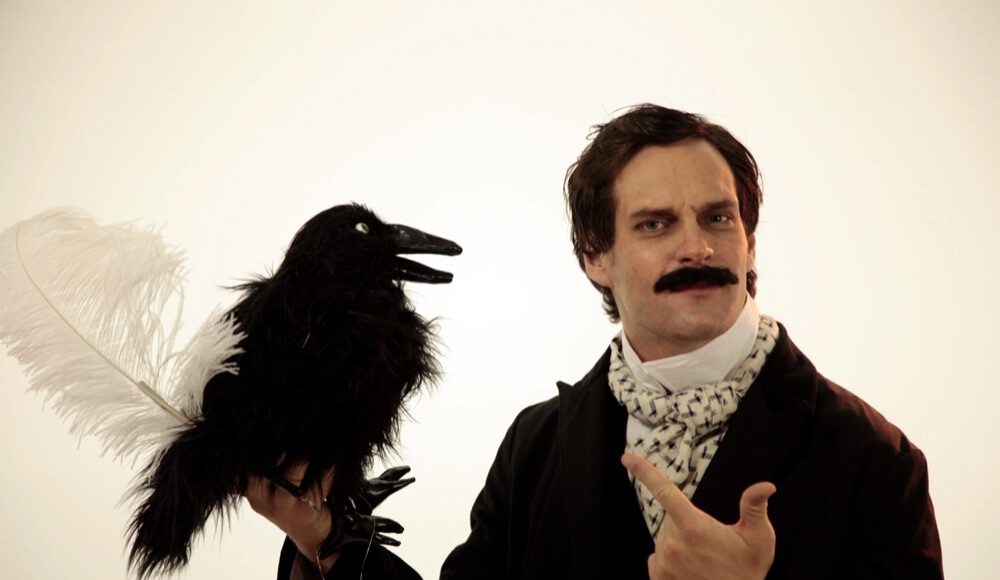
This coming week, students from Indigo Middle School in San Jose will take the stage at The Knoll in Stanford—an intimate, historic room with a dome of speakers inside a Spanish Gothic house on campus—to premiere original written pieces drawn from Edgar Allan Poe’s dark supernatural poem, The Raven. This free public showcase, called Nevermore, Rewritten, marks the end of a week-long residency led by Stanford alumnus and nerdcore rapper MC Lars, whose real name is Andrew Nielsen.
Nielsen has been in the classroom this last week with Indigo’s students, sharing time, space and accumulated experiences as a scholar and artist. “I’m really looking forward to hearing what they do with it,” he says. “When I do these workshops, a lot of kids walk in treating The Raven like old spooky homework, something to get through, but when you put a beat under the meter you can literally see their eyes light up.”
He connects moments like these to his own adolescence. He was 16 when he was assigned to “make fun of Shakespeare’s Macbeth” as a classroom prompt. For Nielsen, this was his moment of clarity.
“That part of Shakespeare’s Scottish play is already in trochaic tetrameter; it just needed a 4/4 kick pattern,” he says, adding: “Poe was writing for meter the same way a rapper writes for a beat; He just didn’t have a drum machine. Watching a 12-year-old figure that out in real time is amazing.”
Nielsen’s method didn’t emerge from nowhere. His graduate project was entitled “Using Rap to Teach Poetry,” a way of quantifying student learning to important literature. He explains and connects the upcoming event thusly: “Poe made nine dollars for The Raven in his lifetime. These kids get a night on one of the best sound systems on the West Coast, with a Stanford professor in the crowd taking their verses as seriously as his own research. That’s the whole point.”
After the students perform, Nielsen will play bonus songs from The Edgar Allan Poe LP, a project he released a year ago, which will celebrate its anniversary with an expanded edition. Afterwards, he’ll join a conversation with Stanford English Department chair Gavin Jones and senior lecturer Judith Richardson. The trio’s panel discussion will examine Poe’s enduring presence in popular culture.
Here, Metro quickly picks Lars’ brain about the process ahead of this special event.
The students will premiere their written pieces in a historical space with teachers, parents, and artists in the room. Why does that matter for them—and for you?
The Knoll has a history worth knowing. Built in 1915 as the university president’s residence, it became home to the Music Department in 1946 and CCRMA in 1986—the same lab that grew out of the FM synthesis work Yamaha later put in a generation of synthesizers. A 1989 earthquake condemned the top floor for nearly 15 years; owls nested in the copier room. The 2005 renovation turned it into what it is now: about a hundred seats under a full dome of speakers, built specifically for new work. It’s not a big room. It’s a serious one.
That’s the stage the English Department is putting these kids on. For most of them, it’s the first time their own words come back through a real PA, in a real room, in front of people who showed up just to hear them.
The event will also feature another Stanford professor and prolific composer, Mark Applebaum. Tell us about the inclusion of Applebaum’s Sock Monkey and how it connects to the evening.
Yes, it will also include Applebaum’s Sock Monkey, which he made by transcribing his toddler bouncing off the walls with a stuffed animal into a full orchestral score. These students are doing a smaller, braver version of the same thing: standing in the room built for new music and hearing their own sentences come back at them.
After the performances, you’ll play the bonus tracks from your album which came out a year ago. Tell us about The Edgar Allan Poe LP and this expanded edition.
It’s been 25 years in the making. My mom bought me a Poe collection as a kid and kept it in a drawer because she didn’t think I was old enough. I found it anyway, and she let me keep rediscovering it until my 12th birthday, when I finally got to open it for real. In high school, I set [Poe’s other poem] “Annabel Lee” to music and burned a girl a CD of it. It was either the most romantic or most unhinged thing a 16-year-old has ever done. So this record isn’t a new interest; it’s a very old one finally getting the budget it deserves. It’s still pop-punk rap at the core; hooks first, jokes allowed. Poe doesn’t really do happy endings, so neither does this one.
What do you hope the panel discussion makes clear about literature and the music kids are actually listening to? Tell us about the others involved.
I hope it shows how thin the wall really is. Gavin Jones is on the panel with me, which still feels funny to say out loud. Not that long ago, I was just a guy with a laptop trying to get a word in. Horror [as a genre] was considered “low” literature in Poe’s own lifetime, the same way rap got dismissed as a fad for its first 20 years. Both ended up defining American culture more than a lot of the stuff that was taken seriously at the time.
One of my first real songs was “Mr. Raven.” It came out of watching The Simpsons’ Treehouse of Horror do The Raven when I was a kid. James Earl Jones narrating Bart reciting Poe line for line. That’s how most of my generation met the poem before we ever opened a book, and that counts. Nobody tells kids that a Simpsons bit and a 19th century poem are doing the same work. A kid who can break down a verse already has the tools to break down The Raven. Somebody just has to point at both at once.
Beyond the performances and the album preview, what do you want people to walk away with? Why do nights like this still matter?
I want them to leave thinking literature isn’t something that happened to other people a long time ago. It’s a technology kids are still allowed to pick up and use. These nights matter because they’re proof, not theory. Proof that a 180-year-old poem about grief can still get a room full of middle schoolers and their families going on a Friday night. In a world that’s constantly telling kids what they should be consuming, there’s something useful about showing them what they can make instead.
** This lit-hop performance and education event with Indigo Middle School students and Stanford faculty takes place at Stanford at the CCRMA Stage on Oct. 16 at 6pm.