Anyone that ever swapped out an ethernet card or tried to troubleshoot local area networks has Kanwal Rekhi to thank.
Back in the ’80s, Rekhi cofounded a company, Excelan, to commercialize Ethernet and TCP/IP, a suite of Defense Department protocols that eventually became the foundation of the Internet. When Excelan later went public, Rekhi became the first Indian-American founder and CEO to take a venture-backed company public on the NASDAQ stock exchange, paving the way for countless other South Asian CEOs.
Kanwal’s son Ben made a tremendous documentary about Kanwal’s life, Breaking the Code, a film that screened at CAAM Fest last spring. Kanwal himself also recently published a book earlier this year: The Groundbreaker: Entrepreneurship, the American Dream, and the Rise of Modern India. The book is a fabulous read.
The Groundbreaker spills the whole lurid story of how Rekhi came to Silicon Valley, the obstacles he faced when rising up the corporate ladder, the battles, the bigotry, the backstabbing and the business lessons he learned in the process.
“The secret history of TCP/IP” wouldn’t exactly be the sexiest marketing tagline on earth, but the early stages of Excelan were just that. Obviously, it helps if you’re old enough to remember the basics of how networked office PCs evolved. But even if you aren’t, the fact that an immigrant from India, born a few years before Partition, came to Silicon Valley and foresaw the way local area networks (LANs) would become ubiquitous, is rocking history.
For example, in a chapter titled “Navigating Successes and Setbacks,” we learn the backstory behind the rise of AppleTalk and Novell NetWare. Again, this is not commercial History Channel intrigue with ominous foreboding soundtracks, but it’s extremely important.
Crudely simplified, in the early ’80s, IBM PCs, priced around $2,000, were taking off in the corporate world, but the machines couldn’t yet speak to each other in all the ways we take for granted nowadays. Excelan started manufacturing ethernet boards to connect PCs to other PCs and also to UNIX machines, which were then about $10,000.
Eventually the Macintosh II began to infiltrate the corporate world, using AppleTalk over Ethernet, a total game-changer, with networking hardware built by a startup called Kinetics. Rekhi saw an opening. He bought Kinetics for $6 million, but left their team in place, giving them the resources to scale up their own inventory, marketing and tech support, while filling in a needed gap in Excelan’s operation.
Around the same time, Novell had its own flagship product, NetWare, designed to connect PCs around the office, but in a way that monopolized the network, preventing any other protocols like TCP/IP or AppleTalk, from running at the same time.
“It was like having a thousand-channel cable box but only one channel ever worked,” Rekhi writes. “We stepped in and showed them how to coexist with other protocols on ethernet—a crucial breakthrough.”
Rekhi and Excelan also helped out Microsoft with Windows 3.0, solving key networking problems. Together, they solved issues like preserving the “state of network connection” when switching between windows.
“Before that, Windows was basically a single-window, one-trick pony,” Rekhi writes.
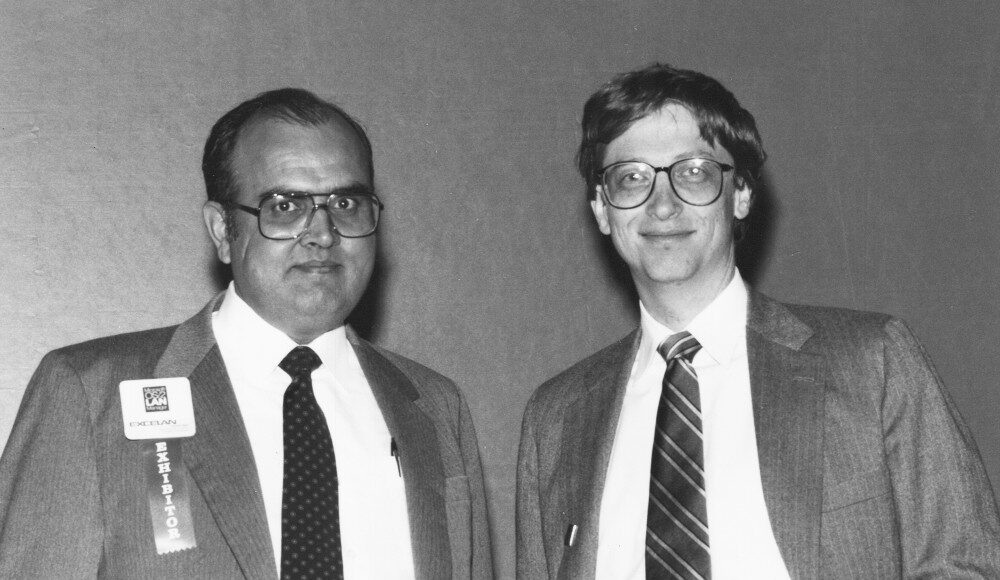
Bill Gates even stood with Rekhi at a conference and announced their new partnership, one that Rekhi thought would last a long time. It didn’t. A few months later, Gates backstabbed him by announcing a deal with 3Com for a new LAN Manager.
This is similar to what Gates had previously done with IBM. He partnered with them on a LAN manager for OS/2, appropriated everything he learned, and then released a competing product, Windows 2.0, shortly thereafter.
The same situation was now happening to Excelan. Rekhi felt betrayed.
“I decided then and there never to partner with Microsoft again,” he writes.
It all worked out for the better when Excelan eventually merged with Novell in a landmark, multimillion-dollar deal in 1989. The first problem? The Novell offices in Provo, Utah, didn’t have coffee because Mormons weren’t allowed to drink it.
Rekhi also later cofounded TiE, The Indus Entrepreneurs, now a worldwide movement dedicated to networking and entrepreneurship. These days, executives of Indian heritage lead Google, IBM, Adobe, Microsoft and YouTube. They all have Kanwal Rekhi to thank.