
As the news from Cornell becomes rough to ingest, it can be a form of self-care to elevate the stories of amazing women right here in Silicon Valley.
In a span of just a few hours, this columnist experienced a retrospective of women artists at the de Saisset Museum, then attended a celebration of South Asian women tech-company leaders at Kepler’s Bookstore, and even learned of a new exhibit about the pro skateboarder Judi Oyama.
All borders between past and present dissolved. All polar opposites were harmonized. Only in Silicon Valley could all of this occur, exactly as it did, on this night.
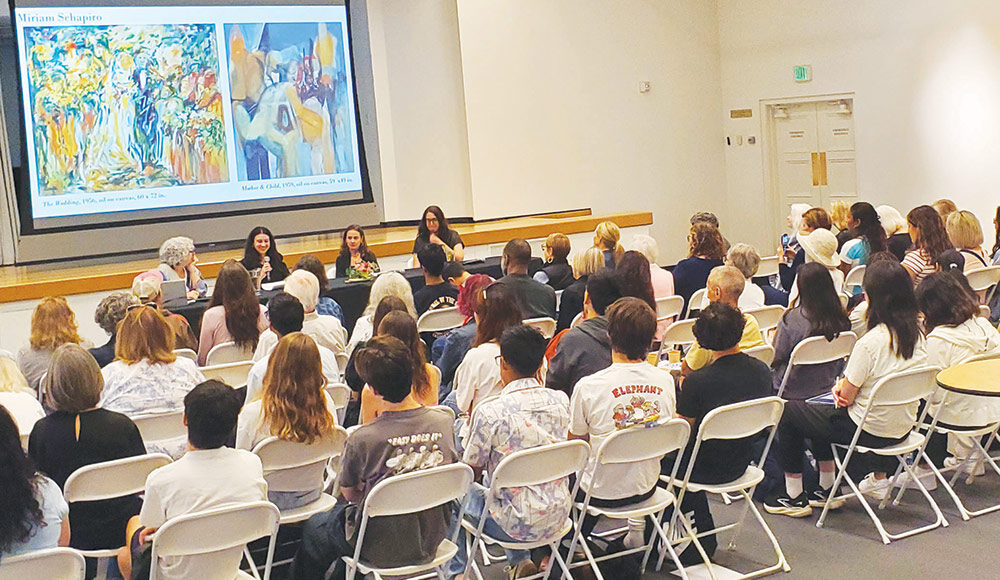
Last week, the de Saisset Museum at SCU opened a new show, The Four (Revisited): Judy Chicago, Lynda Benglis, Miriam Schapiro, Bonnie Sherk (1973/2026). Archival and historical in nature, the show was a recreation of a previous exhibit that happened at the same museum in the ’70s, when a fierce foursome of women artists pioneered feminist perspectives at a time when arts academia, and the practice in general, was very male-dominated.
In particular, Miriam Schapiro collaborated with Jef Raskin on computer art projects in the late ’60s, long before Jef became known at Apple. The de Saisset Museum’s director at that time, Lydia Modi-Vitale, was a visionary that curated several early video and experimental works.
A capacity crowd of mostly students filled the reception space last week for a panel session discussing the work of the original four artists. It was uplifting to see students—future artists, curators and historians—that cared about the arts and humanities in a time when so many tech bros take joy in ruining all of it.
After experiencing de Saisset’s groovy historical adventure, the columnist headed to Kepler’s Bookstore in Menlo Park, where several women executives of South Asian heritage gathered to celebrate the release of a new book, Lotus Leadership by Kamini Ramani.
A decades-long technology marketing leader in Silicon Valley, Ramani spent a few years interviewing more than 30 other South Asian women executives about how their heritage played a role in their success, against all odds, in a male-dominated industry. Lotus Leadership is the result of those interviews, a treatise and a guidebook of ancient wisdom applied to a new business leadership demographic—South Asian women who refused to follow the same playbook of (white or Indian) men in order to succeed in life and business, especially when both become inseparable.
Ramani calls Lotus Leadership a “yoga for business” practice. Many of the women she interviewed rejected the binary “either-or” thinking often foisted upon them in business, the nonsense that women must be either ambitious or compassionate, either an aggressive negotiator or a passive humble type. One chapter is even titled “Cutesy and Concrete.”
The answer? Use yoga as a metaphor.
“Those who have studied yoga (that thing invented in India five thousand years ago, but which only went mainstream when it was coupled with $100 pants and $20 juice cleanses in studios from Brooklyn to Brentwood) will be familiar with the dualities at its core,” Ramani writes. “In yoga you balance strength and surrender; effort and ease; exertion and relaxation to find enlightenment.”
The lotus, India’s national flower, “beautiful, strong and [with] a will to flourish,” is similarly embedded with dualities that don’t need to be fixed or cleaned up. Hence, a great namesake for a new leadership playbook.
“It’s certainly not the bro playbook of male leaders, who are either self-described product geniuses, brash salespeople, or once-in-a-generation hoodie-wearing wunderkinds,” Ramani writes.
Also, many of the South Asian women executives Ramani interviewed didn’t even realize their leadership styles and decisions resembled religious narratives from the Gita, the Koran, or the Sikh teachings, even if the women weren’t inherently religious themselves. Yowza.
As if that wasn’t enough, before the night was even through, I learned about an amazing new show at the Japanese American Museum of San Jose that opens October 31st: Judi Oyama: To Be Seen / Not Heard. Originally from Santa Cruz, Judi was a pioneering pro skateboarder, starting in the ’70s, when there wasn’t even a category for women skaters yet. Now in her sixties, Judi gets a chance to star in her own exhibit and tell the whole story.
In the end, self-care was achieved.