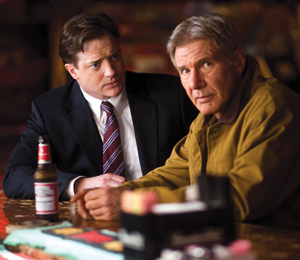
TWO OF the children of an Oregon businessman are doomed to die of a hereditary syndrome called Pompe’s Disease. Fearlessly, the father quits his job and starts a new career financing the development of an experimental drug to keep his kids alive. At this point, at least, Extraordinary Measures is a true story. Despite the title, this fairly ordinary film heads into what seems like fictionalization early on. The search for an experimental drug means recruiting an unappreciated researcher on the subject: crusty Cornhusker Dr. Robert Stonehill (Harrison Ford), the T-shirt-and-Levis-wearing, pickup-truck-driving kind of physician they customarily build medical shows around.
Then comes the conflict: Stonehill, as per his indomitable name, goes up against the internally bleeding family man, John Crowley (Brendan Fraser), who knows how to wear a suit and beat the bushes for money. At various times, both men are fighting with one of the executives in a firm that buys their startup: Jared Harris, with an uncertain American accent. Harris has to lead one of those embarrassing I-don’t-like-you-and-you-don’t-like-me scenes that litter TV. The way the line actually goes is “I may be a tight-ass company man, but I resent being called heartless.” The line is a core sample of the work of writer Robert Nelson Jacobs, amping up the conflict.
The really talented cinematographer deserves praise. Andrew Dunn (Hitch, Precious) deals well with the overcast, uncooperative light of Portland and the Pacific Northwest. Dunn turns down the greens in the flesh tones even in a tricky shoot at the seaside: there are reasons why they never made Beach Party movies in Oregon. Dunn also provides one startling image, a bright, bug-light-yellow corridor outside a laboratory, adding to the feeling of unease we already have hanging around these biotech offices. Considering the TV-like stylings of director Tom Vaughan (What Happens in Vegas), I’m going to guess that it was Dunn who had the intelligent idea for the mouse-eye view of Fraser across the room, weeping alone in an empty office.
Ford’s performance is funny at first and then becomes a one-note sonata. He bellows, “Get the hell out of my lab,” more than once. Ford is headed for curmudgeonness; if he shaves his head, he’ll be able to play Dick Cheney. Fraser is, like Ford, a good actor caught in the mangle of franchise-making machinery. One never loses faith in Fraser, but he needs to look for tougher material to go with his new fleshiness: a sharp bastard, a crooked sheriff. The real romance is between the two men. In the background are the ladies: Meredith Droeger relentlessly working some wheelchair-bound precociousness, and Keri Russell as the mom, subdued halfway to death. Extraordinary Measures isn’t about medicine or sick kids. Rather, it’s about something far more intriguing to an audience: capital. Too bad the film is so often just telethon-grade hooey. As a drama, Extraordinary Measures is bad feel-good, but it may be more interesting in 30 years as a relic of the age of healing for profit—to see the waste, the expense and the self-justifications.
Local theaters, show times and tickets at MovieTimes.com.
EXTRAORDINARY MEASURES (PG; 105 min.), directed by Tom Vaughan, written by Robert Nelson Jacobs, based on the book by Geeta Arnand, photographed by Andrew Dunn and starring Harrison Ford and Brendan Fraser, plays valleywide.