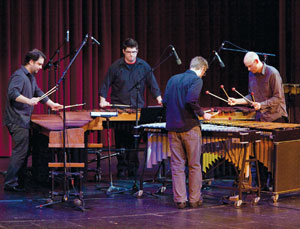
SIX MEN stood at the front of the stage at Stanford’s Dinkelspiel Auditorium on Saturday night facing each other, clapping out a tune. Five were members of So Percussion, a celebrated and famously eccentric New Music ensemble. The sixth was Steve Reich, the 73-year-old winner of the 2009 Pulitzer Prize for Music, widely regarded as the most important living American composer.
Clapping Music, from 1972, is a classic Reich piece: a perfect demonstration of the minimalist concept—and its weird power. First the men stated a simple idea—a rapid-fire staccato rhythm: 1-2-3, 1-2, 1, 1-2—clapped in unison. Over the course of four minutes, the rhythm divided and became more complex, morphing into something multidimensional. Six men clapping, creating a complex, richly textured song. The effect was stunning.
Toward its conclusion, the musicians returned to the simple theme. Here’s the weird part: When that happened, I felt a flood of good feeling. Judging from the explosive ovation that followed I was not alone.
So Percussion followed that with Nagoya Marimbas, from 1994. By the time Reich wrote this piece, he had been composing for the marimba for a decade and had discovered ways to make the instrument do some fascinating things. A perfect vehicle to exploit his love of complex rhythmic patterns, it also allowed him to explore new melodies and challenging harmonies. In the hands of So Percussion, the piece was playful, then briefly melancholic and, finally, ecstatic.
The collaboration between Reich and So Percussion has been a good fit since they began working together in 1999. Although the composer has written for a variety of instruments—including string quartet, 18-voice chorale and looped tapes of random conversations—he has a special love for percussion. He studied drumming at the University of Ghana in the early 1970s and went on to study Balinese gamelan, which may be why the evening’s next piece, Four Organs, could serve as proof of the organ’s status as a percussion instrument.
So Percussion staged the piece simply. Its four main members—Josh Quillen, Adam Sliwinski, Jason Treuting and Eric Beach—sat around a table onstage, each in front of a small portable keyboard, while sometime collaborator Jim Munzenrider stood at the head of the table with a pair of maracas.
Again, the piece began with a simple statement: Munzenrider rapping out a plain, midtempo rhythm. This time, that meter would repeat, relentlessly, for 20 minutes. Meanwhile, one by one, the organists joined the song, playing chords in a similarly simple tempo, over and over, relentlessly. Layering note upon note, the ensemble built dense chords, then took them apart, note by note. The phrase intervals grew longer and longer. The chords built in density—at times, the audience was probably being bathed in 40 separate notes and their overtones—and the volume grew. The piece developed slowly, with punishing repetitiveness, as a series of small, 30-second-long crescendos built toward an almost violent ultimate crescendo. It was a trip to the other side of monotony.
Minimalism is often described as trance music, but experiencing Four Organs, I found myself entering something other than a trance. Remaining alert to the subtle changes, no doubt hypnotized by the droning repetition, I found myself in a sharpened, heightened state of awareness. Maybe it was the wash of organ recalling the Catholic church of my youth, but the effect felt almost religious—darkly so. When it ended I was close to tears. When Reich won a Grammy in 1990 for his composition Different Trains, The New York Times said that the piece “possesses an absolutely harrowing emotional impact.” I was reminded in Palo Alto how deeply music can touch us.
So Percussion followed this tour de force with another: the world premiere of a new work, Reich’s Mallet Quartet. With this piece, the composer seems to be reaching new technical heights and emotional depths. As the ensemble transitioned from the joyful, galloping opening into a quiet, elegiac second section, the players seemed to be moving in slow-motion, their mallets drifting through the air in a graceful ballet. The effect was sublime. And the evening wasn’t half over.