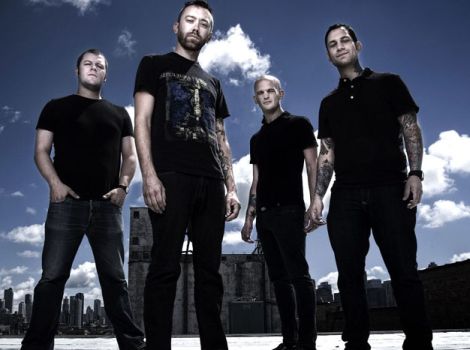
TIM MCILRATH: That’s a good question, and it’s one that we always sort of struggle with, but we’re also excited to tackle at the same time. With this band, we started out playing small punk shows, where a lot of times we were sort of preaching to the converted, I guess you could say. Going to a small punk show, if a band like Rise Against says they’re against the war, it’s like “Wow, big fucking surprise. Tell us something we don’t know, dude.” But at the same time, that was sort of a good rally, a way to find people who are like-minded, and let you know you’re not totally alone out there in the way you feel. At some point, the band got bigger, and we were playing in front of audiences who weren’t used to their chosen entertainment challenging their pre-conceptions and provoking some sort of reaction. Like, “Wait, I came here to have a good time and have a beer, and now this guy’s talking about something beyond that right now.” It’s very challenging, the way people view entertainment. We’re playing for the Everyman now, we’re playing for the casual music fan. We’re at these massive festivals sometimes, where we’re just one of these bands in a giant slew of bands.
Is that a good thing or a bad thing?
At some point I realized, “wow, this is the place to be, man. This is the place where we can really put water where the fire is. This is a place where saying something like ‘Fuck the war in Iraq’ is actually provoking a reaction.” You can see the friction. People’s eyes light up, and they either get pissed off or they’re like ‘”yes, thank you for saying that!” That sort of renewed my lease on this band, in a way. It’s shown me that this band can be an amazing vehicle for that type of change and awareness. We have a whole new audience now, and there is an endless array of options all of a sudden that we can tinker with and find out how our fans will respond to this and this, and really bring some things to light that some of these music fans aren’t necessarily used to.
What led you to that realization?
It was my way of coming to grips with our success, and trying to maintain a mission and vision for it. As opposed to just sitting back and trying to play big shows and rake in ticket money and sell records or whatever. I have to be hungry, I have to go out there with some sort of goal in mind. I didn’t get into music because I had some kind of Guns N Roses/U2 fantasy of being this rock star, guitar-god kind of person. That wasn’t the kind of music that attracted me, I didn’t have an affinity for that excessive rock and roll lifestyle. I got into music through a hardcore scene in Chicago that showed me that music could be a vehicle for so much more. That was what really triggered my interest in doing it. I didn’t grow up playing guitar, I didn’t grow up in a musical family, I didn’t grow up an artiste. But I went to these shows where I learned so much about the world around me. My secondary education in a way was happening in the VFW halls around Chicago, and seeing it all set against this backdrop of great, heavy aggressive music, that to me was the best thing in the world.
What do you say to fans who don’t like how they think Rise Against’s music has changed over the years?
I’ve never really taken offense if a fan walks up to me and says “Hey man, I liked your first record.” I like it too! I’m like “Thank you!” I love that record, I love the second record, I love all of them. I certainly have my favorites, but first and foremost, I’m a music fan, too. I have all my favorite bands’ records, and there are certain songs I wish they would play, and maybe they don’t. We all connect with certain records at certain times in our lives, that’s sort of our journey. It’s like, “I totally get where you’re coming from, and nothing I can say or do is going to change the way you feel. It’s really your journey, and far be it from me to judge you on your journey, because I was on the same exact one.”
The video for your cover of “Ballad of Hollis Brown” is moving and disturbing, more a documentary on poverty than a music clip. How did it come about with Amnesty International?
TRENDING:
Interview: Rise Against Sees Mainstream Success As a New Medium for Their Message