WILL THERE be enough weed to go around? Some San Jose patients requiring medical marijuana to cope with their ailments worry they will be left out in the cold once the city’s new regulations take effect.
The regulations, which the San Jose City Council approved Sept. 27, will grant 10 permits to dispensary operators on a first-come, first-served basis. Those 10 collectives will be required to grow their buds and manufacture all edibles and ointments onsite. Currently, the city’s 140 or so dispensaries source their meds from dozens of growers and manufacturers, many of them well outside city limits.
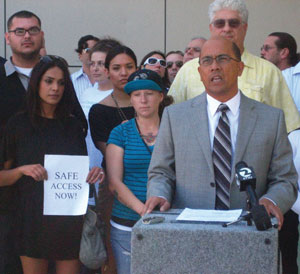
“My wife and I were probably some of the most vulnerable patients in San Jose, and this law is going to make me even more vulnerable,” says John Shannon, a soft-spoken polio survivor who stood with a group of about 40 activists, growers, doctors, patients and dispensary operators at a press conference outside of City Hall last week. The group formed to create a referendum calling for repeal of the city’s soon-to-be-enacted medical cannabis regulations.
Shannon, who uses a cane, tells Metro he worries the new regulations will make it harder to get the only medication that calms his muscle spasms. Other speakers took a more direct tone. “They passed a law which is an effective ban on medical cannabis collectives in this city,” said James Anthony, an attorney and the chairman of the week-old Citizens’ Coalition for Patients Care (CCPC).
CCPC has begun collecting signatures on a referendum petition to repeal the regulations. The group has just 30 days to gather 30,050 signatures from registered voters to qualify for the November ballot.
The referendum’s rallying cry is: Let the voters decide. Activists recently collected enough signatures to put cannabis regulations on the ballot in Butte County, while cash-strapped San Diego, citing the cost of a vote, repealed its ordinance.
San Jose City Clerk Dennis Hawkins tells Metro that if the referendum qualifies for the ballot, a special election could cost the city between $1.4 million to $3.4 million.
“It is unfortunate that some marijuana advocates are opposed to reasonable regulations that will allow safe access to medical marijuana,” Mayor Chuck Reed said in a statement. Reed added that the city is trying to accommodate patients in the absence of state and federal guidelines, and that the coalition is putting patient safety and the city’s budget at risk.
Shannon says CCPC contacted him hoping that his wife, a vocal cannabis activist who battled throat cancer and emphysema, would speak at the press conference. She died two weeks earlier, which is why Shannon spoke that morning in her honor.
“That’s probably all I’m capable of doing right now, is asking people to please show some compassion for their fellow citizens,” Shannon says.