The intersection of Wolfe and El Camino recently provided a microcosm of Silicon Valley in ways that can only be understood on foot.
At first, I was going to say the Patio might be the only bar in Santa Clara County within walking distance of 10 different Indian restaurants. After I thought about it some more, I’d say any bar on El Camino between Santa Clara and Palo Alto was probably walking distance from 10 Indian restaurants. Such was the beauty of modern-day Silicon Valley.
If I had three months to spare, I could literally start at Kebab & Curry’s (with an apostrophe) just off El Camino near Santa Clara City Hall, and then walk north on El Camino, eating at a different Indian restaurant every day for three months. The Camino de Santiago in Spain is a famous pilgrimage and the subject of several books. Why not do the same thing with Indian restaurants in Silicon Valley?
One day years ago, over chai and aloo gobi at Chaat House on El Camino and Wolfe, I met an Indian tech-industry employee who was here on a three-month contract. He was trying a different Indian restaurant every day, all in the same general Sunnyvale/Santa Clara vicinity, since it was entirely possible. I have no idea who he was, but I thought about that guy last week while dining again at Chaat House.
Of course, at Chaat House, the term “dining” was somewhat overstated. One ordered from the register and then grabbed plastic spoons and paper plates from a table. It was a humble, no-frills joint, but I could still see the Punjabi grandmother cooking vegetarian digs in the kitchen. Every customer was South Asian. A poster on the wall explained the “Aum” symbol in 12 different South Asian languages.
The same family also owned Royal Taj on Camden for 40 years, but they just recently shut down that place and retained a few Chaat House locations. Another Chaat House used to be in the strip across Stevens Creek from De Anza College. The remaining ones were nondescript, pleasantly lowbrow gems with decent food.
After Chaat House, I crossed the congested intersection and went right to the grove of heritage oak trees that still existed at the opposite corner, an island of serenity where one could simply feel the present moment, feel all of life and ignore the insidious traffic that flowed in every direction.
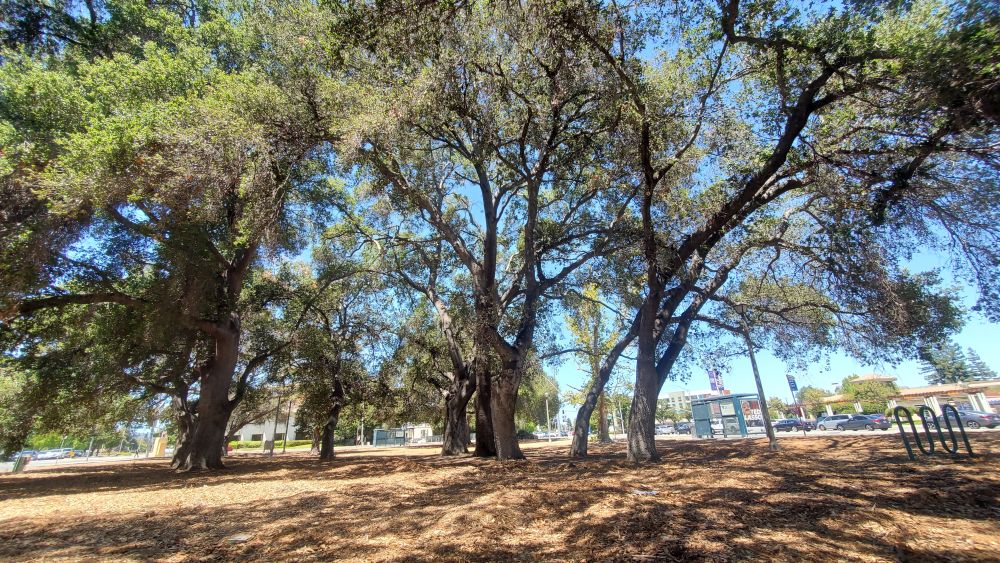
When I arrived at the grove, a dude was scouring the whole place with a metal detector and a trowel. It didn’t kill the vibe, though. He just smiled as I stared.
On the west side of Wolfe, a perpetually unfinished housing complex rose from the horizon. One could not roam anywhere in Silicon Valley without various spats between developers and neighbors. Such was life.
Heading southeast past the oak tree grove, I saw a locksmith in the former McAllister Electronics shop and also a Middle Eastern market with a two-seater table out in front. There were no seats inside.
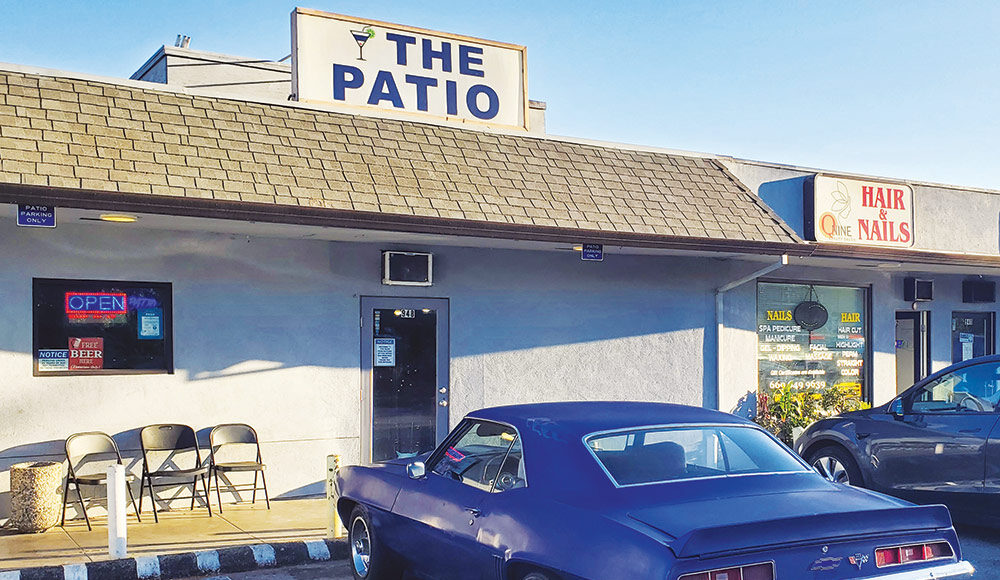
And of course, the Patio looked amazing. An old Chevy muscle car was parked outside, an iconic symbol of suburban America, the kind of suburbia that still appealed to many, despite the tech industry colonizing the landscape. That image—the Chevy in front of the Patio—was a perfect juxtaposition against the oak trees, the nearby AI companies, a zillion Indian restaurants and the adjoining Sunnyvale neighborhood that sprawled southward with roadside mailboxes and no sidewalks.
The Patio had three chairs in front. I didn’t go in. I resisted the temptation. But I knew it was an amazing outpost, still plugging away while everything else seemed to come and go.
From there, I could have walked all the way to Lawrence Expressway—and another nine or 10 Indian places—but I never made it. In the same strip as the Patio, I slid into another humble Indian restaurant, Radhe Chaat, where the employees wore black shirts from various AI companies. Just like Chaat House, my order came with all the chai I wanted.
With a full belly and heart, I visited the oak trees one more time, where the dude and his metal detector were still at work. I hope he found something.