Together, Rebecca Solnit and Juan Felipe Herrera recently re-ignited my obsession with exploring San Jose on foot.
How did this start? Well, 20 years ago, when this very page featured walking experiments in the more wounded parts of San Jose, emphasizing their Zen-like beauty, the results were mostly successful. Readers responded in kind, suggesting even more suburban interstices they thought I needed to visit.
One reader cut out the column from the paper, stuck it on a tree branch somewhere on a side-street I wrote about, and thanked me for introducing him to a part of the city he hadn’t explored. One person made a video project of San Jose strip-malls and listed this column as a source. Others left me voicemails, saying things like, “Dude, there’s this dump over on Santa Teresa. It’s hideous. You have to write about it.”
Those were simpler times. In 2006, we didn’t have social media. Most people didn’t have smartphones. Everyone still knew what a newspaper was. I could amble down 24th Street with “Zen Mind, Beginner’s Mind”—that is, with childlike curiosity and a sense of wonder—and jot down whatever I found. I certainly didn’t write those columns with any intellectual weight behind them. Streams of consciousness pervaded.
After I wrote several of those, an old friend gave me a copy of Rebecca Solnit’s scholarly tome, Wanderlust: A History of Walking. There was my intellectual weight. Boom. I loved that book.
This is why a recent visit to Rebecca Solnit’s author event at Kepler’s reinvigorated my penchant for exploring my own home town. I lugged that exact same copy of Wanderlust over to Kepler’s and after she signed it, I went back through the chapter titled, “The Solitary Stroller and the City.” After ingesting passages about Virginia Woolf, Frank O’Hara and other intellectuals waxing poetic about the benefits of walking, I knew it was time to revisit some of those strolls I took 20 years ago.
Solnit writes from the perspective of interdependence. We’re all in this together.
In terms of my own condition, her writing perfectly dovetails with another masterpiece, this one a local reflection from the ’80s by Juan Felipe Herrera called Zenjose: Scenarios. This tiny pamphlet contained short meditative haikus about the San Jose of that time, when Herrera was living in Japantown. The words accompanied Japanese brush drawings (enso) by Roberto Segura. Herrera later became the first Hispanic poet to ever serve as United States poet laureate, from 2015 to 2017. He came back to San Jose on many occasions.
The only copy of Zenjose I have ever seen resides in the SJSU collection at the main library. It used to be in the Asian American Studies area but now it’s in the Chicano section, both on the fifth floor. Part Chicano, part Zen, I guess. A glorious combination. Only in San Jose would such an amazing poetic fusion emerge.
Armed with screenshots from both those books for inspiration, I took to the sidewalks, 24th Street in particular, and revisited a column I wrote 20 years ago. Like before, I walked the whole length of 24th from San Jose High south past interesting residential neighborhoods and a few gems I wrote about last time, like Dulceria Mi Carnaval, a legendary party supply shop. Throughout the journey, I sauntered past a few industrial yards and defunct railroad tracks, gorgeous in their mundane everydayness.
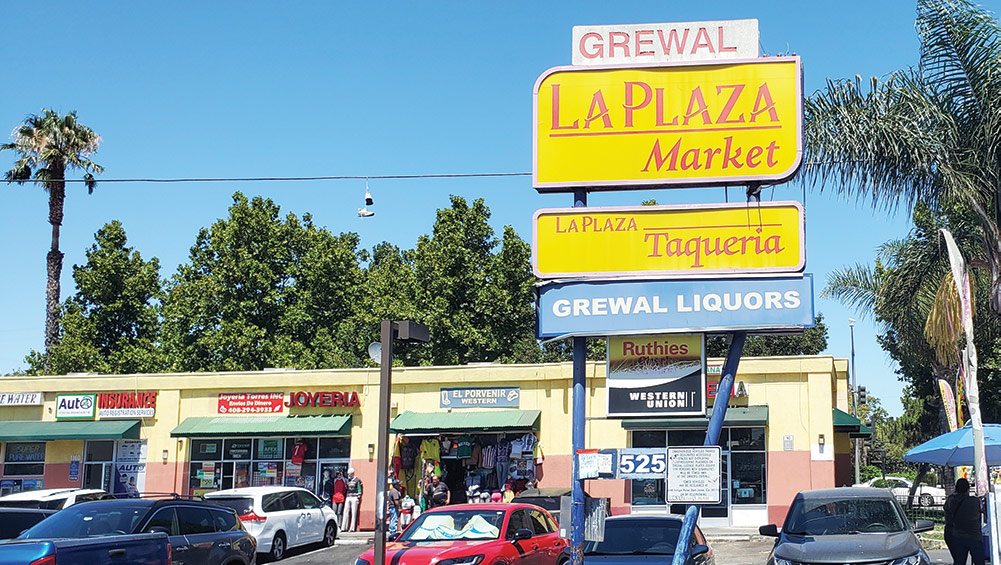
Eventually, I crossed William Street where 24th became McLaughlin, concluding my stroll at Grewal Plaza, which may or may not be its official name. The beautifully weathered strip-mall had definitely improved since my last visit. It was there, over a killer burrito in the corner taqueria, that everything came full circle.
Grewal is the Sikh who owns the property, yet almost every tenant in the strip-mall is a native Spanish-speaking business. What a fantastic combination. Just like reading the Chicano Zen scenarios of Juan Felipe Herrera and Roberto Segura, to experience the Punjabi-Spanish vibes of 24th and William was a vitamin and supplement package for the everyday San Jose condition.
After 20 years, it remains my view that to become a travel writer in one’s home town, one must hit the sidewalks. You see and perceive things differently. You find killer burritos you might have missed. And your wanderlust becomes even better.