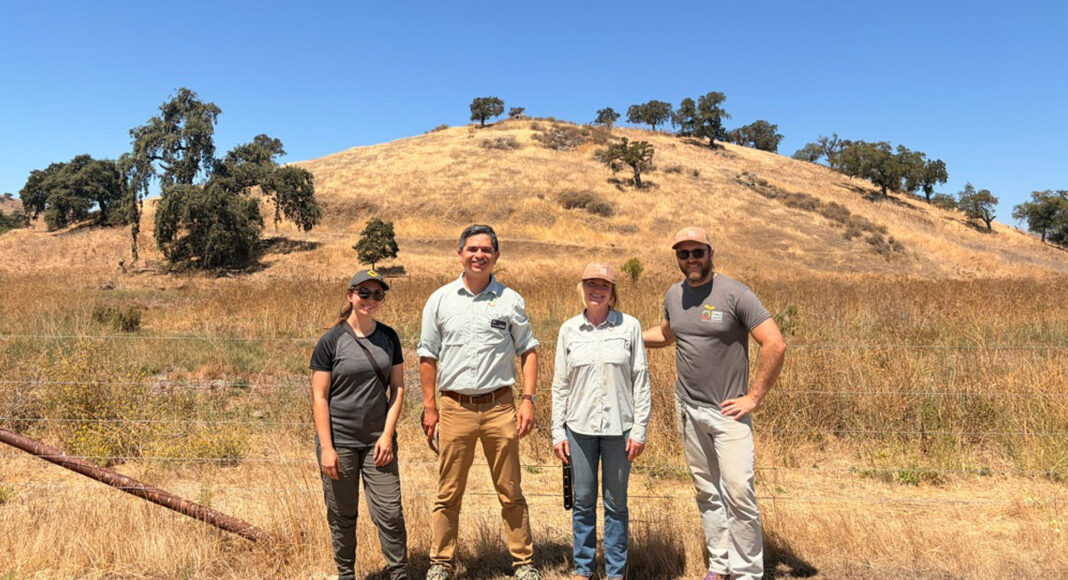
As warm, dry breezes brush past the hills and fields that make up Coyote Valley, Nick Perry recalls overlooking the landscape with his grandfather, and deciding he would help protect it. Perry now serves as Santa Clara Valley Open Space Authority’s Coyote Valley project manager.
A migrant farmworker who lived behind a powerplant in the distance, Perry’s grandfather taught him that once all of Coyote Valley was nothing but natural habitat until development crept in. The place they stood, still undeveloped, gave a glimpse into what the entire valley once looked like. Then, in 1999, the technology company Cisco Systems entertained a 6.8 million-square-foot corporate campus in one of San Jose’s last remaining undeveloped areas on the valley floor. Amidst a slowing economy, the plan was put on hold in 2002
All Perry could ask was why? Why expand into the beautiful green fields? He started a website called Save Coyote Valley which introduced him to city planning. That led him to his eventual and current role in working to restore the lands, animals and floodplains between the Santa Cruz Mountains and the Diablo Range.
“Imagine four-story office buildings surrounded by parking lots,” said Perry. “That’s what this all was going to be. And now it will be restored.”
The area is a prime animal-crossing zone, leading to road kill in areas like Monterey Road. In a 2019 report, the Open Space Authority found that bobcats routinely tried crossing the road, with many losing their lives when they reached the hard-to-pass two-way thoroughfare.
“You can pay now or you can pay later,” said Andrea Mackenzie, general manager at the Open Space Authority.
Though it might seem difficult and costly—$160 million dollars from both public and private sources have been invested in protection of this land since 2019—stepping aside to allow for immediately lucrative developments might only lead to environmental-related costs down the line. A 2017 flood in the valley cost 14,000 evacuations and millions in damages. On top of being pivotal for the migration of native species, this area is also a historic wetland that continues to provide flood protection upstream in San Jose.
In 2019, California passed a bill formally recognizing approximately 17,000 acres of Coyote Valley as a landscape of statewide significance. Despite this progress, the fight continues as developers attempt to use state laws to override protections. Meanwhile, conservation and advocacy groups work to connect the valley’s floodplains and open up access to the public so that community members can appreciate the area for themselves.
This is all part of Open Space Authority’s Coyote Valley Conservation Areas Master Plan, which it hopes to begin implementing as early as 2027. This winter, the Peninsula Open Space Trust (POST) acquired the last chunk needed to connect the floodplains, meaning that it’s finally possible to make decisions on where wildlife will be directed.
“Coyote Valley is like the missing puzzle piece in the middle of that landscape bridge,” said Mackenzie.
On a recent afternoon, members of the Open Space Authority gave a sneak peak at the hill that will become available to the community once the plan is enacted. The walk up the peak can be strenuous under the heat, but it’s ultimately worth it to get a 360-degree view of the entire valley.
On the way up, natural resources manager Aaron Hébert points to a badger den on the trail. It’s one thing to know Coyote Valley is home to hundreds of diverse animal species, and another to see evidence of it through a small hole that breaks up its dry grass surroundings. In bringing back the historic wetlands, conservationists hope to give animals like the tiger salamander, red legged frog and endangered pawn turtles a stable place to live.
Coyote Valley also sits on the territory between the Amah Mutsun and Muwekma tribes. Before Spanish colonizers herded their populations into missions in San Juan Bautista and Santa Cruz, they lived along the valley’s length as its stewards, a tradition continued and supported by groups such as the Amah Mutsun Tribal Band and the Amah Mutson Land Trust.
Jennifer Peth, senior open space planner and tribal liaison, works in partnership with members of tribes that have ancestral ties to the land. Partners from the Muwekma Ohlone tribe helped name a preserved hill in the valley Máyyan ‘Ooyákma (coyote ridge). The Open Space Authority also supports grant applications for tribes to reclaim their land as it can be useful to have a government agency in one’s corner.
Alice Kaufman, executive director at Green Foothills, gives an idea of the types of work advocacy organizations like hers engage in with local governments to save land without necessarily acquiring it.
In 2019, Green Foothills started working with the San Jose Planning Department to remove Coyote Valley’s industrial zoning designation. Three years later, these efforts came to fruition when San Jose unanimously voted to change the land use to open space and agriculture. Santa Clara County Supervisors followed San Jose’s lead by shifting from planning for urban development to putting the area of Coyote Valley under their jurisdiction in a climate resilience district.
With land conservation, however, the key is to never get too comfortable as this win was quickly followed by proposals for a battery energy storage facility in the heart of the valley. It would be surrounded by not only protected wildlife, but also a school.
The neighborhood opposed it, and so did San Jose. Since the plan for the Jewelflower Battery Energy Storage project conflicted with the city’s new zoning, the proposal never made it as far as a permitting application. “After careful consideration, AES has decided not to move forward with the proposed Jewelflower Battery Energy Storage project,” it’s proponents wrote on their web site.
The company had intended to seek approval from the California Energy Commission under a state law that allows large renewable energy and storage projects to pre-empt local approvals.
“Something else like this could come forward again in the future,” said Kaufman.
Green Foothills is shifting focus to Sacramento, with a current push for state laws that recognize areas as inappropriate for development.
But for now, the lack of construction on a battery storage facility is another win for conservation in the valley. Not just mountain lions and bobcats, but also farmers who work with the Open Space Authority to plan ecologically conscious agriculture.
“Luis, one of our longtime farming tenants in Coyote Valley—I think he’s been here more than 20 years,” said Perry. “He does goats, hay and cattle. Sells locally to people in his community directly. We also have a tiny little pilot one-acre saffron farm. A guy from Kashmiri, India. …He grew up in a farming community and has the farming bug. He approached us, and we were able to accommodate him.”