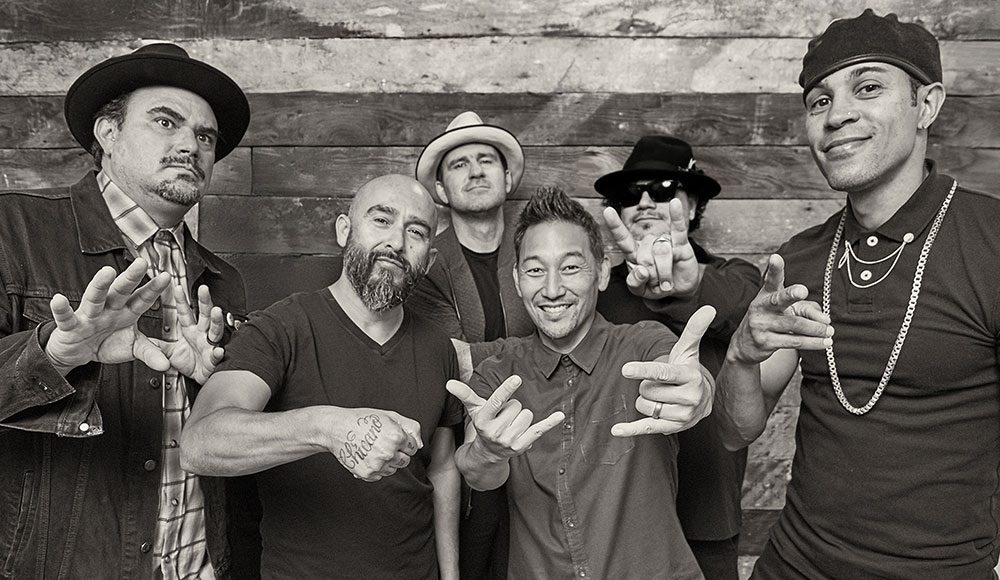
Anyone who’s spent 30 seconds with the group’s high-energy, groove-oriented, stylistically diverse catalogue knows Ozomatli makes body-moving music based in Latin rhythms like salsa, cumbia and merengue that are fused with reggae, samba, funk, hip-hop and second line jazz.
For 30 years, Ozo’s six founding members—Raúl Pacheco (guitar, vocals), Wil-Dog Abers (bass), Ulises Bella (saxophone, vocals), Asdru Sierra (trumpet, vocals), Jiro Yamaguchi (percussion) and Justin Porée (percussion, vocals)—have been bringing people together and starting parties with their global sounds, something they’ll continue to do on the celebratory “30 Revolutions Tour.”
The tour “is not just a celebration of the past—it’s about reconnecting with communities and cultures that shaped us,” Porée said in a press release. “The miles we travel remind us of the years we’ve put in, and the fans who still show up remind us why we do it. I’m excited! Every stop on this tour will feel like a reunion—with fans, with each other and with the road itself.”
Among the more than 40 shows booked from coast to coast, Ozomatli is making a special local stop, where the band will add energy and excitement to the annual Avenida de los Altares, the Mexican Heritage Plaza’s annual Dia de los Muertos celebration.
“Our whole lives were committed to the first 15, 16 years,” Pacheco added in a recent interview. “That’s really when we traveled the most and toured the most.” From hometown clubs in Los Angeles to touring several continents as U.S. State Department Cultural Ambassadors, to earning three Grammys, it’s been quite a run.
In going so hard for so long, there wasn’t a lot of time for reflection. Looking back “is something I don’t think we have a tendency to do,” Pacheco said.
But when 30 years officially hit on April Fools’ Day of this year, the guys in Ozomatli paused and realized, “Oh, wow. This is kind of a big deal,” he explained. “We looked at each other and [said] it’s worth recognizing that we survived for this long and appreciating one another and appreciating the history we’ve experienced. And the love we have felt, the love we’ve given. All the good that we’ve done and mistakes that we’ve made, how we don’t need to repeat those things and how we can continue to do good things.
“The joke is: This is the longest relationship that we’ve ever been in. It’s worth taking the time as a bunch of men to thank one another, but thank everybody else, too, for allowing us to have a life as musicians, which is what we always wanted from the beginning,” Pacheco said.
Of course, bandmates have come and gone (most famously emcee Chali 2na and turntablist Cut Chemist, who were featured on the group’s 1998 self-titled debut, but ultimately decided to focus their energies on their rap group, Jurassic 5); meanwhile the core of Ozomatli has been able to stick with it for so long because while music is how the six players (plus drummer Mario Calire, currently in his 13th year) express themselves, it may not be their highest calling.
“We love to play music, so we had committed to that as individuals. We were gonna do that for our lives,” Pacheco said, adding that in 1995, bassist Abers was the one who made the first call “to see if we wanted to support some workers that were on strike. We’re the ones who showed up.” It was not just an opportunity to play music but “a cause that we felt compelled to support.
“Here’s a group of people who desperately want to play music and do it any chance that they can, because they want that to be their life and their livelihood. And in this instance, it happened to be something that had kind of a social justice space that we all responded to. That combination has been there from the beginning,” Pacheco explained.
Involvement in various causes has been one binding factor for a band that has thrived despite—or perhaps because of—the varied influences the band members bring to the music.
“We’re all very different,” he continued. “It’s why our songs go from one style to the next, depending who brings the idea and who is spearheading that particular idea that turns into a song. We’re all into different music. … You don’t have to be the same or like the same things in order to make something special and good.”
This statement could serve as a broader metaphor for how anyone can live their lives: You don’t have to share the same opinions to collaborate or meet in the middle. “Our creative process is a real negotiation,” Pacheco said. “I think that’s one of the reasons why we probably don’t have more records out, but it’s also one of the reasons why we’re still together. None of us are forcing stuff down each other’s throat.
“As it evolved, it also became a metaphor that exemplified how different styles could be (and) fit in, and in a way, how different people can fit in. And then in the bigger picture, how we can all fit in if we have a similar goal,” he said. “I think to this day that’s a meaningful perspective for us.”
The band’s eclectic sound was also born of necessity. The early months saw Ozomatli playing chaotic but fun free shows (where “anybody could show up—there could be 15 people on stage”) to support what Pacheco termed “lefty social justice causes,” like immigrant rights groups, teachers unions and a women’s shelter.
As for what to play at each gig, “everyone just put their two cents in and then it would evolve into something, because we were under pressure to have music to play the next day or that night,” Pacheco said. “It was to solve an issue of a need to have songs to play.”
At that first gig for the striking workers, they had just hours to prepare. “I don’t even think we had a drummer at the time, and Cut [Chemist] had his turntable so we played to a loop that Cut was spinning, this kind of hip-hop beat. Concepts just happened,” Pacheco said. “We were just trying to find solutions to the situation.”
Whether singing in Spanish or rapping in English, Ozomatli’s lyrics have consistently spoken out about injustices and pushed for global equality. It’s always been music with a message, often immigrant rights.
“A lot of working-class people around the world and in this country came here from somewhere else,” Pacheco said. “[There’s a] basic inequality that exists [and] we don’t think people should be victimized. We’re on the side of the underdog, in the sense of people who are just trying to make a better life for themselves. We support that.”
While rehearsing and preparing for all the songs that could appear on this anniversary tour, Ozomatli is also making new music. True to themselves, “Red Line” is “an ode to the workers of the world,” Pacheco said. The new song’s chorus goes, “They say, ‘Don’t take the red line.’
“It’s about working-class people having to [travel] two hours on a train to go to work, not really being able to integrate, how we often don’t integrate, whether we’re rich or poor or whether we’re from different races, and how we encourage that people should. You know, we think that the world would be better if we were a little bit more open to one another.”
It’s clear Pacheco and Ozomatli have the right mindset for this lap around the country, but how does an old dog physically prepare to be a road dog again?
Pacheco said “I’m about to go for a run after this so I’m getting ready.”
Ozomatli plays Nov 1 at Avenida de los Altares, taking place 5:30-10:30pm at the Mexican Heritage Plaza, 1700 Alum Rock Ave, San Jose. Free.