At the Cantor Arts Center, a reproduction of Shahzia Sikander’s circular artwork Infinite Woman graces the elevator doors on the ground level. As the doors open, so does the image, a perfect arrival metaphor.
The show on the second level, Collective Behavior, is the most comprehensive exhibition to date of the internationally renowned Pakistani American artist, spanning 35 years of Sikander’s career. For decades Sikander has subverted Central and South-Asian visual art categories, relentlessly yet patiently expanding her practice to encompass a variety of other media. Her work has been pivotal in cementing the art of the South Asian diaspora as a contemporary American tradition. The show includes watercolors, paintings, mixed media collages, gold leaf, graphite, laminated glass, video installation, glasswork, mosaic and screenprints on handmade marble paper.
Rooted in a space of transnational experimentation, the body of work presented in the show provides a toolbox of thematic spatiotemporal trajectories: migration, trade, colonialism, the violence of borders, the petroleum industry, Western relations with the Global South, power, trauma, empire, gender and body politics—all centering women in the process. One can straddle the various trajectories and follow them through the show. All of them have evolved during the 35 years Sikander has been working.
Collective Behavior premiered at the 60th Venice Biennale in 2024, after which additional iterations emerged at the Cincinnati Art Museum and the Cleveland Museum of Art. The Cantor Center is the only West Coast venue for the exhibit, where two sold-out events—a symposium and a lecture by Sikander—take place on Nov. 13. Both will be livestreamed on YouTube.
Upstairs in the gallery, Collective Behavior begins with a few of Sikander’s books placed underneath a glass case, prepping visitors for what’s to come. This is the first display one sees upon entering the gallery on the second floor. In the case, Rabindranath Tagore and Amitav Ghosh sit right next to Angela Davis and Bell Hooks.
The rest of the show unfolds in three sections: 1) Point of Departure, 2) Feminine Space and 3) Negotiated Landscapes and Contested Histories. These themes reflect not just major throughlines in Sikander’s practice, but also serve as mental signposts for anyone traveling through the show. Many of the individual pieces, analog or digital, suggest a journey through various landscapes, whether it be fusions of media, geography, language or diaspora.
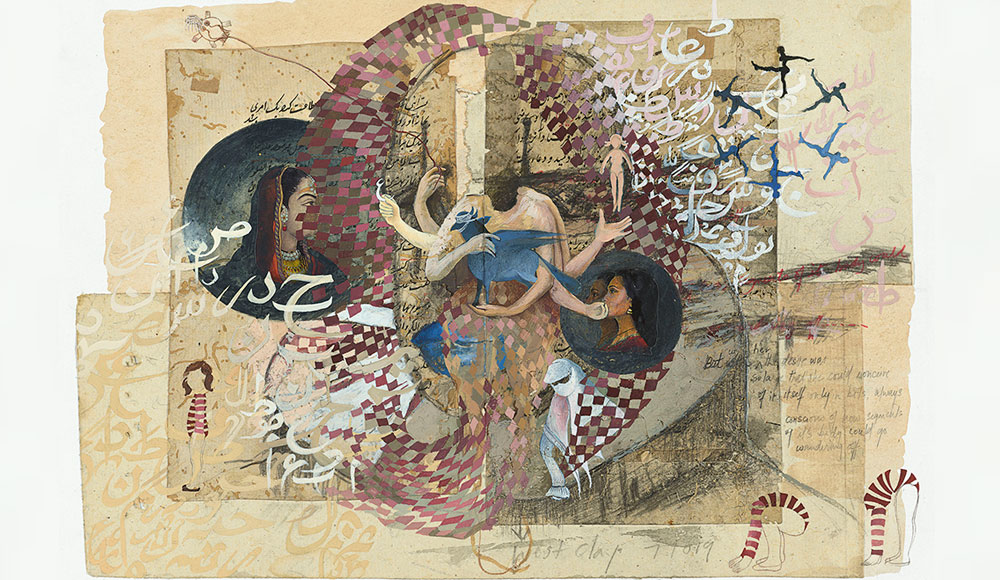
One collage, for example, Segments of Desire Go Wandering Off, combines vegetable color, dry pigment, watercolor, graphite and tea on wasli paper. Layering imagery and text to explore the hyphenated identities many in the United States are forced to carry, the collage features a multi-armed, uprooted female struggling to contain her ambitions and desires. We see a chalawa, symbolizing impermanence, and a turtle, symbolizing endurance. There’s also a floating child and a self-portrait of the artist. All faces are obscured, highlighting the paradoxes that characterize the Asian American—or Asian-anything—in the West. One must remain invisible while standing out. The turtle flying off the page references another paradox—the freedom offered to immigrants if they want to reinvent themselves in America, so long as they remain tethered to predetermined definitions.
Infinite Woman, the actual piece itself, hangs on a wall inside the gallery. It’s even more glorious after extended contemplation. The large-scale drawing incorporates both minute detail and macro-level monumentality to convey the immeasurable capacities of women. The central image resembles a parched earth or perhaps even a satellite image.
On closer inspection, however, the sphere is formed by isolated gopis’ hair and gold leaf. Repeated standing female forms, shown in profile, encircle the earth-like image, forming a collective swarm of the gopis’ hair. The sharp feminine forms resemble spikes. There is power, presence and persistence. Questions arise: Do women move the earth? Do they control the earth? Does their labor make the earth go around? What stories do their bodies hold?
If one departs the exhibit the same way he came in, a catalog sits on a table near a few comfy chairs, offering various texts and poetic responses to Sikander’s work. In particular, the writings of Aruna D’Souza place the work in elaborate context. Then, after descending in the elevator, the doors open and he exits through Infinite Woman all over again, a perfect metaphor.
Collective Behavior runs through Jan 25, 2026, at Cantor Arts Center, 328 Lomita Dr, Stanford. Free. 650.723.4177. museum.stanford.edu