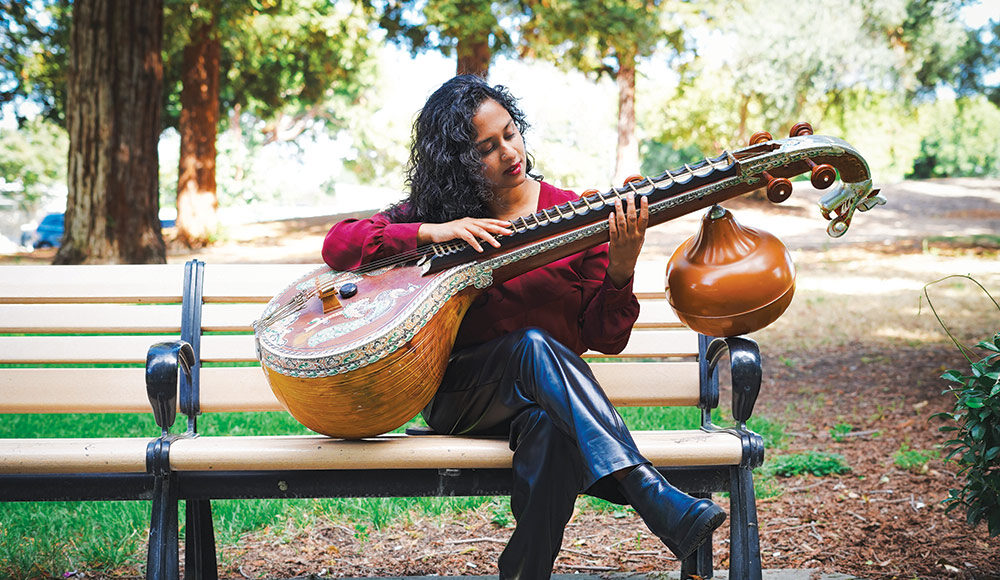
With roots in Southern India as a veena player and Carnatic vocalist, Indian-American musician Ananya Ashok from Santa Clara blends together the elements of Carnatic music with indie-folk.
She started releasing music in 2025 and has toured across India, Singapore, the United Arab Emirates, Australia and in the U.K. and Germany.
Her most famous song on Spotify is “Little Voice,” which has 4,785 listens. Another great track is “Humpty,” which Ashok wrote when thinking about the nursery rhyme “Humpty Dumpty Sat On A Wall” and why he couldn’t be fixed after being broken.
“Quite literally, I was picturing Humpty sitting on a wall and he’s just like, ‘I’m sitting on a wall, I’m afraid I’m gonna fall’ and then I went with that idea,” says Ashok. “Okay, what is this fear of Humpty’s? Like, what if he breaks open? What is gonna happen? And the song really just kind of unfolded that way.”
Another track, “Unrealized Dreams,” has Ashok reflecting upon her own life and the people who motivated her. The song also talks about how people are looking at love and how young people look at love in an immature way.
“You have a very narrow view of what love is, and you think like, ‘If I’m with this person, I’m sure I’m with them forever.’ Even if you don’t know much about them, you kind of just go in,” Ashok says.
In addition, the song talks about dreams that are unrealized unless a person achieves them.
“Ideally, we should all live our lives letting it unfold and not holding on to a specific idea of what ‘good’ looks like,” says Ashok.
To me, her most inspiring track is “First Love,” which is built around the resonance of the veena—an ancient, plucked string instrument from India—as the emotional core of the song rather than as a decorative flourish.
“Promising Youngster” is a passionate song that talks about what it’s like being young and trying to succeed but somehow beginning to “age out.” Ashok describes the track as an experimentation of American folk music by bringing in the veena.
“So for the sake of this EP, it’s new American folk, if you want to call it that,” Ashok says.
Music is in her family as well, as she comes from a multigenerational lineage of musicians from both sides. Her father, Ashok Subramaniam, is a teacher and musician. On her maternal side, her great grandmother is a disciple of Carnatic musician, accompanist and teacher, Ramalinga Bhagavatar; and Carnatic vocalist, Harikatha exponent, scholar and composer Sangeetha Kalanidhi Kallidaikuruchi Vedanta Bhagavatar.
As a student of renowned violinist Anuradha Sridhar, Ashok studied numerous types of music. Then she became a vainika, a term for veena player, after training under vainika Srikanth Chary, who was a disciple of another vainika, Lalgudi G. Jayaraman.
In 2011, Ashok received the Alliance for California Traditional Arts’ Fellowship Award for an intensive study of the veena, giving her more opportunity to have one-on-one sessions with Chary.
Ashok specializes in playing Carnatic music, which originates from Southern India. It’s a little different from classical Hindustani music. While both use the seven notes and concept of ragas, the singing and the way the instruments are played differs.
“The major difference is our heavy usage of something called gamakas, which are basically like notes that oscillate, and that’s really prevalent in Carnatic music,” says Ashok. “Hindustani focuses more on pure tone and pitch and notes that are plain.”
Soon, Ashok plans to have shows with dancers that practice a dance form called Bharatanatyam, characterized by a low center of gravity, originating from the Tamil Nadu state in India.
Ashok will also be writing another album about the beauty, chaos and turbulence of motherhood, and what she would want for her children and future grandchildren to know about her.
For more info, visit ananyaashok.com and @ananyaashokmusic on Instagram.