
As Dante tells it, an inscription on the Gates of Hell reads: “Abandon all hope, ye who enter here.” A similar trigger warning is nowhere to be found upon the threshold of Miljohn Ruperto’s exhibit Animal, Vegetable, nor Mineral. The first room in the gallery emits a crepuscular light. Further inside, shadows curve and creep like apparitions in a black fog. Video screens flicker with a profound sense of menace.
In Janus (2014), a cartoon animal lies flat against the ground in its death throes. Its trembling body disturbs both the heart and the eye. The animal also shapeshifts. It’s a rabbit; it’s a bird. It’s a rabbit and a bird, the ears double as a beak. A scarlet wound on its chest, or back, corresponds with the color of its single bloodshot eye. When the viewer arrives to observe the poor creature, the narrative should be at its end. But Ruperto loops the 3:30-minute animation. He traps the character(s) in an eternal state of pain and distress. It’s the point of departure for an admirable and unnerving body of work.
Throughout the darkened galleries, nearly every piece in the exhibit bears the name of an artistic collaborator. Aimée de Jongh is credited for the Janus animation as well as for the Mineral Monsters (2014) series of animations on the opposing wall. Framed in vertical monitors, minerals are set to loop in 2-frame animations that move like the aftershocks of an earthquake; or, the beating of an agitated heart.
Like the hybrid rabbit-bird, the “minerals” look like internal organs or malignant tumors that have been harvested from one of Tolkien’s Ents. They advance Ruperto’s engagement with, what he calls, the instability of the image.
Taken in from a few steps back, each mineral monster is wreathed within a rocky formation. With a slight change in perspective, they look like monstrous pupils housed in cavernous sockets. When I spoke with Ruperto about the exhibit, he expanded on his interest in instability. “I try to create an image that’s unstable in multiple registers,” he said. “Or occupy a place of suspension where it oscillates and keeps up that tension between poles or registers.”
Conceptually, the mineral is only “kind of active” in its two shuddering frames of movement. The effect of motion and the illusion of depth are activated by the viewer’s left and right eye working in tandem. As an artistic strategy, the unstable image pushes back on the viewer’s preconceived ideas of what’s being represented. Ruperto added, “Then it also serves this purpose of suggesting there’s no objective reality.” No two people will see, interpret or experience this instability in precisely the same way.
Ruperto partnered with fellow artist and filmmaker Daniel Small to engage with AI. Their video installation Fathoms (Tartarapelagic) (2025–26), gave me a nightmare. On a single vertical monitor, neon-colored sea creatures emerge and grow, one at a time, from the center of a pure black background.
Unlike Janus, there’s no Lynchian background noise to accompany the images. The blackness surrounding each creature could be mimicking outer space, the deep blue sea’s frigid twin. The tech specs for Fathoms indicate “a single channel digital simulation, continuous duration.” It was AI’s “continuous duration” that got to me in my dreams. One after another, this infinite undersea army was rising malevolently to the surface.
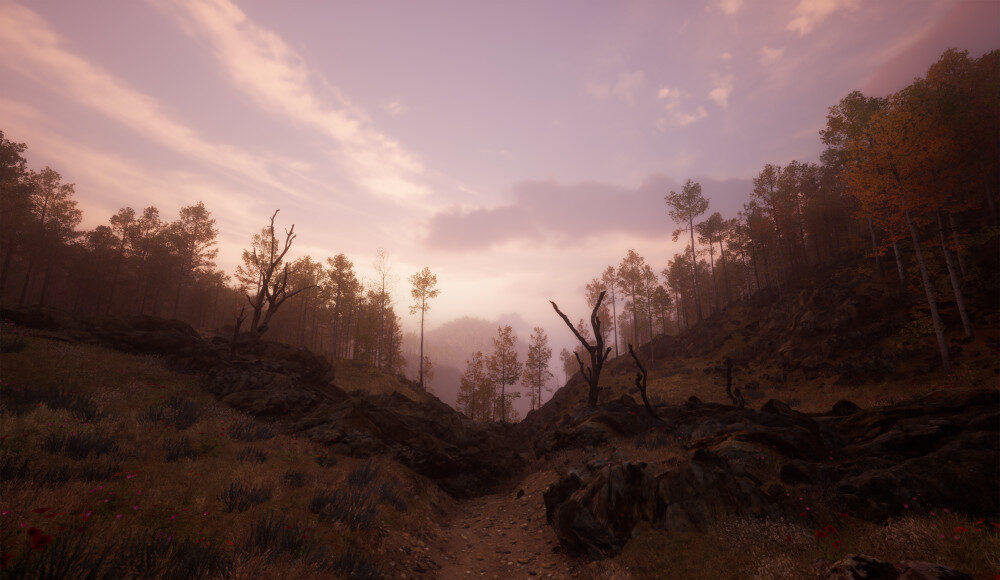
Several sculptures populate the gallery but in this exhibition video installations are Ruperto’s primary mode of expression. As the title implies, What God Hath Wrought (Kairos) (2026–ongoing), depicts the Garden of Eden as a thwarted place, stripped of its majesty. Created with a game engine, three richly saturated videos play out post-apocalyptic scenes at the back of the gallery. Collectively, they respond to the paintings made by the 19th century Hudson River School.
Donning VR goggles, the viewer can “walk” across these vistas in the aftermath of a catastrophe. Those once bucolic landscapes are depopulated and desultory. Whether it was climate collapse or nuclear war, Eden is—and perhaps always was—an illusory place. In this particular endgame, birdsong is replaced by the sound of burning embers.
Animal, Vegetable, nor Mineral: Works by Miljohn Ruperto is now on view at the Cantor Arts Center through September 14, 2026. 328 Lomita Drive at Museum Way, Stanford. museum.stanford.edu.