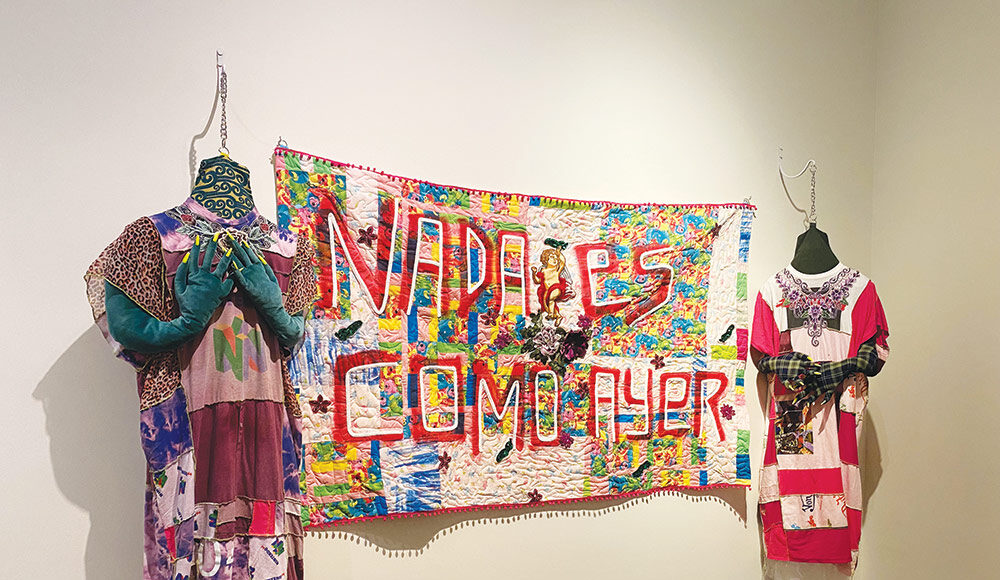
The San Jose Museum of Quilts and Textiles is one of those places that people can live in Silicon Valley their whole lives and never know exists. Which is a shame because in 1977 the museum became the first in the United States to feature quilts and textiles as its sole focus. They’ve been at their current location at 520 S. First Street since 2005, storing 1200 pieces in their collections archive. A hidden gem that shouldn’t remain hidden.
In the past, exhibits have focused on everything from climate change to digital weaving, but the one currently on display, “A Mi Manera / My Own Way,” is a tribute to Silicon Valley’s Latine community.
Marisela Gonzales Ginestra, who co-curated the exhibit with Demetri Broxton, knew exactly what she wanted to be the focus.
“The Mexican community and broadly the Latino community has an amazing blanket culture,” she says. “[On the Latino internet], as soon as the cold months hit, memes about blankets come out.” For example, taking the meme of Homer Simpson snuggled up in bed and adding a San Marcos blanket, which many immigrants remember their families buying at flea markets in the ’80s.
What better theme for a quilt museum?
“There’s an interest for this,” says Ginestra. “We talk about it so often. We have a reverence for it. We build altars around it. We have photoshoots devoted to our family blankets.”
Ginestra is a veteran of the fashion industry but a newbie to curating. But a point of connection between the two fields—besides fabric—is that both rely on collaboration and teamwork. Thanks to support from Broxton, museum director Kris Jensen, and board chair Greg Climer—not to mention the contributions of 24 artists—different threads came together into a warm and beautiful show.
“It felt really good to use the skillset that I had honed in my 15 years in the fashion industry and apply it here,” says Ginestra.
Taking the theme “New Heirlooms for Future Generations,” the exhibit explores a version of “my own way” that is extremely interconnected with the past and the community. Gallery 1 starts in the ancestral past, exploring textile arts “not as fixed traditions but as living practices” (per the gallery guide), with techniques that reach back in time such as weaving from Fatima Mendez Reynoso and stretched leather from Pilar Augüero-Esparza.
Gallery 2 takes a step into the more recent past, with pieces based on family memories. “The artists treat memory as something material. It can live in a blanket, a family photograph, a bed sheet, a garment…or an object passed from one person to another.” Among these are cloth pinatas by Serena “Espinas” Madrigal.
Gallery 3 looks to the future, where traditions are “stretched, interrupted, reworked and reinvented.” And although every piece includes some textile, there’s also a bicycle, and photography. Matching the time traveling nature of the exhibit, artists are represented across generations, including four student artists.
One family blanket does hang on the wall near the entrance. And it feels like a worthy companion to the more fanciful art pieces. This is part of a central question of when something becomes art. For Ginestra, in fashion anything 20 years old is considered vintage. So why should gallery art be any different?
“It’s not a ‘traditional heirloom,’ but it’s an heirloom to us,” she says. “Because that’s the blanket that kept us warm in the fall/winter months. That’s the blanket that was at your grandma’s house and that’s the blanket that you used every time you were there. Made you feel safe, made you feel secure, made you feel like you were home.”
Outside the three main galleries, the museum chose Latine and family heritage themed works for the hallway and front gallery, in an exhibit titled “Dance of Life.”
Jensen explains, “When we do exhibits, the main exhibit’s always in the three main galleries. And then we always bring stuff from our permanent collection out here to show people the history.”
With a wealth of materials in the archives, they definitely have a lot to work with.
Jensen echoes the sentiments expressed in “A Mi Manera.” That the oft-overlooked handcrafts—often developed by women, made for practical purposes—are just as rich in artistic merit as more traditionally recognized forms of art.
“There’s been a history of people not accepting [textile] as fine art like a painting or sculpture or things like that,” he says. “We disagree. We think that this work is fine art. And it should be respected as fine art.”
Bringing together a variety of artists and Latine and immigrant forms to a small corner of downtown San Jose feels serendipitous. It came together in a way that exceeded the expectations of everyone involved.
Ginestra says with a laugh, “I’m just a kid from San Jose that stumbled into this.”
‘A Mi Manera’ and ‘Dance of Life’ will be up through Sept. 20, 2026. San Jose Museum of Quilts and Textiles, Thu-Fri: 1-5pm, Sat-Sun: 11am-5pm. $10 General Admission. sj-mqt.org