
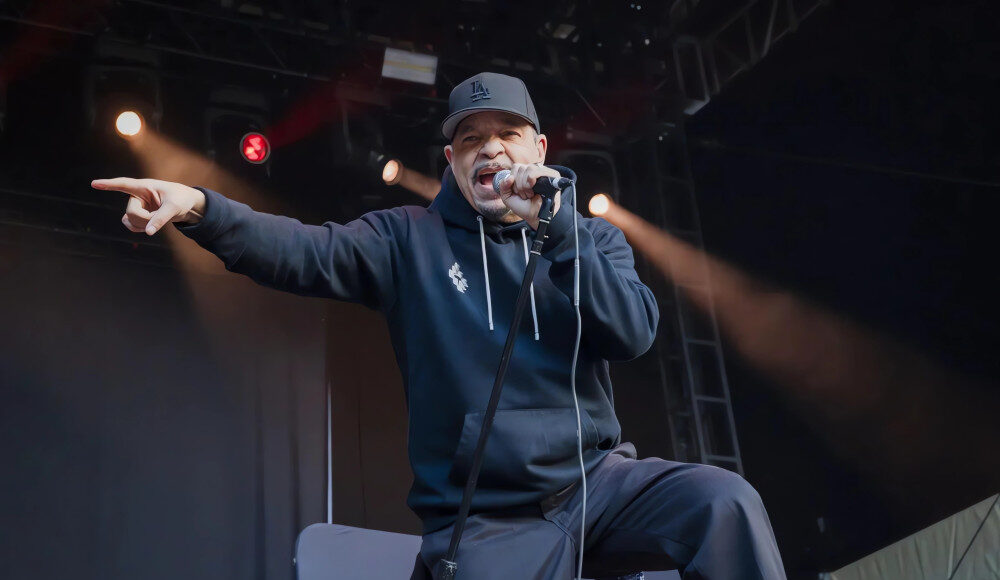
Rapper and actor Tracy Lauren Marrow, better known as Ice-T, is quick on his feet, a man of many pivots — from a dancer and DJ, to recording hard street narratives heard on his 1987 debut (Rhyme Pays), to being a detective on the long-running series Law & Order: SVU, he’s many things, but sheepish has not been one of them.
The Newark, NJ, native moved to South Central Los Angeles in junior high after suddenly losing both his parents. Just after the Vietnam War’s draft ended, he enlisted in the Army and served four years in the 25th Infantry Division. That’s when hip-hop entered his life and has been his guiding force since. “Hip-hop showed me possibilities to be what you can be. I heard brothers doing it and wanted to be them. Now I’m one of them,” he said. “You start off wack, but you can get better. That’s the beauty of the culture.”
He’s been through so many career stages, including having to navigate his metal group Body Count’s “Cop Killer” controversy, which at first posed a threat to his career but, in the end, likely bolstered it. Says Ice: “To me, it was a publicity stunt. The cops were under siege at the time. So they decided to go after Warner Brothers and say Ice-T is a problem.”
That was years ago, but then came a quiet decision to step back from rapping when hip-hop drifted into distant and unfamiliar territory. After all, he’s spent four decades refusing to become anyone but himself, avoiding trends that didn’t sit right with him. “After all the different trends, like ringtone rap or trap. I just had to step back,” he said.
After roughly twenty years without a major solo album, he returns with Criminal Migraine, not as a calculated bid for relevance or nostalgia, but as the work of a veteran who felt modern rap artists were pulling culture away from the unfiltered storytelling that defined his early work.
What eventually brought him again to the forefront was a subtler shift, what he calls a recent “rap renaissance.” Respected peers like Nas, Raekwon, Ghostface, and Slick Rick began releasing ballyhooed projects that celebrated the foundational traits of ’90s rap, which so much of today’s music borrows from.
Since the start, he’s had little time to shift gears because his career has always been in overdrive. Yet somehow he’s managed to stretch his talents for forty years, achieving elder statesman status without needing real reinvention, an achievement any true artist would appreciate. He’s left aggressive street tales he once spoke of behind him, playing different characters on screen but leaving true character intact.
Taking time from an expected demanding schedule, ahead of his anticipated show at San Jose’s Music in the Park, with collaborator DJ Evil E and Bay Area mainstay Lyrics Born, he spoke in typical candid fashion about his longevity.
In the interview, Ice-T discusses his successes, his thoughts on today’s musical landscape, his serendipitous foray into acting and the strange paradox of depicting law enforcement on screen. He also reveals what he’s most proud of through it all.
“I got grandmothers like, “Oh, I love Ice-T.” It’s crazy, man,” he said. “But it just proves anybody can make a change if you have different options.”
Special Victims Unit
I want to start with your brand new album, Criminal Migraine, and work our way backwards to cover all your history. This is your first album in twenty years. What kept you away?
I had kind of stepped out of hip-hop for a while because hip-hop went left on me. About 20 years ago, all of a sudden, what they call ringtone rap and auto-tune came in, it really just went out of my zone. It’s not the way I rap and just not my style.
And I think the worst thing you can do at times is try to chase trends and do something that’s not familiar to you. That happened at the same time when I started Law & Order. So I was like, “You know what, I may not rap again because they’re rapping different from me. A lot of this shit sounded goofy.” I’ll keep it real.
What was it about the current state of modern music that made you return?
I feel like we kind of went through a hip-hop renaissance recently. I’ve seen clips of people making hot albums.
I opened a studio during Covid, and I was doing a bunch of features for people’s stuff, but I really got the bug after people that I respected started to rap again. Nas opened a lot of people up over on his label [Mass Appeal] with the Slick Rick, Raekwon, and Ghostface projects. And then rap just kind of did a turn. People started wanting to rap again, and I was like, “OK.” It got me back going.
Tell us a bit about your first exposure to hip-hop culture. You started as a dancer and DJ before rapping. Tell us a bit about those early days and how it was initially getting involved.
Hip-hop reached me when I was in the army, and my friends gave me some tapes of rap music being done in New York. And I, like most people who got into hip-hop, got into it through multiple entry points.
There are four entry points: you could be a DJ, a dancer, a rapper or a graffiti artist. KRS-One was a graffiti artist first. Kool Keith was a dancer first. Run [of RUN DMC] started off as a DJ. That’s the beauty of the culture. There are multiple entry points. Anybody can get into hip-hop. With practice, you can do it. You can’t be an opera singer if you’re not gifted with that voice. But with a little practice, hip-hop — you can do it.
You quickly went from rapping to being in front of the camera in film and TV — New Jack City, Trespass, Surviving the Game, Ricochet were all big movies. Can you talk first about your first appearance in the film Breakin’?
Breakin’ happened because of the club Radio. That’s where hip-hop was really growing in LA, because the guys that owned the club would bring in New York groups. That’s where I met Afrika Islam, Cold Crush Brothers, Soulsonic Force, New York City Breakers, Rock Steady Crew. The guys who owned the original club would bring in New York groups, and I used to go there and rap.
When people decided to make the movie Breakin’, they just walked into the club and were like, “Oh, we’ll use this guy. In the movie, I was credited as “Featured Rap Talker.” They didn’t even know what a rapper was yet. That’s how early that movie was. They put me in there as the rapper.
Then arguably, your biggest break in film was with the movie New Jack City. Tell us about how you got involved and what comes to mind now.
I remember when I first saw New Jack City. I sat in the audience really low-key, and nobody knew. When I came on screen, I heard a couple of guys go, “Look at Ice-T with that hat.” I was still Ice-T. Fifteen, twenty minutes into the movie, they’re yelling, “Scotty!” At some point, I no longer am Ice-T. I’m Finn or Scotty or whoever the fuck.
As humans, we can suspend our disbelief. You can watch the same actor in five different movies and believe they’re different. But we allow that. That’s the scariest part. As a musician, you kind of are always who you are. When you act, you’re somebody totally different, and you have to get used to that.
When I got to do New Jack City, there just weren’t enough Black actors to make a Black version of Scarface. Wesley Snipes had only made one movie, maybe two. He might have done a Spike Lee joint, and he did Major League, but that’s it. Now we can make Black Panther, but at the time there just weren’t enough of us.
So they said, “Well, Ice-T sold millions of records. We’ll take Ice, who’s got that gangster side, and he’s conscious. And we’ll take Chris Rock, who was the youngest, hippest street comedian at the time on the streets. Maybe their appeal and their numbers will show up at the box office.”
That’s how I got in the movie. I got in the movie because of my record sales, and I was just the right guy at the right time.
You not only had a starring role, but you also did music for the film, including the title song. What was the experience of being so deeply involved in a major project like that?
I was nervous as fuck. They wanted me to play the police. I had an album coming out called Original Gangster that year. I’m like, “This is suicide.” But my friends and people told me, “Ice, do not turn down this opportunity. You come from a background with no opportunity. Now you’re gonna shit on this movie? You got a chance. Everybody knows you ain’t the police. Go ahead, do it. Fuck it, go.”
So I did the movie. And when it was time to do the soundtrack, I pitched them. I said, “I could do the main song, but I can’t do it from Scotty’s perspective. I got to do it from Nino’s [the villain’s] perspective.” So that’s why “New Jack Hustler” is called “Nino’s Theme.”
Was it ever hard finding a balance between rap and acting?
No, not at all. It was simple. You gotta remember that music is acting. Music is theatrical. An R&B singer says, “Baby, I love you,” then “Baby, get out of my house,” then “I miss you,” then “I don’t.” You’re dealing with all these different emotions.
When I perform my song “Colors,” for example, I have to go back. I have to pretend and remind myself how I felt when I made that song to perform it correctly. When you see that R&B guy up on stage acting like he’s crying, he’s acting. He’s thinking about that. And also, musicians do videos. We’re familiar in front of the camera.
What is the hardest aspect of what you do?
I think the hardest thing is realizing that people will accept you as a character. Because, you know, I’m Ice-T. Everybody knows who I am. Will you believe I’m a school teacher if I play a school teacher? Well, people go along with it. There’s that fear of, “Will people believe it?” But they will. If that’s the story and you’re a good guy, they’ll believe you’re a good guy. If that’s the story and you’re a bad guy, people go along with the story.
You still consistently released music during this time, both as a solo artist as well as with Body Count. Playing a cop in film and eventually on TV with Law & Order I’m sure added to the “Cop Killer” controversy; when you were highly criticized for violent lyrics, people felt unfairly targeted police. I was a kid, and I remember the media uproar. How did that strike you at the time?
It was the Fraternal Order of Police out of Austin, Texas, who started the whole shit. I thought talking shit about cops was fair game. Rock stars have been doing it. Black Flag had done it. There’s a rock band called Millions of Dead Cops. So I felt you were just attacking the system. Fuck it. And it was Body Count. It wasn’t a rap group. But the shit hit the fan, and I weathered the storm.
I made it clear: I don’t dislike cops. I dislike racists. I dislike bullies. Those are the two things I dislike most. Even in the streets, a real criminal doesn’t dislike cops. The cops are just the opponent. You and I know we’re gonna break the law, but we’re just gonna outsmart these motherfuckers. We’re not mad at them.
I say if you’re a drug dealer, the cops create the margins. If coke’s legal, then it’s not worth anything. So they have to be there on the playing field. You understand that, but you’re still gonna do it any motherfucking way.
What comes to mind now when you think of all the criticism you received?
I call it challenging the system. I tell guys when they get out of jail, “Are you done testing the system? Are you done?” Because these motherfuckers are sophisticated now, and you ain’t getting away. You can’t beat them for a long period of time. Crime is kind of like betting against the house in Vegas. The house will eventually win. The odds are against you. You might be able to get away with a little bullshit, but you can’t make it a career. It’s not gonna work out for you. Trust me.
You mentioned Law & Order, so I have to ask: An entire generation knows your character on the show, Fin. And now it’s been more than 25 years since you joined the show. What goes through your mind when you think about your Law & Order run?
That’s what’s interesting when I perform because you have a whole generation that has no reference point of me rapping. I was shooting SVU the other day. This young lady was going out to the club. She’s dressed, got her heels on, dress on, and everything.
She goes, “Oh my God, I’ve been watching you my whole life.” I said, “Yeah, right. How old are you?” She said, “25.”
And my brain went: “I’ve been doing this show long enough for you to come out of a vagina and walk down the street to go to a club. That’s a long time [laughs].”
What do you think is the greatest realization you’ve had about your generation and today’s youth?
I realized that my generation, the people that were with me, have to be at least in their 40s or 50s. But thanks to YouTube, thanks to parents, the younger kids get to do their homework. The one thing about my generation of hip-hop is we know we are the coolest. As parents, we won’t let the kids be like, “Nah, nah, nah, you think that’s cool? No, you gotta listen to N.W.A.” Our generation was so hip-hop that we made sure the kids knew the history.
Love it or hate it, it’s just weird to be around this long. It’s just weird, but it’s fun. Even when I come to San Jose, I’ll shock the shit out of them because they’re like, “Oh, this is Fin from television.” If they show up and they don’t know what to expect, they’re like, “Oh no, these are the motherfuckers that started all the trouble.”
When you see me or Ice Cube or the Geto Boys or any of us, we’re still doing the same show. It doesn’t change. But I like the mature hip-hop fans — the ones that grew up, the ones that have been there, that are grown but still love the music to death because it was their childhood, it was their teenage years. They show up, and it’s a great feeling to see them.
You mentioned San Jose. Do you have any memories of playing here?
I can’t remember last night or predict tomorrow, homie. I only remember places where bad things happen, and I’m lucky to say nothing bad happened to me in San Jose. That’s a compliment [laughs].
Any direct comments you want to tell fans who will be in attendance?
Don’t bring any little kids. It’s parental guidance suggested, but it’s pretty hardcore. If you listen to my music, every other word is like “motherfucker.” So think about that.
With over twenty-five years on television, countless recordings, and major film work, what part of your career are you most proud of?
I’m proud that I’m here. I’m proud that people still give a fuck about me. Really, if I’m being honest to God, I’m proud of transitioning out of the streets. I’m proud of being able to get out of there and make that transition into a musician and actor. Because a lot of cats that are in the streets can’t do it. Even transitioning from being a hustler to having work and a job — I’m quite sure you know people that can’t make that transition, that get stuck in that zone or in that mindset. They just can’t break it. They get caught up in it.
Teaching myself how to change, and teaching my friends, and seeing other people make that move. You’ve seen Snoop do it. You’ve seen [Ice] Cube do it. You see 50 Cent do it. It can be done. A lot of cats that were headed to prison made a change, and now they’re respected. You get yourself together, and you wanna change. I’m very proud of that. And being able to do so many different things and being relatively successful at it, too.
The cool thing is that I did it my way. I never totally changed. I’m still the same dude. I just work hard, and I try to keep my nose clean and stay out of trouble.
Music in the Park
September 19
Ice-T, DJ Evil E, Lyrics Born
CalTix.com