
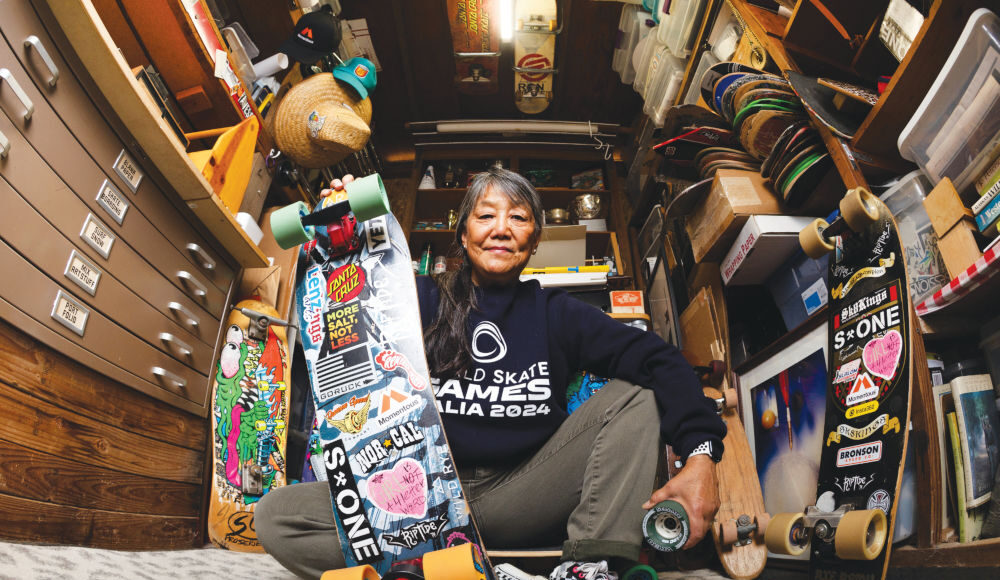
Judi Oyama’s mom told her to “be seen, not heard.” Those words, although well intentioned, will not work anymore.
Thanks to a new exhibit at the Japanese American Museum of San Jose (JAMsj) with that same title, Judi Oyama: To Be Seen / Not Heard, the Santa Cruz native’s lifelong career as a pro skateboarder and graphic designer is on display through next year.
Oyama rose to prominence in the ’70s, when skateboarding was almost entirely a male-dominated activity. The dudes got all the press. They were in the videos and the magazines. There wasn’t even a separate category for women skateboarders. Thankfully, the photos remain, especially a legendary shot from the pink pool at Winchester Skatepark. Oyama even painted a version of that photo, which is included in the show, along with stories, artifacts, imagery and other tidbits from her skateboarding career and her graphic design practice. In the ’80s, graphic design was not yet a conventional choice for a career path.
Last week, JAMsj collections and exhibit curation manager Chisa Matsunaga took me through the exhibit as it was being installed in a corner of the museum. Tools, scraps and materials were strewn everywhere, but Oyama’s story was well-documented in the text panels, both in Japanese and English. Now in her 60s, Oyama was finally landing her first solo exhibit.
“She’s had to deal with all of these things working in not just one, but two very white-male-dominated industries,” Matsunaga explained, pointing to various images on the wall. “And that’s turned her into this person that is so resilient. She’s so direct in how she feels because that’s how she’s learned to survive in these environments. But that’s also what makes her such an incredible athlete and an incredible artist.”
The show was not yet open but people occasionally wandered in, saw the flyer and said things like, “Oh yeah, I remember her back when I skated.” They seemed happy to see Oyama getting recognition besides the media hype from setting a Guinness world record for the oldest competitive female skateboarder.
“Another really big central theme to this exhibit is about how in media, and larger media spaces, she’s been portrayed as graying, she’s old, she’s a senior,” Matsunaga said. “And that’s the main draw they’ve been playing on when it comes to her perception in the media.”
No more.
“So this exhibit really at its core is kind of like a rebellion against those labels that are placed on her,” Matsunaga said, adding that Oyama has other passions just as meaningful to her, but it all gets buried underneath the label of an old skater. The rest never gets recognized.
“The spirit of this exhibit is to provide that space,” Matsunaga said.
In the show, various text panels accompany the story. We learn about Oyama’s background, her parents and their own expectations. Both parents experienced wartime incarceration. Skateboarding and graphic design were not exactly the safe, secure and domestic choices her parents intended for their daughter, but Oyama’s dad photographed her early skateboarding exploits from a parent’s perspective.
“This is some of the first moments of her actually ever talking about her family history, and how much that has impacted her life, and how she views the Japanese American, Asian American identity,” said Matsunaga, pointing to the text panels she wrote.
In high school, Oyama used her mom’s sewing machine to make her own clothes, bags and skate shorts. She did the same for fellow skate legend Steve Caballero, who apparently couldn’t find adult sizes that fit him. The entrepreneurial spirit was there, but she just wanted to skate.
Even though the show is in a relatively small corner of the museum, the overall journey comes through. There is never a time, or an age, when the capacity for creative or personal growth must stop. Anyone can evolve at any moment, no matter how old one becomes.
“We really do just want to show people like, ‘Hey, there’s never a wrong time to start exploring what this Asian American, this Japanese American identity means to you and how it has impacted you throughout your whole life and how it can find new ways.’”
It’s never too late to be seen and heard.
**To Be Seen / Not Heard will be on display at the Japanese American History Museum of San Jose through May 31, 2027. jamsj.org