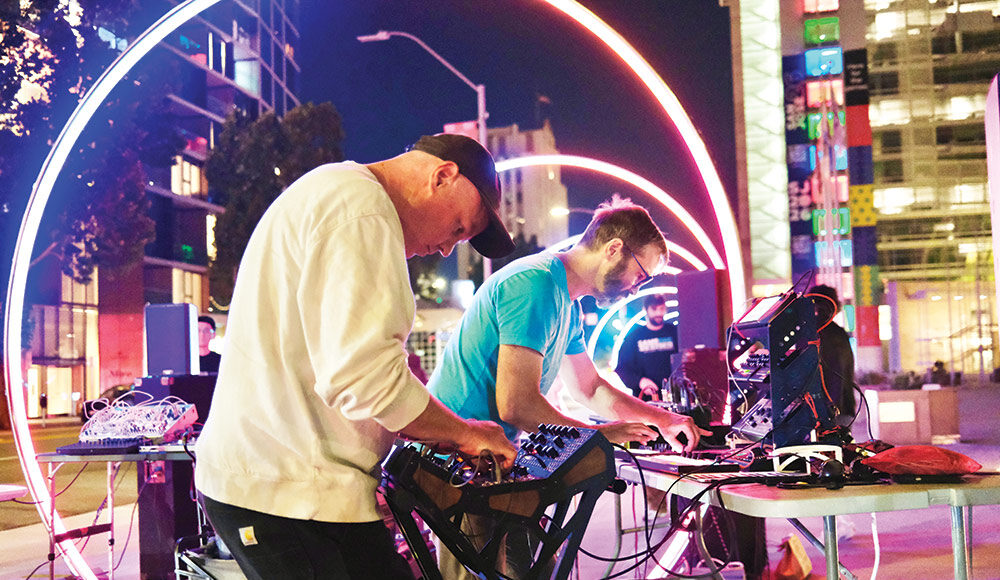
To San Jose sound artists Peter Nyboer and Andrew Blanton, technology is a vessel through which humans breathe life to create new sounds, emotions and experiences.
The duo created and hosts “Column,” a live series and community gathering for audio and visual presentations on computers and synthesizers. Their sets range from live video installations, danceable beats, ambient sound collages, live coding and experimental soundscapes. The recurring gatherings take place at San Jose’s Good Karma vegan restaurant.
Nyboer has lived in San Jose for 22 years and has long been enthralled by the intersections of technology and music. He builds, programs and performs MIDI controllers (a tool that sends data to computers or instruments), synthesizers and various instruments. He works for Buchla, a manufacturer of modular synthesizers and controllers.
Blanton is an associate professor of media arts at San Jose State University who just finished a PhD in music composition at UC Berkeley. His research focuses on electroacoustic performance and building synthesizers using both hardware and software.
The pair met at an experimental music conference, and reconnected later in the South Bay.
They felt that the San Jose experimental music scene fell short and decided to create the experiences and opportunities they were looking for. After trying and failing to get a city arts grant, they had another idea.
“Andrew’s friend Bob, who runs Good Karma downtown, was looking for things to spice up life,” said Nyboer. “And so he put his faith in us, and so we started showing up.”
Today, Column has been operating for nearly three years with monthly experimental audio acts.
Blanton and Nyboer explained that while San Jose may seem like an unlikely setting for such avant-garde arts, it actually is rife with unique opportunity.
Blanton said, “[South Bay] is a really special place in the universe. For better or worse, we have these neighbors who are big tech, right? So much of that’s embedded into synthesis and the building of synthesizers over the years, and there are so many people with so much talent for doing this type of work here locally that is pretty unique.”
Because the scene is small, they said, it’s easy to find community, meet important figures in the movement and experience lots of small coincidences. For example, one of Blanton’s students recently presented live video using a technology that Nyboer had worked on, unbeknownst to either of them.
Nyboer also said that San Jose’s unlikeliness as a creative hotspot is actually part of what draws such interesting and diverse creatives.
“I just think San Jose gets the short end of the stick in the Bay Area a lot of times, because there’s so much immigration to the area, you have people coming from all over the country and their north star is like San Francisco. And it’s like, ‘I couldn’t quite make San Francisco work, so I ended up in the East Bay in Oakland.’ But people come to San Jose to work, right?” he pondered.
But actually, he continued, the cross sections of people who do end up in the South Bay are unique and defy specific molds of who “should” be doing what, and where.
While existing near Big Tech is an exciting prospect for the experimental artists, the duo’s careful not to get carried away with fads. Innovation is important to their craft, but is not everything.
Blanton said, “There’s a real fluidity for technology with me in my practice, and so one of the things that I think about these days is the technology is more like a wash that comes and goes…I tend to find that within works, the artworks and the compositions that I’m most interested in are the ones that have more conceptual depth and a longevity.”
Nyboer added, “A lot of my technology journey has been professionally driven, but then I’m interested in helping push that technology into a certain space… I’m very interested in process, and I’m working to make these processes interesting and engaging.”
Part of what sets human art apart from pure technology is the key idea of responsibility. Humans guide the ship of technology. And when creativity is involved, said Nyboer, that role is crucial.
“You’re responsible for a whole orchestra, at this very granular level sometimes, and so you have to make sure you can control a good number of things so things maintain interest and don’t get stupid or boring,” he explained.
While it’s common to hear the use of technology in music described as “cold,” “unfeeling” or “sterile,” the sound artists have a different perspective.
They explain that older notions of musical creativity rested on the idea that instruments can create ranges of tones and expressions within singular chords or notes, while technologies like synthesizers or drum machines are more fixed and rigid. That’s not necessarily the case these days, especially in modular or vintage technologies.
Blanton gives the example of a Buchla 200, a 40-year-old synthesizer which he describes as incredibly deep.
“This thing was built in 1972,” he said. “It’s a Bugla 200 series, and it’s funky and warm, and it’s a beautiful sound. That’s one thing about the aging of these synthesizers that people maybe don’t talk about so much. But as these resistors and capacitors kind of decay and age over time, you get a more crackly and funky sound.”
Nyboer argued that even if these instruments and technologies were cold and unfeeling, the artist’s role is to change that.
“But you have to impart the humanity into it,” he said. “You have to put that investment into it.”
When asked about their thoughts on AI-generated music, the pair laughed.
Nyboer posed, “How do you feel about water in the ocean at this point?”
While they each admitted to some of AI’s more practical uses, they also agreed that its disconnection from humanity is its severest limitation, as well as its most likely downfall.
“In the end, the novelty wears off,” said Nyboer. “I can’t see that really reaching people. Advertising is very different now. The whole point of a television spot was that you had 30 seconds to connect with somebody emotionally…the only reason you want to make music like that is that you need to get it done in a short window of time. And you got bills to pay.”
Blanton added, “There’s a lot of commercial application for people who are getting plugins to do audio analysis, to do source separation, and this type of thing. I think those actually open up some more interesting pathways than close things down.”
He continued, “You can do some really cool shit with that. But that doesn’t mean that it should be in everything.”
In the end, they focus on human creativity.
Nyboer said, “I want to go have fun and just see people doing things and making art in real time.”
Column provides people the opportunity to do just that. The duo marked the three-year anniversary, with a fusion of art, music and community. They invite both newbie experimental artists and veterans of the scene to experience and participate in the many facets of experimental music.
Blanton said, “There’s this space where people can come in for real and just perform for the first time ever. But then also bringing in some people who have big records and they’ve performed all over the place, and that’s really, really powerful. That mix and that diversity is actually quite interesting, and I think that’s definitional of Column nowadays.”
Column performs monthly at Good Karma in San Jose. Check their website for their schedule. col-m.us Find more personal projects and research by Nyboer and Blanton on their sites.